

Friday, September 11, 2015

Friday, August 28, 2015
St Augustine

Today is the Feast of St Augustine. Read about this great Saint and Doctor of the Church here.... https://
Wednesday, August 26, 2015
Our Lady of Czestochowa: The Marvelous Story of an Embattled Icon

In the monastery-fortress of Jasna Gora, in Czestochowa, Poland is venerated an ancient icon of Holy Mary and the Infant God, with a fascinating history. Tradition has it that it was painted by the apostle St. Luke on a table built by Our Lord Jesus in St. Joseph’s workshop. Empress Saint Helena who found Our Lord’s cross, also discovered this icon in Jerusalem, and took it to Constantinople where her son, Constantine, built a church to enshrine it.
The image remained in Constantinople for 500 years until, through dowries, it was taken to Russia to a region that later became Poland.
 |
| Monastery-fortress of Jasna Gora, in Czestochowa, Poland |
This icon, now known as Our Lady of Czestochowa, has an embattled history.
While still in Constantinople, placed on the wall of the city, the icon so frightened an army of besieging Muslims that they took flight.

Under a Holy King
In the 15th century, the polish king Saint Ladislaus installed the holy image in his castle. Tartar invaders besieged the castle and an arrow pierced the image in the region of the throat, leaving a scar.
Interestingly, repeated attempts to repair the damaged painting failed. The scar always reappears.
Wishing to protect the icon from subsequent attacks, Saint Ladislaus took it to his town of birth, Opala.
On the way, he stopped at city of Czestochowa to rest, placing it in the wooden church of the Assumption in the nearby place of Jasna Gora (Bright Hill).
In the morning, the horses pulling the carriage containing the icon refused to move. Taking this as a sign, St. Ladislaus re-installed the image in the church of the Assumption and confided sanctuary and monastery to the Pauline Fathers.
It was on this day, August 26, 1382 that Saint Ladislaus established the feast of the Madonna of Czestochowa and it is still observed today.
Vandalized
Next, the Hussites, followers of the heretic John Hus from Prague, attempted to harm the holy icon. In 1430 they stormed the monastery and stole the image. Placing it in a wagon, they were carrying it away when the vehicle stopped and could not be moved. The attackers hurled the image to the ground, breaking it in three pieces. One man pulled his sword and struck the image twice on the cheek leaving two deep scars. On attempting to slash it thrice, the man went into agonizing convulsions and died.
The two scars on the holy image as well as the one on the throat have always reappeared after attempts to repair them.
Besieged
 The
holy icon’s great epic was the Siege of Czestochowa in 1655 when an
army of 12,000 Swedish Protestant invaders led by a General Miller,
attempted to take the monastery-fortress of Jasna Gora. The year before,
a vision of a scourge in the face of the sun had been seen over the
area. Indeed, King Karl Gustav, and the Swedes invaded and conquered
most of Poland with the help of Calvinist Polish nobles, ousting King
Jan Kasimir.
The
holy icon’s great epic was the Siege of Czestochowa in 1655 when an
army of 12,000 Swedish Protestant invaders led by a General Miller,
attempted to take the monastery-fortress of Jasna Gora. The year before,
a vision of a scourge in the face of the sun had been seen over the
area. Indeed, King Karl Gustav, and the Swedes invaded and conquered
most of Poland with the help of Calvinist Polish nobles, ousting King
Jan Kasimir.One monastery, led by a heroic prior, Fr. Augustine Kordecki, refused to surrender. Taking in five Catholic Polish nobles, the monastery resisted with only 300 men. The besieged faced treason, threats, and numerous assurances of the enemy’s “good will” in attempts to seduce them into an inglorious “peace”.
But placing their full trust in Our Lady, whose image they guarded, the monks answered, “Better to die worthily than to live impiously.” Thus began the 40-day siege, and nothing was spared to bring down the walls of Jasna Gora.
Meanwhile, the forty monks and the besieged prayed before the Holy Icon of Czestochowa. They prayed and fought, fought and prayed. And a mysterious “Lady”, dressed in a white or blue mantle, whom the Swedes called a “witch” began to appear on the ramparts, herself supplying the canons. The sight of her terrified the invaders.
A mysterious fog also enveloped the holy hill, which at times gave the illusion of the monastery-fortress being higher, at others lower, the result being that the canon-balls missed their target.
Finally, the mysterious lady appeared in the night to General Miller himself. After procuring a copy of the icon of Czestochowa, Miller said, "It is absolutely not comparable to that virgin who appeared to me; for it is not possible to see anything comparable on earth. Something of the celestial and divine, which frightened me from the beginning, shone in her face."
 In
the end, spooked and discouraged by these supernatural occurrences, the
Swedes lifted the siege. From the victory of Czestochowa, the Poles
again took heart, and rallying around King Jan Kasimir, took back their
country.
In
the end, spooked and discouraged by these supernatural occurrences, the
Swedes lifted the siege. From the victory of Czestochowa, the Poles
again took heart, and rallying around King Jan Kasimir, took back their
country.(For the full account of the siege of Czestochowa Click here)
The next year, in the presence of the clergy, nobility and people, King Kasimir solemnly proclaimed Our Lady of Czestochowa Queen of Poland. Recognizing that Poland had been chastised for its sins, and oppression of the less fortunate, He promised to rule with equity.
In 1920, when the Russian army assembled at the River Vistula, the Polish people had recourse to their Madonna. The Russians quickly withdrew after the image appeared in the clouds over Warsaw.
In Polish history, this is known as the Miracle of Vistula.
During the Nazi occupation of Poland in WW II, Hitler ordered all religious pilgrimages closed. In a demonstration of love and trust in Our Lady, half a million Poles defied Hitler’s orders and visited the shrine. Following the liberation of Poland in 1945, a million and a half people expressed their gratitude to their Madonna by praying before the miraculous image.
Twenty eight years after the first attempt to capture Warsaw, the Russians took the city. That year 800,000 visited the Lady of Czestochowa in defiance of the invader.
And today, free from Communism, Czestochowa continues to be the religious heartbeat of Poland. To the miraculous, fearless Lady of Jasna Gora, the Polish go with their needs and petitions, their sorrows and their joys. Indeed she is their embattled, victorious, miraculous queen.
“I will see you in heaven,” man says on deathbed, after doing the 1st 5 Saturdays devotion
A Timely Response to Our Lady’s Request
While visiting a home in Ohio, I heard an amazing story about the First Five Saturday devotion that Our Lady requested at Fatima.She asked all Catholics to make reparation to her on the first Saturday of five consecutive months by going to confession, praying at least one rosary, making a fifteen minute meditation and receiving Communion. Our Lady promised that she would “…assist them at the hour of death, with all the graces necessary for salvation.”

The family, of good practicing Catholics, decided to take up the devotion. However, as it often happens when one sets out to do God’s will, all kinds of obstacles run into our path.
On the Friday preceding the first Saturday they had a car accident. On the Saturday some were called to their jobs and some children fell ill. However, all still managed to fulfill Our Lady’s devotion requests, including the father.
Their resolution to do Our Lady’s request could not have been timelier. After completing the five month devotion, the father became extremely sick. Doctors found that he had cancer in an advanced stage and only had a few days to live.
The family asked their fellow parishioners for prayers and Masses in his intentions. Many family members began a round-the-clock vigil praying the rosary around his bed. For a whole week, those faithful prayer warriors continued to give him spiritual and psychological support with their generous vigil.
Click here for a FREE First Saturday Devotion Holy Card
Through all the suffering, the completion of the 5 First Saturday devotion was a continuous source of consolation to the father and family. “I will see you in heaven,” he reassured his children.
Shortly before his death a priest gave him last rites and he peaceably surrendered his soul to the Lord.
By Godofredo Santos
Tuesday, August 25, 2015
August 25 – King, Crusader, Saint
Saint Louis IX
King of France, son of Louis VIII and Blanche of Castile, born at Poissy, 25 April, 1215; died near Tunis, 25 August, 1270.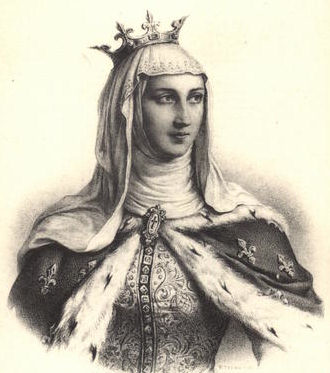
Marguerite of Provence, wife of St. Louis IX
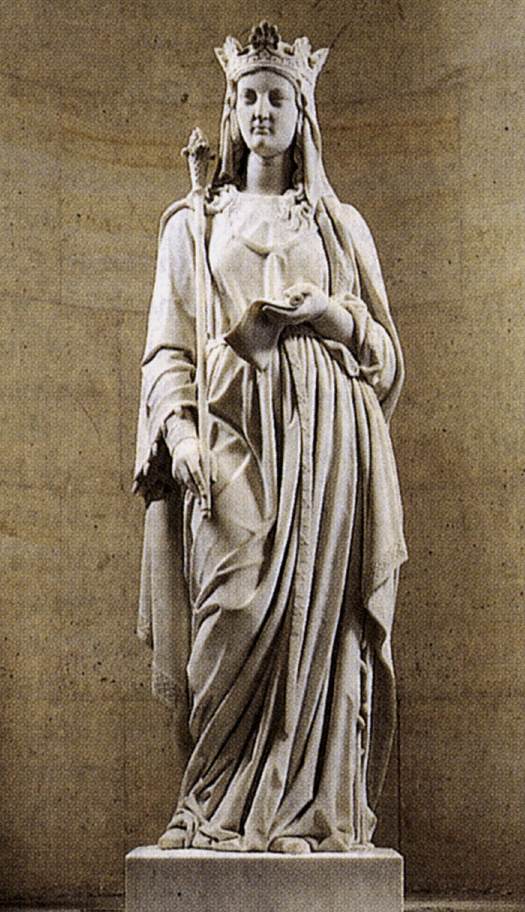
Blanche of Castile Sculptor Antoine Etex located at Versailles
It was one of St. Louis’s chief characteristics to carry on abreast his administration as national sovereign and the performance of his duties towards Christendom; and taking advantage of the respite which the Peace of Bordeaux afforded, he turned his thoughts towards a crusade. Stricken down with a fierce malady in 1244, he resolved to take the cross when news came that Turcomans had defeated the Christians and the Moslems and invaded Jerusalem. Between the two crusades he opened negotiations with Henry III, which he thought would prevent new conflicts between France and England. The Treaty of Paris (28 May, 1258) which St. Louis concluded with the King of England after five years’ parley, has been very much discussed.

Treaty of Paris. King Henry III of England does homage to Saint Louis.
St. Louis’s relations with the Church of France and the papal Court have excited widely divergent interpretations and opinions. However, all historians agree that St. Louis and the successive popes united to protect the clergy of France from the encroachments or molestations of the barons and royal officers. It is equally recognized that during the absence of St. Louis at the crusade, Blanche of Castile protected the clergy in 1251 from the plunder and ill-treatment of a mysterious old marauder called the “Hungarian Master” who was followed by a mob of armed men — called the “Pastoureaux.” The “Hungarian Master” who was said to be in league with the Moslems died in an engagement near Villaneuve and the entire band pursued in every direction was dispersed and annihilated.
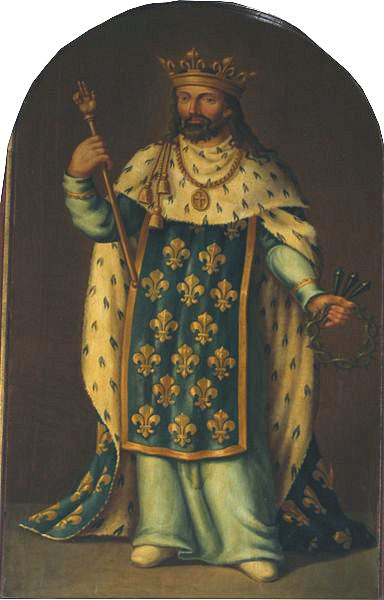
St. Louis IX. Painting in Notre-Dame de Poissy
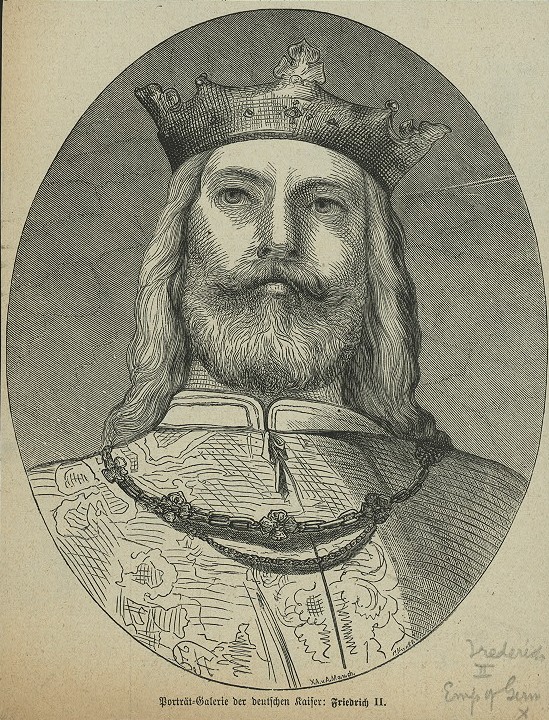
Frederick II

Statue of St. Louis IX in Notre Dame Church of St-Vincent de Lyon
St. Louis led an exemplary life, bearing constantly in mind his mother’s words: “I would rather see you dead at my feet than guilty of a mortal sin.” His biographers have told us of the long hours he spent in prayer, fasting, and penance, without the knowledge of his subjects. The French king was a great lover of justice. French fancy still pictures him delivering judgements under the oak of Vincennes. It was during his reign that the “court of the king” (curia regis) was organized into a regular court of justice, having competent experts, and judicial commissions acting at regular periods. These commissions were called parlements and the history of the “Dit d’Amiens” proves that entire Christendom willingly looked upon him as an international judiciary. It is an error, however, to represent him as a great legislator; the document known as “Etablissements de St. Louis” was not a code drawn up by order of the king, but merely a collection of customs, written out before 1273 by a jurist who set forth in this book the customs of Orléans, Anjou, and Maine, to which he added a few ordinances of St. Louis.
St. Louis was a patron of architecture. The Sainte Chappelle, an architectural gem, was constructed in his reign, and it was under his patronage that Robert of Sorbonne founded the “Collège de la Sorbonne,” which became the seat of the theological faculty of Paris.
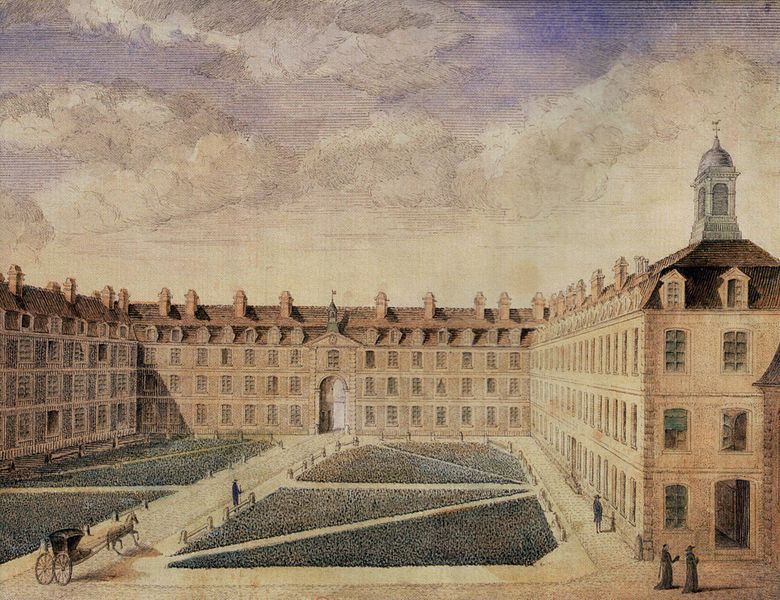
A Painting of the Hôpital des Quinze-Vingts in 1809. It is still in existence at 28 de la rue de Charenton.
The Enseignements (written instructions) which he left to his son Philip and to his daughter Isabel, the discourses preserved by the witnesses at judicial investigations preparatory to his canonization and Joinville’s anecdotes show St. Louis to have been a man of sound common sense, possessing indefatigable energy, graciously kind and of playful humour, and constantly guarding against the temptation to be imperious. The caricature made of him by the envoy of the Count of Gueldre: “worthless devotee, hypocritical king” was very far from the truth. On the contrary, St. Louis, through his personal qualities as well as his saintliness, increased for many centuries the prestige of the French monarchy. St. Louis’s canonization was proclaimed at Orvieto in 1297, by Boniface VIII. Of the inquiries in view of canonization, carried on from 1273 till 1297, we have only fragmentary reports published by Delaborde (“Mémoires de la société de l’histoire de Paris et de l’Ilea de France,” XXIII, 1896) and a series of extracts compiled by Guillaume de St. Pathus, Queen Marguerite’s confessor, under the title of “Vie Monseigneur Saint Loys” (Paris, 1899).
(Catholic Encyclopedia)
Monday, August 13, 2012
Blessed Mark of Aviano
(1631–1699)
 Capuchin
friar. His baptismal name was Carlo Domenico Cristofori, his birthplace
Aviano, a small community in the Republic of Venice (Italy). From an
early age, he felt attracted to a life of devotion and martyrdom.
Educated at the Jesuit College in Gorizia, at 16 he tried to reach the
island of Crete, where the Venetians were at war with the Ottoman Turks,
in order to preach the Gospel and convert the Muslims to Christianity.
On his way, he sought asylum at a Capuchin convent in Capodistria, where
he was welcomed by the Superior, who knew his family, and who, after
providing him with food and rest, advised him to return home.
Capuchin
friar. His baptismal name was Carlo Domenico Cristofori, his birthplace
Aviano, a small community in the Republic of Venice (Italy). From an
early age, he felt attracted to a life of devotion and martyrdom.
Educated at the Jesuit College in Gorizia, at 16 he tried to reach the
island of Crete, where the Venetians were at war with the Ottoman Turks,
in order to preach the Gospel and convert the Muslims to Christianity.
On his way, he sought asylum at a Capuchin convent in Capodistria, where
he was welcomed by the Superior, who knew his family, and who, after
providing him with food and rest, advised him to return home.
 Inspired
by his encounter with the Capuchins, he felt that God was calling on
him to enter their Order. In 1648, he began his novitiate. A year later,
he professed his vows and took his father’s name, Marco, becoming Fra’
Marco d’Aviano. His ministry entered a new phase in 1664, when he
received the licence to preach throughout the Republic of Venice and
other Italian states, particularly during Advent and Lent. He was also
given more responsibility when he was elected Superior of the convents
of Belluno in 1672, and Oderzo in 1674.
Inspired
by his encounter with the Capuchins, he felt that God was calling on
him to enter their Order. In 1648, he began his novitiate. A year later,
he professed his vows and took his father’s name, Marco, becoming Fra’
Marco d’Aviano. His ministry entered a new phase in 1664, when he
received the licence to preach throughout the Republic of Venice and
other Italian states, particularly during Advent and Lent. He was also
given more responsibility when he was elected Superior of the convents
of Belluno in 1672, and Oderzo in 1674.
 His
life took an unexpected turn in 1676, when he gave his blessing to a
nun, bedridden for some 13 years: she was miraculously healed. The news
spread far and wide, and it was not long before the sick, and many
others from all social strata, began to seek him out.
His
life took an unexpected turn in 1676, when he gave his blessing to a
nun, bedridden for some 13 years: she was miraculously healed. The news
spread far and wide, and it was not long before the sick, and many
others from all social strata, began to seek him out.
 Among
those who sought his help was Leopold I, Holy Roman Emperor, whose wife
had been unable to conceive a male heir. From 1680 to the end of his
life, Marco d’Aviano became a close confidant and adviser to him,
providing the irresolute and often indecisive emperor with guidance and
advice for all problems, political, economic, military or spiritual. His
forceful, energetic and sometimes passionate and fiery personality
proved a good complement for Leopold’s Hamlet-like tendency to allow
endless doubts and scruples to paralyse his capacity for action. As the
danger of war with the Ottoman Turks grew near, Marco d’Aviano was
appointed by Pope Innocent XI as his personal envoy to the Emperor. An
impassioned preacher and a skillful mediator, Marco d’Aviano played a
crucial role in resolving disputes, restoring unity, and energizing the
armies of the so-called ‘Holy League,’ which included Austria, Poland,
Venice, and the Papal States under the leadership of the Polish king Jan
III Sobieski. In the decisive Battle of Vienna (1683), the Holy League
succeeded in inflicting a decisive defeat on the invading Ottoman Turks.
This marked the end of the last Turkish attempt to expand their power
in Europe, and the beginning of the long European counter-offensive that
was to continue ultimately until the disintegration of the Ottoman
empire in 1918. This may therefore be considered one of the decisive
battles of history. It also put an end to the period of Ottoman revival
under the Koprulu Grand Vizirs and their protégé and successor, Kara
Mustapha, who was in command of the Ottoman army at Vienna.
Among
those who sought his help was Leopold I, Holy Roman Emperor, whose wife
had been unable to conceive a male heir. From 1680 to the end of his
life, Marco d’Aviano became a close confidant and adviser to him,
providing the irresolute and often indecisive emperor with guidance and
advice for all problems, political, economic, military or spiritual. His
forceful, energetic and sometimes passionate and fiery personality
proved a good complement for Leopold’s Hamlet-like tendency to allow
endless doubts and scruples to paralyse his capacity for action. As the
danger of war with the Ottoman Turks grew near, Marco d’Aviano was
appointed by Pope Innocent XI as his personal envoy to the Emperor. An
impassioned preacher and a skillful mediator, Marco d’Aviano played a
crucial role in resolving disputes, restoring unity, and energizing the
armies of the so-called ‘Holy League,’ which included Austria, Poland,
Venice, and the Papal States under the leadership of the Polish king Jan
III Sobieski. In the decisive Battle of Vienna (1683), the Holy League
succeeded in inflicting a decisive defeat on the invading Ottoman Turks.
This marked the end of the last Turkish attempt to expand their power
in Europe, and the beginning of the long European counter-offensive that
was to continue ultimately until the disintegration of the Ottoman
empire in 1918. This may therefore be considered one of the decisive
battles of history. It also put an end to the period of Ottoman revival
under the Koprulu Grand Vizirs and their protégé and successor, Kara
Mustapha, who was in command of the Ottoman army at Vienna.
 From 1683 to 1689 he participated in the military campaigns in the
role of promoting good relations within the Imperial army and to help
the soldiers spiritually. His assistance helped to bring about the
liberation of Buda in 1686 and Belgrade in 1688. At the same time, he
always maintained a strictly religious spirit, to which any needless
violence and cruelty were repugnant. As a result, at the siege of
Belgrade several hundred Muslim soldiers successfully appealed to him
personally, in order to avoid being massacred upon capture.
From 1683 to 1689 he participated in the military campaigns in the
role of promoting good relations within the Imperial army and to help
the soldiers spiritually. His assistance helped to bring about the
liberation of Buda in 1686 and Belgrade in 1688. At the same time, he
always maintained a strictly religious spirit, to which any needless
violence and cruelty were repugnant. As a result, at the siege of
Belgrade several hundred Muslim soldiers successfully appealed to him
personally, in order to avoid being massacred upon capture.
In the judgement of historians, Marco’s influence over Leopold was exercised responsibly, in the sole interests of Christianity and of the House of Austria. In one of his private letters to the Emperor, Marco actually scolds him quite forcefully for granting a benefit to one of his brothers, reminding him that, by so doing, he was only providing ammunition for the enemies of their cause.
In 2003, he was beatified by Pope John Paul II.
(cfr: Vatican)
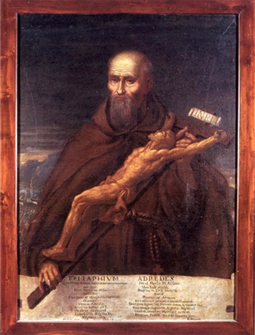 Capuchin
friar. His baptismal name was Carlo Domenico Cristofori, his birthplace
Aviano, a small community in the Republic of Venice (Italy). From an
early age, he felt attracted to a life of devotion and martyrdom.
Educated at the Jesuit College in Gorizia, at 16 he tried to reach the
island of Crete, where the Venetians were at war with the Ottoman Turks,
in order to preach the Gospel and convert the Muslims to Christianity.
On his way, he sought asylum at a Capuchin convent in Capodistria, where
he was welcomed by the Superior, who knew his family, and who, after
providing him with food and rest, advised him to return home.
Capuchin
friar. His baptismal name was Carlo Domenico Cristofori, his birthplace
Aviano, a small community in the Republic of Venice (Italy). From an
early age, he felt attracted to a life of devotion and martyrdom.
Educated at the Jesuit College in Gorizia, at 16 he tried to reach the
island of Crete, where the Venetians were at war with the Ottoman Turks,
in order to preach the Gospel and convert the Muslims to Christianity.
On his way, he sought asylum at a Capuchin convent in Capodistria, where
he was welcomed by the Superior, who knew his family, and who, after
providing him with food and rest, advised him to return home.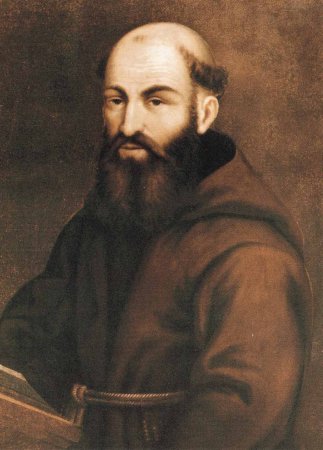 Inspired
by his encounter with the Capuchins, he felt that God was calling on
him to enter their Order. In 1648, he began his novitiate. A year later,
he professed his vows and took his father’s name, Marco, becoming Fra’
Marco d’Aviano. His ministry entered a new phase in 1664, when he
received the licence to preach throughout the Republic of Venice and
other Italian states, particularly during Advent and Lent. He was also
given more responsibility when he was elected Superior of the convents
of Belluno in 1672, and Oderzo in 1674.His
life took an unexpected turn in 1676, when he gave his blessing to a
nun, bedridden for some 13 years: she was miraculously healed. The news
spread far and wide, and it was not long before the sick, and many
others from all social strata, began to seek him out.
Inspired
by his encounter with the Capuchins, he felt that God was calling on
him to enter their Order. In 1648, he began his novitiate. A year later,
he professed his vows and took his father’s name, Marco, becoming Fra’
Marco d’Aviano. His ministry entered a new phase in 1664, when he
received the licence to preach throughout the Republic of Venice and
other Italian states, particularly during Advent and Lent. He was also
given more responsibility when he was elected Superior of the convents
of Belluno in 1672, and Oderzo in 1674.His
life took an unexpected turn in 1676, when he gave his blessing to a
nun, bedridden for some 13 years: she was miraculously healed. The news
spread far and wide, and it was not long before the sick, and many
others from all social strata, began to seek him out.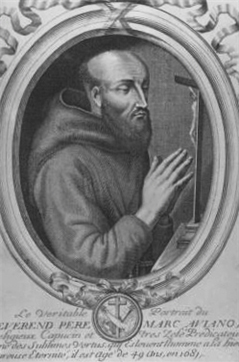 Among
those who sought his help was Leopold I, Holy Roman Emperor, whose wife
had been unable to conceive a male heir. From 1680 to the end of his
life, Marco d’Aviano became a close confidant and adviser to him,
providing the irresolute and often indecisive emperor with guidance and
advice for all problems, political, economic, military or spiritual. His
forceful, energetic and sometimes passionate and fiery personality
proved a good complement for Leopold’s Hamlet-like tendency to allow
endless doubts and scruples to paralyse his capacity for action. As the
danger of war with the Ottoman Turks grew near, Marco d’Aviano was
appointed by Pope Innocent XI as his personal envoy to the Emperor. An
impassioned preacher and a skillful mediator, Marco d’Aviano played a
crucial role in resolving disputes, restoring unity, and energizing the
armies of the so-called ‘Holy League,’ which included Austria, Poland,
Venice, and the Papal States under the leadership of the Polish king Jan
III Sobieski. In the decisive Battle of Vienna (1683), the Holy League
succeeded in inflicting a decisive defeat on the invading Ottoman Turks.
This marked the end of the last Turkish attempt to expand their power
in Europe, and the beginning of the long European counter-offensive that
was to continue ultimately until the disintegration of the Ottoman
empire in 1918. This may therefore be considered one of the decisive
battles of history. It also put an end to the period of Ottoman revival
under the Koprulu Grand Vizirs and their protégé and successor, Kara
Mustapha, who was in command of the Ottoman army at Vienna.
Among
those who sought his help was Leopold I, Holy Roman Emperor, whose wife
had been unable to conceive a male heir. From 1680 to the end of his
life, Marco d’Aviano became a close confidant and adviser to him,
providing the irresolute and often indecisive emperor with guidance and
advice for all problems, political, economic, military or spiritual. His
forceful, energetic and sometimes passionate and fiery personality
proved a good complement for Leopold’s Hamlet-like tendency to allow
endless doubts and scruples to paralyse his capacity for action. As the
danger of war with the Ottoman Turks grew near, Marco d’Aviano was
appointed by Pope Innocent XI as his personal envoy to the Emperor. An
impassioned preacher and a skillful mediator, Marco d’Aviano played a
crucial role in resolving disputes, restoring unity, and energizing the
armies of the so-called ‘Holy League,’ which included Austria, Poland,
Venice, and the Papal States under the leadership of the Polish king Jan
III Sobieski. In the decisive Battle of Vienna (1683), the Holy League
succeeded in inflicting a decisive defeat on the invading Ottoman Turks.
This marked the end of the last Turkish attempt to expand their power
in Europe, and the beginning of the long European counter-offensive that
was to continue ultimately until the disintegration of the Ottoman
empire in 1918. This may therefore be considered one of the decisive
battles of history. It also put an end to the period of Ottoman revival
under the Koprulu Grand Vizirs and their protégé and successor, Kara
Mustapha, who was in command of the Ottoman army at Vienna.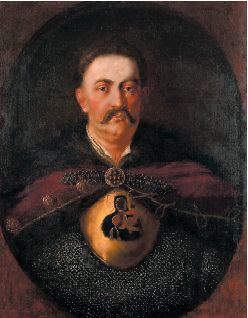
King Jan III Sobieski with a gorget of the Black Madonna of Częstochowa.
In the judgement of historians, Marco’s influence over Leopold was exercised responsibly, in the sole interests of Christianity and of the House of Austria. In one of his private letters to the Emperor, Marco actually scolds him quite forcefully for granting a benefit to one of his brothers, reminding him that, by so doing, he was only providing ammunition for the enemies of their cause.
In 2003, he was beatified by Pope John Paul II.
(cfr: Vatican)
What They Say
Some Testimonies of Illustrious Figures Regarding Books By Plinio Corrêa de Oliveira
Revolution and
Counter-Revolution
As we
mentioned in the Preface, the publication of Revolution and Counter-Revolution
had an immediate and profound impact. Ecclesiastical personages like those
already quoted, as well as theologians, professors, and conservative leaders
from around the world, acclaimed the author's analysis of and solution to the
contemporary crisis. More than thirty years after its first edition, the
essay's repercussion continues to grow, especially among youth. Three
testimonies regarding Revolution and Counter-Revolution are herein transcribed
exempli gratia. – Ed.
Lima, July 24, 1961
NUNCIATURA APOSTOLICA EN EL PERU
Distinguished Professor,
The reading
of your book “Revolution and Counter-Revolution” made a magnificent impression
on me because of the courage and mastery with which you analyze the process of
the Revolution and shed abundant light on the true causes of the crumbling of
moral values disorienting consciences today. and also because of the vigor with
which you indicate the tactic and the methods to overcome it.
I
especially appreciated the second part of your book, highlighting the efficacy
of Catholic doctrine and the spiritual remedies the Church possesses to combat
and vanquish the forces and errors of the Revolution.
I am
certain that your book has rendered an important service to the Catholic cause
and that it will help gather the forces of good in order to soon solve this
great contemporary problem. This is, in my opinion, the way repeatedly
indicated by the present Vicar of Christ, who, with so much conviction and
solicitude, has insisted on a profound renewal of Christian and sacramental
life as a sure remedy for the evils afflicting the world, evils that government
leaders vainly seek to solve through the precarious efficacy of weapons.
technology, and purely human progress.
I wish, most dear
Professor, a widespread diffusion of and a well-merited response to your book
from Catholic leaders wishing to join the ranks of the counter-revolutionary
movement.
Please accept the testimony of my sincere admiration for your work and the
expression of my deepest esteem.
Romolo Carboni
Titular Archbishop of Sidon
Apostolic Nuncio
Archbishop Romolo Carboni was
born in Fano, Italy, in19l1. Ordained in 1934, he was made a bishop in 1953. He
was raised to the archepiscopate and appointed Apostolic Nuncio to Peru in
1959. He served as Nuncio to Italy from 1969 to 1936 and now lives in
retirement in Fano.
SANTO DOMINGO EL REAL
DOMINICAN FATHERS
July 17, 1984
Dear Friend,
Yesterday, at a stretch, I read the 1973 Spanish edition of your magnificent book
Revolution and Counter-Revolution," which you had kindly sent me.
I had
already read other works of yours and I have been aware of your colossal
defense of Christian civilization for quite a while.
I
understand perfectly the third part of this edition (“Twenty Years After”), on
the concern regarding the infiltration of the Church in the post-Conciliar
times. Since your faith is deeply rooted in the indefectability of THE CHURCH,
this phenomenon will be a further stimulus to labor with hope...
A
small book of mine will be ready next month. I will send you a copy as soon as
it is available.
With
an embrace,
Victorino Rodriguez. O.P.
Fr. Victorino
Rodriguez y Rodriguez. O.P., is one of the most distinguished intellectual
figures of Spain today. Born in Carriles, Asturias, on February 14, 1926, he
joined the Order of Saint Dominic when he was 19. Ordained a priest
in 1952, he traveled to Rome to complete his studies and
obtain a doctorate.
An
eminent theologian and presently prior of the Convent of Santo Domingo el Real
in Madrid, he was professor of the School of Theology of San Esteban in
Salamanca and held a
chair at the Pontifical University of the same city. He is professor of
Madrid's Superior Council of Scientific Investigations and member of both the
Royal Academy of Doctors of the same city and the Pontifical Roman Theological
Academy. More than 250 of his books and articles have been published, many by
the renowned publishing house Biblioteca de Autores Cristianos of Madrid.
Rome, February 10, 1993
Distinguished Professor,
It
was with extreme interest, pleasure, and personal benefit that I read the
Spanish copy of Prof. Plinio Corrêa de Oliveira's work dedicated to me with
expressions of great affection and esteem, for which I am grateful.
"Revolution and Counter-Revolution" is a masterly work whose
teachings should be disseminated far and wide so as to penetrate the
conscience, not only of all those who consider themselves truly Catholic, but I
would say even more, of all other men of good will. In it, the latter would
learn that salvation can be found only in Jesus Christ and His Church; the
former would feel confirmed and fortified in their Faith and psychologically
and spiritually forewarned and immunized against the cunning process that
employs many of them as useful idiots or fellow travelers.
Its
analysis of the revolutionary process is impressive and revealing on account of
its realism and profound understanding of history, from the end of the Middle
Ages in decadence, which paved the way for the paganizing Renaissance and the
pseudo-Reformation, thence for the terrible French Revolution, and. soon after,
atheistic Communism.
That
historical analysis is not only external. The actions and reactions it deals
with are also explained in light of the human psychology, both the individual
psychology and the collective psychology of the masses. However, it is
necessary to recognize that someone directs this profound and systematic
de-Christianization. Man undoubtedly tends toward evil – pride and sensuality –
but were not someone holding the reins of these disorderly tendencies and
sagaciously coordinating them, they most probably would not have produced such
a constant, skillful, and systematic action, which, tenaciously maintained,
profits even from the ups and downs caused by the resistance and natural
"reaction" of the opposing forces.
"Revolution and Counter-Revolution" also foresees, although using
caution in its prognoses and by means of hypotheses, the next possible
evolution of the revolutionary action and, in turn, that of the
Counter-Revolution.
The
book abounds in perspicacious sociological, political, psychological, and
evolutive insights and observations, not few of which are worthy of an
anthology. Many of them outline the intelligent "tactics" that favor
the Revolution and those that may and should be used in a general
counter-revolutionary "strategy."
In
sum, I would dare to affirm that this is a prophetic work in the best sense of
the word. It should be taught in the Church’s centers of higher education so
that at least the elite classes become fully aware of a crushing reality about
which, I believe, they do not have a clear notion. This, among other things,
would contribute to revealing and unmasking the useful idiots or fellow
travelers, among whom are found many ecclesiastical figures, who act in a
suicidal manner by playing the enemy's game; this group of idiots, allies of
the Revolution, would in good measure disappear....
The
second part of the book well explains the Counter-Revolution's nature and the
courageous and "aggressive" tactics that counter-revolutionaries must
implement while always avoiding excesses and improper and imprudent attitudes.
Before such realities, one doubts there is a true "strategy" in the
Church as there is in the Revolution. One does find many "tactical"
elements, actions, and institutions, but they seem to act in isolation, without
a notion of the whole. The concept of a Counter-Revolution and the realization
that a Counter-Revolution is acting could unify and provide a greater sense of
collaboration within the Church.
I
must congratulate the TFP movement for the stature and quality of its founder,
Prof. Plinio. I foresee and desire with all my soul a vast development and a
future full of counter-revolutionary successes for the TFP.
I
conclude stating that the spirit with which this work is written greatly
impresses me: It is a profoundly Christian spirit, one with a passionate love
for the Church. This book is an authentic product of Christian wisdom. It is
moving to find in a layman such a sincere devotion to the Mother of Jesus and
ours - a clear sign of predestination. "Uncertain, like everyone, about
tomorrow, we prayerfully raise our eyes to the lofty throne of Mary, Queen of
the Universe.... We beseech the Virgin, therefore, to accept this filial
homage, a tribute of love and an expression of absolute confidence in her
triumph" (pp. 165, 167).
Rome, September 8, 1993
Feast of the Nativity of Our Lady
Fr. Anastasio Gutierrez
Fr.
Anastasio Gutierrrez, C.M.F., is one of the Catholic Church's most
renowned canonists.
Born
in Buenos Aires, Argentina, in 1911, Father Gutierrez is a Spanish citizen who
has lived in Rome for the last fifty years.
In
Rome, he received his doctorate in Canon Law from the Pontifical Lateran
University Later, he held a chair at that university's School of Canon Law,
eventually becoming its dean.
Father Gutierrez
served as a peritus during the Second Vatican Council, and for many years was
Cardinal Larraona's assistant in the Congregation for the Religious. He also is
a founder of the Institutum Iuridicum Claretianum of Rome.
He participated
in the commission charged to write the new Code of Canon Law, and is presently
a consultant to the following Vatican dicasteries: Congregation for the
Oriental Churches, Congregation for the Clergy, and Congregation for the
Institutes of Consecrated Life and Societies of Apostolic Life. He is also a
consultant to the Pontifical Council for the Interpretation of Legislative
Texts, the highest Church organ for canonical questions.
More
recently, Father Gutierrez became postulator of Queen Isabella of Castile's
cause of canonization.
Nobility and Analogous
Traditional Elites in the Allocutions of Pius XII
Rome, February 10, 1993
Distinguished Professor,
It
was with keen interest that I read your work “Nobility and Analogous
Traditional Elites in the Allocutions of Pius XII to the Roman Patriciate and
Nobility.”
The
thought of the great Pope Pius XII, as one can see in the documents mentioned,
remains entirely relevant, and you have taken the good initiative of presenting
it to today's public along with opportune annotations. tt is useful to remind
people, as Paul VI himself did after the Second Vatican Council, that the
teachings his predecessor addressed to the Roman Patriciate and Nobility
continue to be fully valid.
In
the comments and documentation with which you facilitate a more complete
understanding of the full range of Pius XII's magisterium, one can see great
erudition and sureness of thought, justly highlighted by the well-known French
historian Georges Bordonove in his foreword to [the French edition of] this
work.
I am
certain that I am performing a good deed by recommending your book to all who
wish to deepen their knowledge of the wise and enlightening teachings of Pius
XII.
Hoping your timely book will have a wide circulation, I send you cordial
greetings.
Silvio Card. Oddi
Silvio Cardinal Oddi was born in Morfasso, in the province of Piacenza, Italy,
in 1910. Having completed his studies at the Angelicum of Rome, lie entered the
Pontifical Ecclesiastical Academy. At the service of the Secretariat of State,
the still very young Father Oddi began a brilliant career in Vatican diplomacy.
Cardinal Oddi speaks Several languages and is one of the best informed
ecclesiastics on the Middle Fast, where he held diplomatic posts in several
countries. On behalf of the Holy See, he also undertook very delicate missions
in Yugoslavia and in Cuba immediately after the accession of the communist
regime. In 1969, while Apostolic Nuncio in Belgium, he
received the news of his elevation to the cardinalate. Since then he has
resided in Rome, holding high offices in the Vatican Coria. In 1979, John Paul II
made him Prefect of the Congregation for the Clergy, a position he held until
1985. He is presently Pontifical Legate for the Sanctuary of Saint Francis of
Assisi.
Cardinal Oddi, an expert on life in the Vatican, of which he has been a protagonist
in the last decades, is often interviewed by the Italian and international
press on the situation of the Church in our days.
Rome, February 13. 1993
Distinguished Professor,
Your
great renown and the words of praise and encouragement given for your work by
the illustrious Fr. Victorino Rodriguez, O.P., generally considered one of the
glories of contemporary theology, have led me to read with lively interest your
book “Nobility and Analogous Traditional Elites in the Allocutions of Pius XII
to the Roman Patriciate and Nobility.”
When
Pius XII gave the world the splendid series of fourteen allocutions to the
Roman Patriciate and Nobility, there were many who saw them less as a
theological, philosophical, and historical work regarding values destined to
yet play a fundamental and timeless role, than as a nostalgic effusion of love
for virtues, greatnesses, and glories that the world understood less and less.
The
most recent of the abovementioned allocutions was that of 1953. More than
thirty years later, we can now see how wrong the people were. Indeed, Pius XII
had seen the course of events correctly. Today, not only is the old hostility
to the nobility gradually dying out, but there are prominent intellectuals
emerging most everywhere who emphasize how detrimental is the loss of authentic
elites – with the concomitant vulgarization of the human type – to culture and
the lifestyle of contemporary society. This is why in many places we now see
manifested an ardent aspiration for the restoration of influence of authentic
elites over the multitudes, so that the latter may once again become – in
accordance with Pius XII's teachings – peoples instead of nameless masses (cf.
Christmas radio message off Holiness Pius XII, 1944).
In
this historical context. your work proves to be extraordinarily timely, since
in echoing the magisterium of Pope Pius XII a commenting on it with such
notable penetration and consistency makes an appeal to the nobility and the analogous
elites to contribute, with more courage than ever before, toward the common
spirit and temporal good of all nations.
Indeed it falls to them, as that immortal Pope underscored to fulfill the
precious mission of communicating by example, word, and action the treasure of
religious and temporal truths of Christianity, the luminous torch of so ninny
truths that societies can never forget without the risk of succumbing to the
vortex of chaos and moral misery that threatens them.
I therefore
hope for the best of receptions for your book, to which you have devoted the
vast resources of your intelligence and erudition. besides your unlimited love
for the Church. May it please Divine Providence to grant it widespread
circulation, so that both the preferential option for the nobles, inspired by
Pius XII and high-lighted by you, and the preferential option for the poor, to
whom the current Pontiff has devoted his ardent love, will be forever better
understood.
Mario Luigi Card. Ciappi. O.P.
His Eminence Mario Luigi Cardinal Ciappi
Mario
Luigi Cardinal Ciappi. O.P., was born in Florence on October 6. 1909. and was
ordained a priest on March 26, 1932. For many years be was a professor at the
Angelicum, where he taught Moral and Dogmatic theology and Mariology. Among his
students was the then Father Karol Wojtyla, later His Holiness John Paul II.
Cardinal Ciappi went on to become dean of the Faculty of Theology at this
athenaeum. He was elevated to the episcopal dignity as titular of the Church of
Miseno on June 10, 1977, and in the Consistory of June 27 of the same year he
received the cardinal’s hat from the hands of Paul VI.
Until
1939 he was theologian of the Pontifical Household, that is, private theologian
of the Holy Father. Cardinal Ciappi is currently president of the Pontifical
Roman Academy of Saint Thomas Aquinas and Catholic Doctrine, which gathers some
of the greatest names in contemporary theology.
Vatican City, Feast of Saint Joseph, 1993
Most illustrious Professor,
I
thank you heartily for the kind gift of your work “Nobility and Analogous
Traditional Elites in the Allocutions of Pius XII to the Roman Patriciate and
Nobility,” sent to me in its Italian translation.
It
made a deep impression on me for several reasons: first of all, for its
timeliness, in that it is the reaffirmation of the teachings of the great Pope
Pius XII on the subject at a historico-cultural moment when ferocious hostility
to the nobility, spread all over the world by the French Revolution, seems
everywhere to be diminishing.
Secondly, the work – amid the universal decay of natural and, above all,
Christian values – will awaken in many hearts everywhere the desire to see
nobiliary elites, who in past centuries played an important and often decisive
role in upholding these values through their lives and actions, once again
setting for humanity the examples it needs so urgently and supremely.
A
third reason derives from your observations-which seem to me extremely
relevant-regarding the formation, alongside the nobilities and elites of blood,
of nobilities and elites of spirit and mind that, by associating and organizing
among the many existing noble souls, are assuming all over the world the roles
of exemplars of and guides toward a natural and perennial order of things.
This, whether to support the nobilities of blood still existent and now
re-emerging, or to replace those no longer capable of efficaciously reacting to
the manifest decadence of our days, as has happened in more than one instance.
Using
vast and solid documentation, you have done a fine analysis of the very complex
sociopolitical reality of our day, and commenting with great logical rigor on
the luminous teachings of Pius XII, you have shown how much he and his
successors up to John Paul II continue to expect from the existing nobility and
future analogous elites for the religious, moral. and cultural uplifting of the
world.
I
therefore rejoice at this book, illustrious Professor, and wish it a broad
circulation, so it may spark, sustain, and build a deep and vast sensitivity to
this excellent tool for the re-creation of a sound natural ethics and a revived
religious morality that may lead all humanity to that peace, prosperity and
happiness that only authentic and genuine values can realize and guarantee.
To
these good wishes ~ add my fervent prayers to the Lord and to the Mother of the
Church, that they may sustain you in the work which is both beneficent and
painfully pressing in the times in which we live.
Yours in Christ.
Alfons M. Card. Stickler, S D B
Alfons M. Cardinal Stickler, S.D.B., was born in Neunkirchen. Austria, in 1910.
While still young he entered the Salesian Congregation and made his first
Studies of philosophy and theology in Austria and Germany, later specializing
in Canon Law at the Roman School of San Apollinare and the Pontifical Lateran
University.
His
particular vocation to the study of juridical sciences led him to teach at the
Pontifical Athenaeum Salesianum, first in Turin and later in Rome. Father
Stickler became dean of the Canon Law School and then rector of the athenaeum,
an office beheld from 1958 to 1966. Placing his
superior academic talents at the service of the Holy See. Father Stickler,
after having directed the Pontifical Institute of Higher Latin Studies, was
named Prefect of the Vatican Library. an institution unequaled in the world on
account of its bibliographic treasures.
In
1983 John Paul II elevated him to the episcopal dignity and made him
Pro-Librarian. Afterward. upon making him a cardinal, he appointed him
Librarian and Archivist of the Holy Roman Church, an office that since its
creation in the sixteenth century has been held by great ecclesiastical
figures. Cardinal Stickler held this office until 1988. Especially notable
among his important responsibilities was his participation ill the commission
responsible for developing the new Code of Canon Law.
A Call to Reflection
(Published in the September- October 1994 issue of TFP Informa, the
organ of the Ecuadorian TFP)
A
serious and objective study of history shows that all times, all cultures, and
all races have had undeniable differences among their constituents. There have
always been wise men and ignorant men, classes that rule and classes that obey,
rich and poor. Christ Himself taught, "The poor will always be with
you." The variety of elements within human society is as natural and
human as the variety of elements in the human body. As the body has a diversity
of organs, it has a diversity of functions. Mankind has a like diversity.
Although this diversity is so natural, there is a tendency, when speaking of
society's components, to consider the differences as contradictory, as alien to
human nature. Thus was born the slogan of the French Revolution, which set the
desire for liberty equality, and fraternity as the foundation of society,
not according to the Christian concept that all human beings are equal because
they are creatures of the same God and sons of the same Father, but according
to the erroneous concept that there should be no differences of any kind
between human beings. This denial of the diversity of functions among men
contradicts God's plan in creating the universe and corresponds to the
rationalist theory that all social inequalities must be eliminated, through
violence if necessary.
That
way of thinking characterized the French Revolution and also led materialistic
sociologists to the idea of class struggle, practical atheism, and the use of
tyranny to eliminate everything that could be considered favorable to the
acceptance of the difference of values that is part of the historical reality
of society. Marxism-Leninism, inspired in this dialectic, rejected the values
of the Christian faith and espoused a materialistic and atheistic philosophy.
The
class struggle preached by Marxism received a death blow with recent events in
the Soviet Empire. But the new concept that must inspire the
reestablishment of society destroyed by historical materialism has not been
explored. For this, a new insight into the understanding of the human being is
needed, as well as a deeper study of the variety of values in society. We need
to ask ourselves: Is the idea of radicalizing unity valid? Or is an in-depth
study concerning the transcendental variety of the factors that constitute
society necessary?
Basing himself on interesting Church documents, this is what the intelligent
and profound thinker Plinio Corrêa de Oliveira proposes to do. He has written a
work that can positively help to study and resolve this problem. Entitled
"Nobility and Analogous Traditional Elites in the Allocutions of Pius
XII," it deals with a seemingly new subject: social elites and the
seasoned aristocracy of the old nobility. The author declares that elites must
reclaim the social values of the privileged class, of the families with a heritage,
of the families with a background enriched by titles and traditions.
To
some, reviving the social values of the elites may seem anachronistic and
obsolete. Nevertheless, Pope Pius XII, remembering the old and noble traditions
of his own family, presents the nobility of former times not only as holders of
titles but, above all, as holders of a treasure of great virtues that benefited
not just elite families but all of society.
Based
on these reflections, I would venture to affirm that immorality and corruption
have assumed scandalous proportions in modern society precisely because a wrong
criterion of equality has crept in. In every society, in every culture, in
every community, groups that stand out from the rest by their greater culture,
by their greater morality, by a sense of nobility that not only dignifies an
individual but conquers the admiration and respect of those who come to know
these human values and, even more, Christian virtues, should be cultivated and
fostered. For the same reason, the larger the community of families
characterized by the practice of the human and Christian virtues, the better
oriented society in general will be.
Pius XII
left us a whole arsenal of documents in which, especially addressing the Roman
nobility, he exalts the traditional virtues of the families considered noble
and urges the Patriciate to cultivate qualities and virtues that should adorn a
family (or person) that feels or considers itself noble. He exhorts the elites
not only to maintain their ancestral values of nobility, but to purify them
with the teachings of Christ.
For
all these reasons I believe the launching of Plinio Corrêa de Oliveira's book
is a prophetic call for contemporary society to make an examination of
conscience regarding the true nobility that distinguished the men of the past,
and the genuine virtues that must contribute to the building of a more human
and Christian society. True nobility is based not on vanity and selfishness,
but on the solid foundation of truth and goodness. We are convinced, therefore,
that this book is a call to a serious reflection that will culminate in the
return to the eternal values of the human being that are a basis of greatness
and likeness with God.
Ibarra, June 21,1993
Bernardino Cardinal Echeverria Ruiz
Bernardino Cardinal Echeverria Ruiz, O.F.M., was born in Cotacachi, Ecuador, in
1912. He became a Franciscan in 1928 and was ordained in 1937. He studied at
the Pontifical Institute Antoniano in Rome and received his doctorate in
Philosophy in 1941. Returning to Ecuador, he filled high posts in the
Ecuadorian Province of his Order, founding numerous apostolic works and carrying
Out important missions in and outside his country.
He
was named bishop of Ambato in 1949, a dignity he held for twenty years. He was
secretary, vice-president, and president of the Ecuadorian Bishops' Conference,
of which he was recently named honorary president. He represented this
body at the Latin American Bishops' Conference (CELAM), of which he is a
founding member, and he was honored with the title of Assistant to the
Apostolic See.
In
1969 he was designated archbishop of Guayaquil, a see he held until 1989. He
revitalized its seminaries and apostolic movements, built churches, and strove
for the establishment of new religious orders in the Archdiocese. He headed
national movements in the field of pastoral work and the defense of the Faith,
carrying out campaigns with great repercussion in Catholic opinion for the
inclusion of the name of God in the Constitution, the defense of private
education, and the promotion of devotion to the Most Holy Virgin.
The
author of several books and a frequent lecturer, he had weekly and daily radio
and television programs. A Fellow of the Language Academy, he has received
decorations from the Ecuadorian nation and from other countries, including
Spain's Commendation of Isabella the Catholic.
After
accepting his resignation as archbishop of Guayaquil in 1939 in accordance with
Canon Law, the Holy Father named him apostolic administrator of the Diocese of
Ibarra. As in his former posts, the Prelate has been tireless in his rebuilding
of destroyed churches and in his vast pastoral work.
He
received the cardinal's hat in the November 1992 Consistory as titular of
Saints Nereus and Achilleus, being the third Ecuadorian to receive this high
honor.
SANTO DOMINGO EL REAL
DOMINICAN FATHERS
Madrid, January 25, 1993
Dear friend and admired Professor,
I
have read closely the original of your magnificent work "Nobility and
Analogous Traditional Elites in the Allocutions of Pius XII to the Roman
Patriciate and Nobility," which you were kind enough to send me for
review. I am greatly honored by your confidence in my evaluation and possible
comments. In addition, I admire your ardent desire to be well-founded when
launching so noble a cause, as well as your humility in requesting the opinion
of someone far less knowledgeable than you about the subject, both in its
doctrinal and historical dimensions.
I must say that I
found absolutely nothing to criticize or even to improve in your undertaking. I
would, however, like to highlight what I consider very good:
First, the very writing of a book on this subject. It was needed; and your
selection of a starting point and major basis for discussion could not have
been better, namely, the successive New Year allocutions of Pius XII to the
Roman Patriciate and Nobility. This exceptional Pope Pacelli, whose mind,
heart, and blood were noble, was singularly attentive to the problems and
expectations of his times. Thus, he could not help but be concerned with the
problems of the nobility, to whom he addressed these allocutions, now
opportunely brought to us by a Brazilian nobleman, in whose person one finds so
much devotion to the Apostolic See and love for Christian civilization.
Second, the timeliness, since the genuine values of the nobility are currently
eclipsed in the post-revolutionary "egalitarianism" and the inorganic
modern democracies. More renown ("nobile" = "noscibilie,"
distinguished, excellent, famous) is given to numbers (of votes or dollars)
than to dignifying qualities (knowledge, virtue, art). Yet, as I heard the
great theologian Santiago Ramirez say on several occasions, "truth is not
democratic, but aristocratic." I hope that your carefully documented, thoughtful
work will bring the traditional nobility to the forefront, as bearers of
dignity, honesty, and humanism open to God and to the social common good.
Third, I think that the harmonic complementarity you establish between the
"preferential option for the poor," so accentuated in the new
evangelization, and the "preferential option for the nobility" is
very just and Christian. Indeed, these two outlooks are not exclusive, but
complementary. I believe this is the key: One should love the best more, and
help the neediest more. Hence the two harmonized preferential options. The
charitable option for the indigent should not diminish the singular esteem
deserved by the nobility, especially when such esteem is at a low ebb in times
of widespread egalitarianism. Very much to the point is the information on the
high percentage of canonized saints among the nobility. It was Pius XII who, in
1943, canonized Saint Margaret of Hungary, O.P., daughter of the King of
Hungary and grand-daughter of the Emperor of Constantinople.
Fourth, in an era of "pacifism" (or peace at any cost), it is also
advantageous to give thought to the topic of just war, so often waged by the
nobility, whether military' or civil and ecclesiastical. The Magisterium
and Theology had and have much to say in this regard, as Document XI reminds
us.
Fifth
and last, at a time when democracy, with no discernment or ulterior ethical
resolution, is the sole political dogma for many, it is opportune to recall the
Church's social doctrine on the forms of government. The Papal Magisterium has
incorporated Saint Thomas's nuanced doctrine, taken up so often by
Catholic thinkers and now by you in Appendix IV of your work.
I could
highlight many other interesting points of your work, but do not wish to unduly
lengthen this letter nor to repeat what the reader will find more adequately
and more elaborately expounded in the book. With these remarks I hope to attest
to having read the original with pleasure and to respond to your friendly
gesture.
Victorino Rodriguez O.P.
See previous letter from Fr. Rodriguez for biography.
March 5, 1993
Distinguished Professor.
I
have attentively read your work The Nobility and Analogous Traditional Elites
in the Allocutions of Pius XII to the Roman Patriciate and Nobility,"
which you were so kind to send to me.
I
deem felicitous your idea of giving wide diffusion to those documents of Pius
XII, which at first glance might seem devoid of relevance to the present day.
In fact, however, your lucid and documented commentaries show the
foresightedness of the theme discussed by that Pontiff. Furthermore, you
opportunely recall the beautiful words of Paul VI: “We would like to say many
things to you. Your presence provokes much reflection. So it was also with Our
venerable Predecessors, especially Pope Pius XII of happy memory. . . . We want
to believe that the echo of those words, like a gust of wind swelling a sail, .
. . still vibrates in your thoughts, filling them with the austere and
magnanimous appeals that nourish the vocation preordained for you by Providence
and sustain the role still required of you today by contemporary society."
Your
long experience as professor, congressman, and public figure makes your
commentaries all the more intelligent and instructive, pleasantly facilitating
the reading of the Pontifical documents, which are of such lofty and estimable
value.
I did
not find in your pages any error of a theological or other nature regarding the
teachings of the Church. I can only hope that your excellent work will be given
a warm and full reception by the public for whom it is intended.
Fr. Raimondo Spiazzi, O.P.
Fr.
Raimondo Spiazzi, O.P., was born in Moneglia, in the province of Liguria,
Italy. in 1918. He was ordained a priest in 1944 and obtained a doctorate in
Sacred Theology at the Angelicum three years later.
He
began his long career as a university professor teaching Fundamental Theology,
Moral Philosophy, and Sociology at the Studio Domenicano of Turin and Dogmatic
Theology at the Centro Cattolico di Cultura of the same city.
In
1949 he returned to Rome, where he lectured, first at the University Pro Deo
and then at the Angelicum, whose School of Social Sciences he founded. In 1954
he was appointed dean of the Institute of Religious Sciences at the Angelicum.
In 1957 he began to teach Pastoral Theology at the Pontifical Lateran
University, and, in 1967. Dogmatic Theology at the Center of Theology for the
Laity of the Vicariat of Rome, becoming its dean in 1987.
Father Spiazzi served as Apostolic Visitor to the seminaries in Lombardy and
Milan and as Provincial of the Dominican Order for Piedmont and Liguria. Paul
VI personally nominated him a perius of the Second Vatican Council.
He is
now consultant to the Congregation for Catholic Education and member of several
study commissions of the Vatican congregations and the Vicariat of Rome. He
also belongs to the Pontifical Academy of Our Lady Immaculate, the Pontifical
Roman Theological Academy, and the Pontifical Academy of Saint Thomas Aquinas.
He is rector of the Basilica of. San Sisto Vecchio on the Appian Way.
Father Spiazzi has published numerous hooks and over 2.000 articles. Many of
the latter have appeared in Italian and foreign magazines.
July 20, 1993
My Dear Juan Miguel,
I received
your missive of the 5th along with the beautiful work of Prof. Plinio Corrêa de
Oliveira, your distinguished founder: “Nobility and Analogous Traditional
Elites ...” You have given me a present of great value, a work whose
scientific, historical, sociological, human, and Christian wisdom is
inestimable. I believe that with my 81 years, my 55 years of professorship and
predominantly socio-juridical study, my 50 years in this elevated lookout that
is Rome, I have some claim to be able to judge it and above all appreciate it.
I repeat: It is a work of a wisdom and equity of judgment that can hardly be
matched by so many books, which are excellent if you will, but lack what we
could call a great thinker's charism of knowledge and experience. For me, it is
not so much the documental basis as the elaborations of Professor Corrêa de
Oliveira, who ranges over the fields of history, social psychology, philosophy,
theology, and Christian ethics with profound insight and analytical capacity.
In short, Professor Corrêa de Oliveira is a great MASTER who deserves to figure
at the head of this elite class.
The
work's presentation is on par with its content; like the work's theme, it is
noble... My congratulations. May it have the diffusion
it merits.
Your most affectionate friend
Fr Anastasio Gutierrez C M F
See previous letter of the Rev. Fr. Anastasio Gutierrez for biographical
data.
Excerpts from Georges Bordonove 's foreword to the book's French edition
Prof.
Corrêa de Oliveira ranks among the clear-sighted minds that perceive. with an
almost painful sharpness, the metamorphosis underway in today's society, whose
final features one cannot foresee. He fears, not without reason, that the
combined effect of a galloping progress and a mistaken egalitarianism will
eventually obliterate the individual by the monstrous leveling [of society]. It
is in this perspective that be identifies, with Pius XII, the mission the
patriciate has, unless it prefers to scuttle itself and disappear. In other
words, he invites the elites not to dwell in the lamentation of vanished
grandeur, not to estrange themselves from society, but rather to resolutely
enter the active life, to place their talents, their heritage of experience,
their family traditions, and even their way of being, at the service of
society, with the sole concern for the common good....
This
work is remarkable in all aspects, notably for the abundance and rigorous
exactness of its documentation, the author's universal culture, his solid
argumentation, and the transparency of his thought. The reader will also
appreciate the Professor's prospective effort when he addresses the question of
the world's future. . . . It proposes an itinerary; it erects the first
landmarks for the road to be followed.
Is
this the announcement of that twenty-first century which, it has been said,
will either be mystical or will not be at all?
Georges Bordonove
The
renowned historian Georges Bordonove was born on May25, 1920, in Enghien
(Seine-et-Oise), France. He studied at the Licee Fontanes and at the Literature
and Law School of Poitiers, graduating in Literature and Law. The author of
almost 70 books and essays, numerous articles and short Stories, several of them
award-winning (Grand Prix des Libraires de France. 1959; Prix Bretagne. 1963).
Bordonove is a Knight of the Legion of Honor. Commander of the National Order
of Merit, and Officier des Arts et des Lettres.
Other Works
Vatican Palace, February 26, 1949
SECRETERIA DI STATO DI SUA SANTITA
Illustrious Sir,
Moved
by your filial dedication and piety, you offered the Holy Father the book
"In Defense of Catholic Action," in which you reveal perfect care and
persevering diligence.
His
Holiness is very pleased with you for having explained and defended Catholic
Action – of which you have a complete knowledge and for which you have great
esteem – with penetration and clarity so that it has become clear to all how
important it is to study and promote this auxiliary form of the hierarchical
apostolate.
The
August Pontiff hopes with all his heart that this work of yours results in rich
and mature fruits and that from it you may harvest neither small nor few
consolations. And as a pledge that it be so, be grants you the Apostolic
Benediction.
Meanwhile, with due consideration. I declare myself,
Devotedly yours
J.B. Montini
Substitute
Dr. Plinio Corrêa de Oliveira
President of Catholic Action
Archdiocese of Sao Paulo, Brazil
Msgr. Giovanni Battista Montini
Msgr.
Giovanni Battista Montini, the future Paul VI, was born in Lombardy, Italy, in 1897.
After his ordination in 1920, he pursued studies at the Pontifical Academy of
Noble Ecclesiastics and the Pontifical Gregorian University. In 1924 he began
30 years of service in the Secretariat of State: as undersecretary from 1937
until 1954, he was closely associated with Pius XII.
He
was ordained archbishop of Milan in 1954, and was inducted into the College of
Cardinals in 1958. He was elevated to the Papacy In 1963.
He
reconvened the Second Vatican Council. The main thrust of his pontificate was
toward institutionalizing the trends of the Council.
He
died in 1978.
Rome, December 2, 1964
SACRED CONGREGATION OF SEMINARIES AND
UNIVERSITIES
Most Reverend Excellency,
Only now
have we been able to read the ample and profound study of the illustrious
Professor Plinio Corrêa de Oliveira, of the Pontifical Catholic University of
Sao Paulo, on the important theme “The Freedom of the Church in the Communist
State” (third enlarged edition, Sao Paulo, 1964), which your Most Reverend
Excellency was kind enough to send to this Sacred Congregation with the very
kind letter that reached our offices this past November.
At
the same time that we express to you our sincere gratitude, we congratulate
Your Excellency and the eminent author, justly celebrated for his
philosophical, historical, and sociological knowledge, and we wish the widest
circulation for this compact pamphlet, which is a most faithful echo of all the
Documents of the supreme Magisterium of the Church, including the luminous
encyclicals “Mater et Magistra” of John XXIII and "Ecciesiam Suam" of
Paul VI, happily reigning.
May
Our Lord grant that all Catholics comprehend the necessity of being united “in
uno sensu eademque sententia” in order to avoid the illusions, deceits, and
dangers which today threaten His Church internally.
With
sentiments of particular esteem and consideration, with all my heart I profess
myself once again to Your Most Reverend Excellency
Most devoted in Jesus Christ
Saturday, October 1, 2011
The Little-Known St. Thérèse
by Luis C. Azevedo
On October 1, the liturgy of the Church celebrates the memory of Saint Thérèse of the Child Jesus and of the Holy Face, “the greatest saint of modern times,” in the words of Pope Saint Pius X. The charm of her “Little Way,” with all its sweetness and mercy, admirably harmonizes with the traits of a genuine warrior, “I would die in a battlefield, arms in hand,” she once stated.1
Her soul had infinite aspirations: she wanted to be a warrior, priest, apostle, doctor of the Church and martyr; she felt the courage of a crusader, of a Papal Zouave; she wanted to die in the battlefield defending the Church; she wanted to preach the Gospel to the four continents and to the remotest islands. “‘Jesus, Jesus’–she would say–‘if I were to write all my desires, I would have to borrow Thy book of life; I wanted to have achieved all these deeds for Thee….’”2
An Admirer of Saint Joan of Arc
This warrior aspect of Saint Thérèse’s soul is dominant in her moral profile. Yet, even those who love her most, tend to forget this trait.
“In my childhood, I dreamed of combating in the battlefield. When I began to learn the history of France, I was enchanted with the deeds of Joan of Arc; I felt in my heart a desire and courage to imitate them.”3
Saint Thérèse gradually became increasingly aware of the profound similarities between her life and that of the Virgin of Domrémy. Thus, on January 21, 1894, the 101st anniversary of the martyrdom of the unfortunate King Louis XVI, she wrote a theater play titled, The Mission of Joan of Arc. The following year, as Pope Leo XIII declared her “Venerable,” and France celebrated it’s holy martyr and warrior, Saint Thérèse wrote the play, Joan of Arc Fulfills Her Mission, which the whole religious community staged. Saint Thérèse played the role of Joan of Arc.
The play featured the conquest of Orleans, the coronation of King Charles VII, but above all Saint Joan of Arc’s burning at the stake, which to Saint Thérèse meant the apex of the achievement of the heroine’s mission.
Saint Thérèse signed her Canticle to obtain the canonization of Saint Joan of Arc as “A French soldier, defender of the Church and admirer of Joan of Arc.”
Saint Joan, the Virgin of Orleans, and Saint Thérèse, the Virgin of Lisieux, are two models of militant Catholic combatants against the enemies of the Church and of Christian Civilization. Two great saints, though leading such different lives–one a strictly military life and the other a contemplative one–nonetheless have profound affinities with each other.
Saint Thérèse did not live to see Saint Joan’s canonization, and she was far from imagining that, on May 18, 1925, Pope Pius XI would present her, Saint Thérèse, to the Catholic world as “a new Joan of Arc”; and that during the Second World War, Pope Pius XII would declare her, like the Virgin of Orleans, “secondary patron of all France!”
A Crusader Soul; Apparitions; the Combatant
The idea of fight constantly fed the strong soul of the saint of the “Shower of Roses.”
“I went to sleep for a few moments during prayer,” she would tell Mother Agnes. “I dreamt there were not enough soldiers for a war against the Prussians. You said: We need to send Sister Thérèse of the Child Jesus. I answered that I agreed, but that I would prefer to fight at a holy war. But finally I went all the same.
“Oh no, I would not fear going to war. With what joy, for example, at the time of the Crusades, I would have gone to combat heretics. Yes! I would not have been afraid to be shot; I would not have feared the fire!4
“When I think I’m dying in bed! I would want to die in an arena!”5
The same combative spirit animated her in the struggles of the spiritual life: “Sanctity! We need to conquer it at the tip of the sword…we need to fight!”6
Such is the mettle of this extremely active and energetic warrior soul, according to the testimonies of those who knew her: “Under a suave and gracious aspect [she] revealed at every instant, in her actions, a strong character and a manly soul; she would not be discouraged in her dedication to the interests of the Church.”7
“This is a manly soul, a great man,” Pope Pius XI later said. Saint Thérèse of the Child Jesus thus followed the advice of the great Saint Thérèse of Avila to her daughters: “I want you not to be women in anything, but equal to strong men in everything!”8
Thus wrote Cardinal Vico about the Virgin of Lisieux, “Thérèse’s virtue imposes itself with incredible majesty: the child becomes a hero; a virgin with her hands full of flowers causes astonishment with her manly courage.”9
A handwriting analysis of Saint Thérèse’s Act of Profession gives this admirable testimony: “An iron-clad resolution, a great will to fight, an indomitable energy are expressed here. These traits show at the same time the fright of a child and the decisiveness of a warrior.”10
In 1914, when the First World War breaks out, Saint Thérèse appears some forty times in various battlefields, at times holding a cross in her hand, at times a saber! The soldiers see her; she speaks to them matter-of-factly, resolves their doubts, overcomes their temptations and calms their fears. She protects, consoles and converts them.
French soldiers would invoke her as “my little sister of the trenches,” “my war patroness,” “the shield of soldiers,” “the angel of battles” and “my dear little Captain.” A soldier wrote, “In fact, that gentle Saint will be the great heroine of this war.” Another commented, “I think of her when the cannon thunders with great roar.”
Countless were the artillery pieces and planes named after Sister Thérèse; whole regiments were consecrated to her. Countless relics of the saint that miraculously stopped rifle bullets like real shields, saving the lives of the soldiers who carried them, are in her convent of Lisieux, a testimony to the great prodigies of the one who, in fact, “died with arms in her hand.”11
____________________
Notes:
1. Poésies de Sainte Thérese de l’Enfant-Jésus, “Mes armes,” March 25, 1897, Office Central de Lisieux, 1951.
2. Manuscrits Autobiographiques, dedicated to Mother Mary of the Sacred Heart, Office Central de Lisieux, 1956, folio 4 t’.
3. Lettres de Sainte Thérese de l’Enfant-Jésus, Letter to Father Belliere, Office Central de Lisieux, 1948.
4. Carnet Jaune, 4.8.6 in Demiers entretiens, Éditions du Centenaire, Desclée de Brouwer Éditions du Cerf, Paris, 1971.
5. Summarium of the Process of Beatification and Canonization 1, testimony of Celine, 2753.
6. Correspondance Générale, Éditions du Cerf-Desclée de Brouwer, Paris, 1972, t. I (1877–1890), Letter (no. 89) Celine, April 26, 1889; Letter to Leonie, May 20, 1894.
7. Summarium of the Process of Beatification and Canonization 1, testimony of Mother Agnes, 706, and of Mother Therese of Saint Augustine, 1072.
8. Lettres de Sainte Thérese de l’Enfant-Jésus, as quoted by Saint Therese of Avila in a letter to Father Rouland, November 10, 1896, Office Central de Lisieux, 1948.
9. L’Esprit de Ia Bienheureuse Thérese de l’Enfant-Jésus d’après ses écrits et des témoins occulaires de sa vie. Office Central de Lisieux, 1924, Preface, at VIII.
10. Father François de Sainte-Marie, OCDP, Manuscrits Autobiographiques, Office Central de Lisieux, 1956, vol. II, 53.
11. Cf. Interventions de Sr. Thérèse de l’Enfant-Jésus pendant la guerre, Pluie de Roses, Lisieux, 1920; and Ch. Gabriel Sarraute, Un soldat français: sainte Thérèse de l’Enfant-Jésus, Imprimerie Morière, 1970.
On October 1, the liturgy of the Church celebrates the memory of Saint Thérèse of the Child Jesus and of the Holy Face, “the greatest saint of modern times,” in the words of Pope Saint Pius X. The charm of her “Little Way,” with all its sweetness and mercy, admirably harmonizes with the traits of a genuine warrior, “I would die in a battlefield, arms in hand,” she once stated.1
Her soul had infinite aspirations: she wanted to be a warrior, priest, apostle, doctor of the Church and martyr; she felt the courage of a crusader, of a Papal Zouave; she wanted to die in the battlefield defending the Church; she wanted to preach the Gospel to the four continents and to the remotest islands. “‘Jesus, Jesus’–she would say–‘if I were to write all my desires, I would have to borrow Thy book of life; I wanted to have achieved all these deeds for Thee….’”2
 |
| “A French soldier, defender of the Church and admirer of Joan of Arc.” |
An Admirer of Saint Joan of Arc
This warrior aspect of Saint Thérèse’s soul is dominant in her moral profile. Yet, even those who love her most, tend to forget this trait.
“In my childhood, I dreamed of combating in the battlefield. When I began to learn the history of France, I was enchanted with the deeds of Joan of Arc; I felt in my heart a desire and courage to imitate them.”3
Saint Thérèse gradually became increasingly aware of the profound similarities between her life and that of the Virgin of Domrémy. Thus, on January 21, 1894, the 101st anniversary of the martyrdom of the unfortunate King Louis XVI, she wrote a theater play titled, The Mission of Joan of Arc. The following year, as Pope Leo XIII declared her “Venerable,” and France celebrated it’s holy martyr and warrior, Saint Thérèse wrote the play, Joan of Arc Fulfills Her Mission, which the whole religious community staged. Saint Thérèse played the role of Joan of Arc.
The play featured the conquest of Orleans, the coronation of King Charles VII, but above all Saint Joan of Arc’s burning at the stake, which to Saint Thérèse meant the apex of the achievement of the heroine’s mission.
Saint Thérèse signed her Canticle to obtain the canonization of Saint Joan of Arc as “A French soldier, defender of the Church and admirer of Joan of Arc.”
Saint Joan, the Virgin of Orleans, and Saint Thérèse, the Virgin of Lisieux, are two models of militant Catholic combatants against the enemies of the Church and of Christian Civilization. Two great saints, though leading such different lives–one a strictly military life and the other a contemplative one–nonetheless have profound affinities with each other.
Saint Thérèse did not live to see Saint Joan’s canonization, and she was far from imagining that, on May 18, 1925, Pope Pius XI would present her, Saint Thérèse, to the Catholic world as “a new Joan of Arc”; and that during the Second World War, Pope Pius XII would declare her, like the Virgin of Orleans, “secondary patron of all France!”
A Crusader Soul; Apparitions; the Combatant
The idea of fight constantly fed the strong soul of the saint of the “Shower of Roses.”
“I went to sleep for a few moments during prayer,” she would tell Mother Agnes. “I dreamt there were not enough soldiers for a war against the Prussians. You said: We need to send Sister Thérèse of the Child Jesus. I answered that I agreed, but that I would prefer to fight at a holy war. But finally I went all the same.
“Oh no, I would not fear going to war. With what joy, for example, at the time of the Crusades, I would have gone to combat heretics. Yes! I would not have been afraid to be shot; I would not have feared the fire!4
“When I think I’m dying in bed! I would want to die in an arena!”5
The same combative spirit animated her in the struggles of the spiritual life: “Sanctity! We need to conquer it at the tip of the sword…we need to fight!”6
Such is the mettle of this extremely active and energetic warrior soul, according to the testimonies of those who knew her: “Under a suave and gracious aspect [she] revealed at every instant, in her actions, a strong character and a manly soul; she would not be discouraged in her dedication to the interests of the Church.”7
“This is a manly soul, a great man,” Pope Pius XI later said. Saint Thérèse of the Child Jesus thus followed the advice of the great Saint Thérèse of Avila to her daughters: “I want you not to be women in anything, but equal to strong men in everything!”8
 |
| St.Thérèse’s virtue imposes itself with incredible majesty. |
Thus wrote Cardinal Vico about the Virgin of Lisieux, “Thérèse’s virtue imposes itself with incredible majesty: the child becomes a hero; a virgin with her hands full of flowers causes astonishment with her manly courage.”9
A handwriting analysis of Saint Thérèse’s Act of Profession gives this admirable testimony: “An iron-clad resolution, a great will to fight, an indomitable energy are expressed here. These traits show at the same time the fright of a child and the decisiveness of a warrior.”10
In 1914, when the First World War breaks out, Saint Thérèse appears some forty times in various battlefields, at times holding a cross in her hand, at times a saber! The soldiers see her; she speaks to them matter-of-factly, resolves their doubts, overcomes their temptations and calms their fears. She protects, consoles and converts them.
French soldiers would invoke her as “my little sister of the trenches,” “my war patroness,” “the shield of soldiers,” “the angel of battles” and “my dear little Captain.” A soldier wrote, “In fact, that gentle Saint will be the great heroine of this war.” Another commented, “I think of her when the cannon thunders with great roar.”
Countless were the artillery pieces and planes named after Sister Thérèse; whole regiments were consecrated to her. Countless relics of the saint that miraculously stopped rifle bullets like real shields, saving the lives of the soldiers who carried them, are in her convent of Lisieux, a testimony to the great prodigies of the one who, in fact, “died with arms in her hand.”11
____________________
Notes:
1. Poésies de Sainte Thérese de l’Enfant-Jésus, “Mes armes,” March 25, 1897, Office Central de Lisieux, 1951.
2. Manuscrits Autobiographiques, dedicated to Mother Mary of the Sacred Heart, Office Central de Lisieux, 1956, folio 4 t’.
3. Lettres de Sainte Thérese de l’Enfant-Jésus, Letter to Father Belliere, Office Central de Lisieux, 1948.
4. Carnet Jaune, 4.8.6 in Demiers entretiens, Éditions du Centenaire, Desclée de Brouwer Éditions du Cerf, Paris, 1971.
5. Summarium of the Process of Beatification and Canonization 1, testimony of Celine, 2753.
6. Correspondance Générale, Éditions du Cerf-Desclée de Brouwer, Paris, 1972, t. I (1877–1890), Letter (no. 89) Celine, April 26, 1889; Letter to Leonie, May 20, 1894.
7. Summarium of the Process of Beatification and Canonization 1, testimony of Mother Agnes, 706, and of Mother Therese of Saint Augustine, 1072.
8. Lettres de Sainte Thérese de l’Enfant-Jésus, as quoted by Saint Therese of Avila in a letter to Father Rouland, November 10, 1896, Office Central de Lisieux, 1948.
9. L’Esprit de Ia Bienheureuse Thérese de l’Enfant-Jésus d’après ses écrits et des témoins occulaires de sa vie. Office Central de Lisieux, 1924, Preface, at VIII.
10. Father François de Sainte-Marie, OCDP, Manuscrits Autobiographiques, Office Central de Lisieux, 1956, vol. II, 53.
11. Cf. Interventions de Sr. Thérèse de l’Enfant-Jésus pendant la guerre, Pluie de Roses, Lisieux, 1920; and Ch. Gabriel Sarraute, Un soldat français: sainte Thérèse de l’Enfant-Jésus, Imprimerie Morière, 1970.
Subscribe to:
Posts (Atom)