Saturday, February 11, 2017

"A Fire in My Chest..."

Article Title - Fire in My Chest, From Shepherdess to Saint

Visiting Fatima years back, preparing to work on my children’s book Jacinta’s Story, the tiny town of Aljustrel gave me a glimpse into the personalities of the three small seers, Lucia dos Santos, and Francisco and Jacinta Marto.
I will never forget emerging from the tiny, white-washed cottage that had been Francisco and Jacinta’s home and seeing the last of their living brothers leaning against a wall, available for souvenir photos. He was a man out of modern time, unsophisticated, direct and simple, a man “of the earth”, still untouched by the complications of industrialized civilization.
This is how Jacinta, her brother and cousin, must have been–even more so. There was nothing remarkable about this man, peering at me shyly from under his brow, just as there must have been nothing extraordinary about the little shepherd girl who Pope John Paul II declared “Blessed” in May of 2000, and who looks at us just as shyly from under her brow in her photos.
Pictures and descriptions of little Jacinta show us a pretty, spritely, charming girl who at times, according to Lucia, was a bit sulky, and “the sweetest of his children” in the words of her father, “Ti”  Marto.

Rosary Guide Booklet Banner


We get a glimpse of a sensitive, affectionate child when, at age five, she cried bitterly on hearing about the sufferings of Christ,  and promised not to make Him suffer anymore.
We sense her contemplative nature when we read of her calling the moon, “Our Lady’s lamp.".
And we meet the little Portuguese “hostess” when, at age seven, at the first apparition, on May 13, 1917, she shyly asks Lucia if they should share their lunch with their heavenly visitor.
We also glimpse the pristine innocence in the small oval face of the pictures, coupled with an almost disconcerting directness and strength in the brown eyes–eyes that seem to see “beyond”,  for indeed they had had a glimpse of Heaven–and Hell.
In the second apparition of June 13, the Blessed Virgin said that she would soon take Francisco and Jacinta to Heaven. In the  vision of July 13, they were shown a terrifying scene of Hell, in which they saw, immersed in a huge fire, innumerable souls like  “burning ambers”.

This vision coupled with Our Lady’s pathetic plea “Pray for sinners, many go to Hell because there is no one to pray for them,” lit in the innocent girl’s heart a fire of love for God and souls.
Between the great graces of Our Lady, the knowledge that she was not long for this earth and the thirst to save as many “poor  sinners” as she could, Jacinta forgot the earth, and for four short years lived only to please God, her “Lady” and to help souls  make it to that Heaven she had been promised for herself.
Jacinta’s natural sensitivity and affectionate disposition were sublimated into that burning charity that renders all sacrifice small and all effort easy. Lucia writes in her memoirs how Jacinta never tired of telling Our Lord and Our Lady how much she loved them. She once said, “ I have a fire in my chest but it doesn’t burn me."
This inward “fire” fueled her on until her death of tuberculosis just shy of her eleventh birthday, alone in a hospital in Lisbon, which last sacrifice she embraced for her beloved “sinners”. 
Despite her youth, in the words of Pope John Paul II at her beatification on May 13, 2000, “She could well exclaim with St. Paul: ‘I rejoice in my sufferings for your sake, and in my flesh I complete what is lacking in Christ's afflictions for the sake of his body, that is, the Church’” (Col 1: 24).
In four short years the little Portuguese girl had gone from carefree shepherdess to heroic saint.

On the Anniversary of Blessed Jacinta’s birth:
America Needs Fatima invites you to take the children you love on a wonderful pilgrimage to feel Our Lady’s maternal love and to learn about her beautiful Fatima apparitions through Jacinta’s Story. Children will follow Jacinta’s footsteps to the Cova da Iria—the famous spot where the Mother of God appeared. They will see Jacinta kneel in awe as Our Lady approaches the holm-oak tree in a radiant sphere of light. They will feel Jacinta’s sadness as people spread a rumor that it was the devil instead of the Virgin Mary who had appeared
Jacinta’s Story is the Fatima story imaginatively told through the eyes of Blessed Jacinta Marto, the youngest of the three seers to whom Our Lady appeared in 1917 to deliver the most important message of our times. The book is hardbound and richly illustrated by author Andrea F. Phillips.
Jacinta’s Story contains many vital lessons for children—why it is so important that they pray the Rosary, obey their parents and follow the difficult but rewarding road of virtue in this life.


Jacinta's Story Book

Visit our On-Line store to place your book order: http://store.tfp.org

Or call us toll free 1-888-317-5571 to place your book order.


Jacinta’s Story:


Hardbound, full color illustrations, 61 pgs.       

B23 . . . . . . . . . . . . . $15  


References:  America Needs Fatima online, Mystics of the Church onlineSpeech of Pope John Paul II at Beatification of Francisco and Jacinta Marto-Vatican Website

Friday, February 10, 2017

Incorruptible!


"You will not allow your holy one to see corruption" - Psalm 16:10

The Catholic Church is full of mystery and miracles; those supernatural occurrences in time that display the power of God for eternity.
Incorruptibility is one of those miracles. And Saint Bernadette (feast day: April 16) is one of the saints chosen by God to show forth His power.
Every Ash Wednesday we hear “You are dust and unto dust you shall return.” Death and decay are a fact of life for us mere mortals; all of us, that is, except for God’s chosen few – the Incorruptibles. These are the saints throughout the history of the Church whose bodies have not decayed over time. Even millennia have passed, as in the case of St. Cecelia, without their bodies turning to dust.
The light of Christ has always shone brightest in times of darkness, and the 20th century was no exception. Certainly a dark time of apostasy and the disintegration of customs, one light that shone brightly was the canonization of Saint Bernadette Soubirous, the visionary of Lourdes, France.


The Life of Saint Bernadette Soubirous (1844-1879)
It could be viewed as ironic that the messenger of Our Lady at Lourdes, a place of healing, should be so burdened by illness throughout her natural life. It seems the miracle of Lourdes was not for her. As a matter of fact, in a vision Our Lady said to Saint Bernadette, “I cannot promise you happiness in this life, only in the next.”
Born into a humble family which little by little fell into extreme poverty, Bernadette had always been a frail child. Quite young, she had already suffered from digestive trouble, then after having just escaped being a victim of the cholera epidemic of 1855, she experienced painful attacks of asthma, and her ill health almost caused her to be cut off forever from the religious life. When asked by Monsignor Forcade to take Bernadette, the Mother Superior of the Sisters of Nevers replied: "Monsignor, she will be a pillar of the infirmary."
She lived in the convent for thirteen years, spending a large portion of this time, as predicted by the Mother Superior, ill in the infirmary. When a fellow nun accused her of being a “lazybones,” Bernadette said, “My job is to be ill.” She was gradually struck by other illnesses as well as asthma: among them, tuberculosis of the lung and a tubercular tumor on her right knee.
On Wednesday, April 16, 1879, her pain got much worse. Shortly after 11:00 a.m. she seemed to be almost suffocating and was carried to an armchair, where she sat with her feet on a footstool in front of a blazing fire. She died at about 3:15 in the afternoon. She was thirty-five.

Doctor Declares: “Not a Natural Phenomenon”
Over the course of the next 46 years, Saint Bernadette’s body was exhumed no less than three times: the first time in 1909, then again in 1919 and finally in 1925.
At the first exhumation, it was quickly evident that a miracle had taken place; Saint Bernadette’s skin tone was perfectly natural. The mouth was open slightly and it could be seen that the teeth were still in place. Although the rosary in her hands had decayed, showing rust and corrosion in some spots, the virginal hands that still grasped it were perfect! The sisters present thoroughly washed the body and clothed it in a new habit before placing it in an officially-sealed double casket.
The second exhumation, in 1919, showed no further evidence of decomposition, though her hands and face had become somewhat discolored due to the well-intended washing given by the nuns ten years prior. A worker in wax was commissioned to create a light wax mask of Saint Bernadette’s hands and face. It was feared that, although the body was preserved, the blackish tinge to the face and the sunken eyes and nose would make an unpleasant impression on the public.
That brings us to 1946 and the final disturbing of Saint Bernadette’s resting place. One of the doctors overseeing the final exhumation, Doctor Comte, writes: "From this examination I conclude that the body of the Venerable Bernadette is intact, the skeleton is complete, the muscles have atrophied, but are well preserved; only the skin, which has shriveled, seems to have suffered from the effects of the damp in the coffin. … the body does not seem to have putrefied, nor has any decomposition of the cadaver set in, although this would be expected and normal after such a long period in a vault hollowed out of the earth."
The doctor was amazed by the state of preservation of the liver: "What struck me during this examination, of course, was …the totally unexpected state of the liver after 46 years. One would have thought that this organ, which is basically soft and inclined to crumble, would have decomposed very rapidly or would have hardened to a chalky consistency. Yet it was soft and almost normal in consistency. I pointed this out to those present, remarking that this did not seem to be a natural phenomenon."

Final Considerations
This is truly the body of Bernadette, lifelike in her attitude of meditation and prayer.
This is the face which was lifted eighteen times to the Lady of Lourdes, the very same hands which fingered her rosary during the apparitions, and the fingers which scratched the earth in obedience to Our Lady’s request and made the miraculous spring appear.
It seems only right that Our Lord would preserve perfectly those ears which heard the message of Lourdes and the lips which repeated “the Lady's” name to Father Peyramale; "I am the Immaculate Conception." This is the heart, too, which bore so much love for Jesus Christ, the Virgin Mary and sinners.
There is a profound understanding in this heart which would one day write, "I was nothing, and of this nothing God made something great. In Holy Communion I am heart to heart with Jesus. How sublime is my destiny."
Yes, how very sublime is the destiny of any Catholic who embraces the call of Christ to be a light shining in the darkness of whatever century he finds himself in. And how sublime the destiny of those who find healing in the arms of she who is “the Immaculate Conception.”


 by Tonia Long

There is nothing that pleases God more...

There is nothing that pleases God more
than when we admit that
without Him we are nothing.

St. Paul of the Cross

St. Scholastica

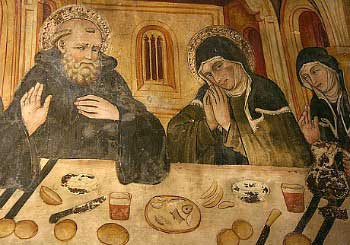
Scholastica, the twin sister of St. Benedict, consecrated her life to God when she was very young. After her brother established his monastery at Mount Cassino, she resided in the neighborhood at Plombariola, about five miles from where her brother lived. Scholastica founded a monastery of nuns that was governed by Benedict, though still under her own direction.

She visited her brother once a year, and as she was not allowed to enter his monastery, he went with a few of his brothers to meet her at a house some distance away to pray together and speak of spiritual matters. On one such occasion in 543, they had passed the time as usual in prayer and holy conversation and in the evening sat down to eat supper. Scholastica begged her brother to remain until the next day, deviating from their usual custom, so that they might continue their conversation. Benedict refused to spend the night outside his monastery as it was contrary to his order’s rule.

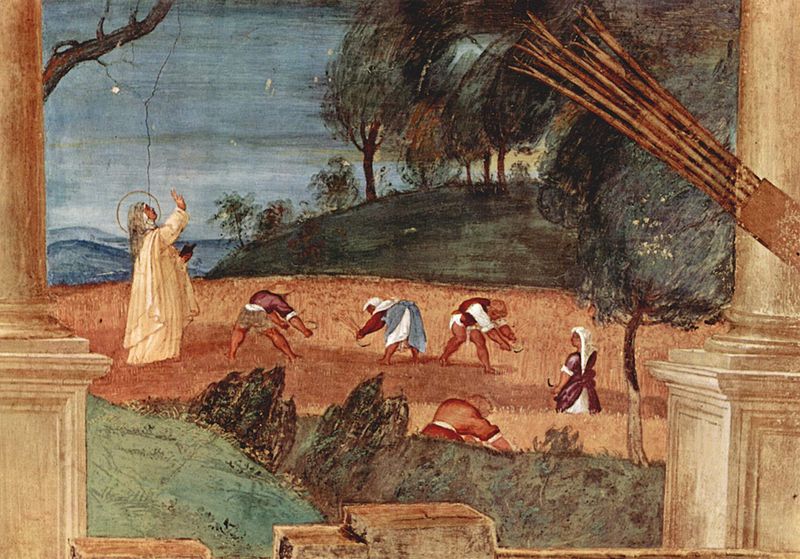
Scholastica turned to God in prayer, and a thunderstorm erupted. The rain and lightning was so violent, that Benedict and his companions were prevented from returning home. "May God forgive you, sister" said Benedict, "for what you have done." "I asked a favor of you," she replied simply, "and you refused it. I asked it of God, and He has granted it!" Thus, they spent the night speaking of holy things. In the morning, they parted ways, never to see one another on earth again: just three days later, Scholastica died.

Thursday, February 9, 2017

What is love?

Love is not just an affirmation,
but a negation.
It implies sacrifice – a surrender of our will,
of our selfish interests, for the good of the other.
It looks not to the lover’s pleasure, but to the happiness of the beloved.

Archbishop Fulton J. Sheen

St. Michael Febres Cordero

Michael was born in Cuenca, Ecuador in 1854 to a wealthy family. From birth he had a deformity that disabled him and prevented him from walking. One day, as he sat in his wheelchair, he saw a rose in the garden. Above the flowers, he saw a beautiful lady wearing a white and blue dress, calling his name. His family, who could see nothing other than the rose, was astonished when he proceeded to get up and walk. From then on, Michel spoke with Our Lady and Jesus on a regular basis.

When the De LaSalle Brothers arrived in Ecuador in 1863 and set up a seminary, Michael enrolled, though his parents objected to his plans to become a lay brother rather than a priest. Instead, they sent him to the seminary where his father taught, but within a few months he became seriously ill and had to return home. His mother finally agreed to let him become a lay brother. In 1868, Michael entered the order of the De LaSalle Brothers and a year later was assigned to the Beaterio, a congregation of lay sisters dedicated to prayer and charitable work in Quito, where he specialized in preparing children for their First Communion for the next 26 years.

Transferred to Spain to assist in the translation of sacred documents, he caught a cold that developed into pneumonia, and he died on February 9, 1910. His body was returned to Ecuador, and his tomb in Quito soon became a shrine and place of pilgrimage. The Ecuadorian government issued stamps bearing his likeness and erected a bronze and marble monument to him in Quito’s central park. Upon the statue’s dedication in June, 1965, there was a huge parade in which 30,000 school children participated.

Wednesday, February 8, 2017

What is the proof of love?

The proof of love is in the works.
Where love exists, it works great things.
But when it ceases to act, it ceases to exist.

St. Gregory the Great

St. Jerome Emiliani

Jerome was born in Venice in 1481. As a military commander who prided himself on the strength of his army, he was not a man of God. Yet when he was taken prisoner and thrown in a dungeon, the proud leader turned to God and miraculously escaped his captors. After his conversion, Jerome dedicated himself to Our Lady and the work of God, and was eventually ordained to the priesthood in 1518.

At that time, famine and plague were rampant in Northern Italy, and Jerome devoted himself to caring for sick orphans, housing and teaching them Catholicism. After contracting the plague and recovering, Jerome decided to wholly devote himself to caring for others. In 1531, he established multiple orphanages and a shelter for penitent prostitutes, and just a year later, along with two other priests, a congregation for men. The congregation, named The Clerks Regular of Somascha, mainly saw to the care of orphans and the instruction of youths and young clerics.

In 1537, Jerome caught an infectious disease while caring for the sick, and died on February 8. The Clerks Regular of Somascha still exist today, and it is said Jerome Emiliani was the first to introduce the idea of teaching catechism to children.

Tuesday, February 7, 2017

What does it mean to love God?

To love God as He ought to be loved, we must be
detached from all temporal love.
We must love nothing but Him, or
if we love anything else, we must love it only for His sake.

St. Peter Claver

St. Luke the Younger

Born on the Greek island of Aegina, Luke belonged to a family of farmers. Saracen raiders forced his family to leave their homeland for Thessaly, where Luke worked in the fields and tended sheep. He was a dutiful child, but his charity towards the poor often frustrated his parents: Luke would often give his own food and clothing to those less fortunate. He was so charitable that God blessed him, and his family’s crops flourished, but his parents still did not approve.

After his father's death, Luke decided to become a hermit. The decision angered his mother, who wanted her son at home. He left Thessaly to find a monastery, but was captured by soldiers who mistook him for a runaway slave. Imprisoned for a short time, he then returned to his mother after he convinced his captors of his true identity.

Later, two monks on their way to the Holy Land persuaded Luke's mother to allow him to join a monastery in Athens. After only a short time, Luke’s superior claimed that his mother had appeared to him in a vision calling for help, and Luke was sent home.

Eventually, Luke's mother understood her son's call to religious life and no longer opposed him. Luke built his hermitage on Mount Joannitsa, near Corinth when he was only eighteen. At times, Luke was seen suspended above the ground in prayer. After his death, his cell was transformed into an oratory and named the Place of Healing.

Monday, February 6, 2017

To conquer the devil

The most powerful weapon to conquer the devil is
humility.
For, as he does not know at all how to employ it,
neither does he know how to defend himself from it.

St. Vincent de Paul

St. Paul Miki and Companions

By 1549, St. Francis Xavier had begun the evangelization of Japan. After he left to spread the faith elsewhere, a Catholic community flourished. The community grew, and eventually expanded to include Paul Miki, a high-born Jesuit priest who became well-known as a preacher. Paul followed St. Francis’ footsteps and continued the spread of Christianity, along with missionaries and priests from various countries and orders.

In 1597, Hideyoshi, a powerful Japanese official, listened to the gossip and lies of a Spanish merchant. The merchant said that Paul and the missionaries were traitors of Japan, and were spies for Spain and Portugal. Hideyoshi cut off the left ears of twenty-six Catholics, including Paul Miki, smeared their cheeks with blood as a warning to others and paraded them through towns before executing them. Priests, brothers, laymen, catechists, doctors, servants, old men and innocent children were bound to crosses and raised into the air, a lance trust into their sides, killing them. Hideyoshi crucified the martyrs on a hill, now known as the Holy Mountain, above Nagasaki. They were canonized in 1862.

Sunday, February 5, 2017

The Power of Prayer

Have you ever felt the urge to pray for someone and thought, “I’ll pray for him or her later”?
This story will show you how real these urges can be.
A missionary on furlough in Michigan told this true story to the congregation at his home church. While in Africa, he served in a small field hospital. Every two weeks he travelled to a certain city for medicines and supplies, and since it was a two-day journey through the jungle on his bicycle, he camped overnight at the halfway point.
On one of these trips, as he entered the city, he noticed two men fighting. As he approached, he realized one of them was seriously injured. He treated the injured fellow and then tried to do good to his soul by talking to him about Our Lord.
The missionary then went on to withdraw funds from the bank and purchased the necessary medicines and supplies for his hospital. After loading everything on his bicycle, he started on the return journey.
Two weeks later the missionary returned for more supplies. As he walked to his errands, he spotted the young man whom he had treated on the previous visit, and engaged him in conversation.
The good priest inquired about his wounds, and touched by the goodness shown to him, the young man confessed, “Last time when you left here, some friends and I followed you into the jungle. We knew you had money and supplies. We also knew you would camp overnight and we planned to kill you and take the money and drugs. But just as we were about to move into your camp, we saw armed guards around you. As we stood there, peering through the foliage and weighing our odds, we counted twenty-six men. We then just gave it all up and walked away.”
The priest laughed and said that he certainly did not have twenty-six guards with him. But the young man pressed the point, “No, sir, I was not the only one to see the guards. My friends also saw them and we all counted them. It was because of those guards that we left you alone.”
Just then, a man in the congregation jumped up, interrupted the missionary and asked him as to the day this had happened. The missionary replied, and it was the man’s turn to tell a story.
“Father, on the night of your incident in Africa, I was playing golf. I was about to putt when I felt a great urge to pray for you. It was so strong that I called several men to come into church and pray with me.” Then, turning to the congregation, he said, “Will all those who joined me in prayer that day stand up?”
As several men in church rose to their feet, the missionary counted. There were twenty-six men.
By: M. Taylor

What does it mean to belong to the Church?

Belonging to the Church is a very great and very demanding thing.
We must think as the Church thinks, have the mind of the Church,
proceed as the Church wishes in all the circumstance of our lives.
This supposes a real Catholic sense,
an authentic and complete purity of customs, and
a profound and sincere piety.

In other words,
it supposes the sacrifice of an entire lifetime.

Plinio Corrêa de Oliveira

St. Agatha

Very little is known about St. Agatha, other than that she was martyred in Sicily during the persecution of Emperor Decius in 251. According to legend, Agatha dedicated her life to Our Lord at a young age and refused any man who wanted to marry her. Agatha was arrested after refusing the advances of Quintian, a powerful man of high rank, and was imprisoned in a brothel. Throughout the month she spent being tortured in the brothel, Agatha would pray, “Jesus Christ, Lord of all, you see my heart, you know my desires. Possess all that I am. I am your sheep: make me worthy to overcome the devil," and was preserved from being violated.

Agatha was removed from the brothel and again advanced upon by her captor. Again, she refused him, saying she was dedicated to God alone. Her captor then sent her to prison, and had her tortured repeatedly. He refused her any medical care, but God comforted her in the form of a vision of St. Peter. Agatha was tortured yet again, and this time her body was grossly mutilated. She died with this prayer on her lips: "Lord, my Creator, you have always protected me from the cradle; you have taken me from the love of the world and given me patience to suffer.”

About a year after her death, Agatha was attributed with calming an erupting volcano, and is revered as a protector against fires. Because of the way her body was mutilated before her death, she is also known as the patroness of breast cancer patients.

Photos by: Hermetiker

Saturday, February 4, 2017

First Saturday


The Five First Saturdays devotion is one of the principal points of the Fatima message. It centers on the urgent need for mankind to offer reparation and expiate for the many injuries that the Immaculate Heart of Mary suffers from the hands of both impious and indifferent men.

1st Five Saturdays Devotion Card Banner

History
During the third apparition on July 13, 1917, Our Lady revealed that she would come to ask for the consecration of Russia to her Immaculate Heart and for the Communion of Reparation of the Five First Saturdays. Consequently, she asked for the devotion in 1925 and the consecration in 1929.
While staying at the House of the Dorothean Sister in Pontevedra, Portugal, Sister Lucia received a vision on December 10, 1925 where the Blessed Mother appeared alongside a Boy who stood over a luminous cloud. Our Lady rested one hand on the Boy’s shoulder while she held on the other hand a heart pierced with thorns around it.
Sister Lucia heard the Boy say, "Have pity on the Heart of your Most Holy Mother which is covered with thorns with which ingrate men pierce it at every moment with no one to make an act of reparation to pull them out."
Our Lady expressed her request in the following words,
"See, my daughter, My Heart surrounded with thorns with which ingrates pierce me at every moment with blasphemies and ingratitude. You, at least, make sure to console me and announce that all those who for five months, on the first Saturdays, go to confession, receive Communion, say five decades of the Rosary and keep me company for 15 minutes meditating on the mysteries of the Rosary, with the purpose of making reparation to Me, I promise to assist them at the hour of death with all the graces necessary for the salvation of their souls."
A few days afterward, Sister Lucia detailed this vision in a letter addressed to Monsignor Manuel Pereira Lopes, her confessor when she resided in the Asylum of Vilar in the city of Oporto, Portugal.


Why Five Saturdays?     
Sister Lucia’s confessor questioned her about the reason for the five Saturdays asking why not seven or nine. She answered him in a letter dated June 12, 1930. In it she related about a vision she had of Our Lord while staying in the convent chapel part of the night of the twenty-ninth to the thirtieth of the month of May, 1930. The reasons Our Lord gave were as follows:
The five first Saturdays correspond to the five kinds of offenses and blasphemies committed against the Immaculate Heart of Mary. They are:
  a.    Blasphemies against the Immaculate Conception
  b.    Blasphemies against her virginity
  c.    Blasphemies against her divine maternity, at the same time the refusal to accept her as the Mother of all men
  d.    Instilling , indifference, scorn and even hatred towards this Immaculate Mother in the hearts of children
  e.    Direct insults against Her sacred images
Let us keep the above reasons firmly in our minds. Devotions have intentions attached to them and knowing them adds merit and weight to the practice.

Modifications to the Five First Saturdays Devotion to facilitate its observation
The original request of Our Lady asks one to confess and receive Communion on five consecutive first Saturdays; to say five decades of the Rosary; to meditate during 15 minutes on the mysteries of the Rosary for the purpose of making reparation to the Immaculate Heart of Mary in reparation for the sins of men.
In subsequent private visions and apparitions however, Sister Lucia presented to Our Lord the difficulties that devotees encountered in fulfilling some conditions. With loving condescension and solicitude, Our Lord deigned to relax the rules to make this devotion easy to observe:
  • Confession may be done on other days other than the First Saturdays so long as one receives Our Lord worthily and has the intention of making reparation to the Immaculate Heart of Mary.
  • Even if one forgets to make the intention, it may be done on the next confession, taking advantage of the first occasion to go to confession.
  • Sister Lucia also clarified that it is not necessary to meditate on ALL mysteries of the Rosary on each First Saturdays. One or several suffice.
With much latitude granted by Our Lord Himself, there is no reason for the faithful to hesitate or delay this pious practice in the spirit of reparation which the Immaculate Heart of Mary urgently asks.

This devotion is so necessary in our days
The culture of vice and sin remains unabated even as one reads this. Abortion, blasphemy, drug abuse, pornography, divorce and bad marriages, religious indifference, the advances of the homosexual agenda and others are just some of society’s many plagues that cut deeply into the Immaculate Heart of Mary.
We must console Our Lady amidst all these insults and injuries to her and her Divine Son. She asks for reparation, she pleads for our prayers, she hopes for our amendment of life. Let us listen to her maternal pleas and atone for the ingratitude of men.
The First Five Saturdays devotion stimulates the spirit of reparation; it instills a tender love for the Holy Sacraments of Confession and the Blessed Eucharist. It nurtures a holy affection for the Immaculate Heart of Mary and the Rosary. Above all, it is an excellent means to maintain one in the state of grace while immersed in the daily spiritual battles and prosaic existence in the neo-pagan world that we live in.
Let us not delay in observing this devotion for it too gives us hope for eternal salvation.


REFERENCE:
Solimeo, Luiz Sergio, Fatima, A Message More Urgent than Ever 
(Spring Grove, PA: The American Society for the Defense of Tradition, Family, and Property-TFP, 2008.)
  
1st Five Saturdays Devotion Card Banner

Begin every day like this

If we wish to make any progress in the service of God
we must begin every day of our life with new eagerness.
We must keep ourselves in the presence of God as much as possible and
have no other view or end in all our actions
but the divine honor.

St. Charles Borromeo

St. John de Britto

John de Britto, was born in Lisbon on March 1, 1647 to a noble Portuguese family. His father died while serving as Viceroy of Brazil. Growing up, John was a playmate to the future King of Portugal, Pedro II. At fifteen, the young nobleman applied to join the Society of Jesus into which he was duly accepted. His talent for academic excellence was soon noted by his superiors; however, John’s great admiration and devotion to St. Francis Xavier urged him to apply to serve in the Indian missions. Amid strong opposition from his family, in 1673 John traveled to Madura in southern India.

As he traveled throughout India on foot, John lived austerely. He dressed himself in the saffron cloak and turban of the native Indians, abstained from eating meat and lived humbly. Through his holy efforts, John soon became well-known, and developed a group of catechists. Though the practice of Catholicism was not illegal in India, John was hated by many because of his faith. He and his followers were often subjected to agonizing torture, but each time John miraculously recovered.

In 1683, John was banished from India, and departed for Portugal. Returning soon after, the ardent missionary continued in his apostolate for three more years. In 1693, he was again arrested, tortured and once more commanded to leave India. When he refused, John was sentenced to death. “I await death, and I await it with impatience,” he wrote to his superior. “It has always been the object of my prayers. It forms today the most precious reward of my labors and my sufferings.”

On February 4, John de Britto was executed. As he knelt at the execution block, the rajah's order of death was read aloud. The executioner hesitated, but John said to him, "My friend, I have prayed to God. On my part, I have done what I should do. Now do your part.”

John de Britto was canonized in 1947.

Friday, February 3, 2017

The Nine First Fridays


“I promise you, in the excessive mercy of my Heart that my all powerful love will grant to all those who receive Holy Communion on the first Friday for nine consecutive months, the grace of final repentance; they shall not die in my disgrace nor without receiving the sacraments; my divine Heart shall be their safe refuge in that last moment.”  — Our Lord to St. Margaret Mary

Sacred Heart Devotional Set

How to complete the First Friday’s Devotion:

  1. Receive Holy Communion on each First Friday;
  2. The nine Fridays must be consecutive;
  3. They must be made in honor and in reparation to His Sacred Heart.

ACT OF REPARATION TO THE SACRED HEART OF JESUS
Sacred Heart of Jesus, animated with a desire to repair the outrages unceasingly offered to Thee, we prostrate before Thy throne of mercy, and in the name of all mankind, pledge our love and fidelity to Thee!
The more Thy mysteries are blasphemed, the more firmly we shall believe them, O Sacred Heart of Jesus!
The more impiety endeavors to extinguish our hopes of immortality, the more we shall trust in Thy Heart, sole hope of mankind!
The more hearts resist Thy Divine attractions, the more we shall love Thee, O infinitely amiable Heart of Jesus!
The more unbelief attacks Thy Divinity, the more humbly and profoundly we shall adore It, O Divine Heart of Jesus!
The more Thy holy laws are transgressed and ignored, the more we shall delight to observe them, O most holy Heart of Jesus!
The more Thy Sacraments are despised and abandoned, the more frequently we shall receive them with love and reverence, O most liberal Heart of Jesus!
The more the imitation of Thy virtues is neglected and forgotten, the more we shall endeavor to practice them, O Heart of Jesus, model of every virtue!
The more the devil labors to destroy souls, the more we shall be inflamed with desire to save them, O Heart of Jesus, zealous Lover of souls!
The more sin and impurity destroy the image of God in man, the more we shall try by purity of life to be a living temple of the Holy Spirit, O Heart of Jesus!
The more Thy Holy Church is despised, the more we shall endeavor to be her faithful children, O Sweet Heart of Jesus!
The more Thy Vicar on earth is persecuted, the more we will honor him as the infallible head of Thy Holy Church, show our fidelity and pray for him, O kingly Heart of Jesus!
O Sacred Heart, through Thy powerful grace, may we become Thy apostles in the midst of a corrupted world, and be Thy crown in the kingdom of heaven.  Amen.

12 Promises of the Sacred Heart to St. Margaret Mary
1.  I will give them all the graces necessary for their state of life.
2.  I will give peace in their families.
3.  I will console them in all their troubles.
4.  I will be their refuge in life and especially in death.
5.  I will abundantly bless all their undertakings.
6.  Sinners shall find in my Heart the source and infinite ocean of mercy.
7.  Tepid souls shall become fervent.
8.  Fervent souls shall rise speedily to great perfection.
9.  I will bless those places wherein the image of my Sacred Heart shall be exposed and venerated.
10. I will give to priests the power to touch the most hardened hearts.
11. Persons who propagate this devotion shall have their names eternally written in my Heart.
12. In the excess of the mercy of my heart, I promise you that my all powerful love will grant to all those who will receive Communion on the First Fridays, for nine consecutive months, the grace of final repentance: they will not die in my displeasure, nor without receiving the sacraments; and my Heart will be their secure refuge in that last hour.

Novena to Our Lady of Lourdes: February 3rd - 11th


Preliminary Prayer to be said each day:
   Be blessed, O most pure Virgin, for having vouchsafed to manifest your shining with life, sweetness and beauty, in the Grotto of Lourdes, saying to the child, St. Bernadette: "I am the Immaculate Conception." A thousand times we congratulate you upon your Immaculate Conception. And now, O ever Immaculate Virgin, Mother of mercy, Health of the sick, Refuge of sinners, Comforter of the afflicted, you know our wants, our troubles, our sufferings; deign to cast upon us a look of mercy. By appearing in the Grotto of Lourdes, you were pleased to make it a privileged sanctuary, whence you dispense your favors, and already many have obtained the cure of their infirmities, both spiritual and physical. We come, therefore, with the most unbounded confidence to implore your maternal intercession. Obtain for us, O loving Mother, the granting of our request.
(mention your request)
Through gratitude for your favors, we will endeavor to imitate your virtues, that we may one day share your glory.
   Our Lady of Lourdes, Mother of Christ, you had influence with your Divine Son while upon earth. You have the same influence now in Heaven. Pray for us; obtain for us from your Divine Son our special requests if it be the Divine Will. Amen.
   Our Lady of Lourdes, pray for us.
   Saint Bernadette, pray for us. 


Day One Day Four Day Seven
Day Two Day Five Day Eight
Day Three Day Six Day Nine


DAY ONE : February 3rd
   O Mary Immaculate, Our Lady of Lourdes, virgin and mother, queen of heaven, chosen from all eternity to be the Mother of the Eternal Word and in virtue of this title preserved from original sin, we kneel before you as did little Bernadette at Lourdes and pray with childlike trust in you that as we contemplate your glorious appearance at Lourdes, you will look with mercy on our present petition and secure for us a favorable answer to the request for which we are making this novena. (mention your request)
   O Brilliant star of purity, Mary Immaculate, Our Lady of Lourdes, glorious assumption, triumphant in your coronation, show unto us the mercy of the Mother of God, Virgin Mary, Queen and Mother, be our comfort, hope, strength, and consolation. Amen.
   Our Lady of Lourdes, pray for us.
   Saint Bernadette, pray for us.


DAY TWO : February 4th
   Be blessed, O most pure Virgin, for having vouchsafed to manifest yourself shining with light, sweetness and beauty, in the Grotto of Lourdes, saying to the child Saint Bernadette: "I am the Immaculate Conception!" O Mary Immaculate, inflame our hearts with one ray of the burning love of your pure heart. Let them be consumed with love for Jesus and for you, in order that we may merit one day to enjoy your glorious eternity. O dispenser of His graces here below, take into your keeping and present to your Divine Son the petition for which we are making this novena. (mention your request)
   O Brilliant star of purity, Mary Immaculate, Our Lady of Lourdes, glorious assumption, triumphant in your coronation, show unto us the mercy of the Mother of God, Virgin Mary, Queen and Mother, be our comfort, hope, strength, and consolation. Amen.
   Our Lady of Lourdes, pray for us.
   Saint Bernadette, pray for us.


DAY THREE : February 5th
   "You are all fair, O Mary, and there is in you no stain of original sin." O Mary, conceived without sin, pray for us who have recourse to thee. O brilliant star of sanctity, as on that lovely day, upon a rough rock in Lourdes you spoke to the child Bernadette and a fountain broke from the plain earth and miracles happened and the great shrine of Lourdes began, so now I beseech you to hear our fervent prayer and do, we beseech you, grant us the petition we now so earnestly seek.
(mention your request)
   O Brilliant star of purity, Mary Immaculate, Our Lady of Lourdes, glorious assumption, triumphant in your coronation, show unto us the mercy of the Mother of God, Virgin Mary, Queen and Mother, be our comfort, hope, strength, and consolation. Amen.
   Our Lady of Lourdes, pray for us.
   Saint Bernadette, pray for us.


DAY FOUR : February 6th
   O Immaculate Queen of Heaven, we your wayward, erring children, join our unworthy prayers of praise and thanksgiving to those of the angels and saints and your own the One, Holy, and Undivided Trinity may be glorified in heaven and on earth. Our Lady of Lourdes, as you looked down with love and mercy upon Bernadette as she prayed her rosary in the grotto, look down now, we beseech you, with love and mercy upon us. From the abundance of graces granted you by your Divine Son, sweet Mother of God, give to each of us all that your motherly heart sees we need and at this moment look with special favor on the grace we seek in this novena. (mention your request)
   O Brilliant star of purity, Mary Immaculate, Our Lady of Lourdes, glorious assumption, triumphant in your coronation, show unto us the mercy of the Mother of God, Virgin Mary, Queen and Mother, be our comfort, hope, strength, and consolation. Amen.
   Our Lady of Lourdes, pray for us.
   Saint Bernadette, pray for us.


DAY FIVE : February 7th
   O Mary Immaculate, Mother of God and our mother, from the heights of your dignity look down mercifully upon us while we, full of confidence in your unbounded goodness and confident that your Divine Son will look favorably upon any request you make of Him in our behalf, we beseech you to come to our aid and secure for us the favor we seek in this novena. (mention your request)
   O Brilliant star of purity, Mary Immaculate, Our Lady of Lourdes, glorious assumption, triumphant in your coronation, show unto us the mercy of the Mother of God, Virgin Mary, Queen and Mother, be our comfort, hope, strength, and consolation. Amen.
   Our Lady of Lourdes, pray for us.
   Saint Bernadette, pray for us.


DAY SIX : February 8th
   O glorious Mother of God, so powerful under your special title of Our Lady of Lourdes, to you we raise our hearts and hands to implore your powerful intercession in obtaining from the benign Heart of Jesus all the helps and graces necessary for our spiritual and temporal welfare and for the special favor we so earnestly seek in this novena. (mention your request)
   O Lady of Bernadette, with the stars of heaven in your hair and the roses of earth at your feet, look with compassion upon us today as you did so long ago on Bernadette in the Grotto of Lourdes.
   O Brilliant star of purity, Mary Immaculate, Our Lady of Lourdes, glorious assumption, triumphant in your coronation, show unto us the mercy of the Mother of God, Virgin Mary, Queen and Mother, be our comfort, hope, strength, and consolation. Amen.
   Our Lady of Lourdes, pray for us.
   Saint Bernadette, pray for us. 


DAY SEVEN : February 9th
   O Almighty God, who by the Immaculate Conception of the Blessed Virgin Mary did prepare a worthy dwelling place for your Son, we humbly beseech you that as we contemplate the apparition of Our Lady in the Grotto of Lourdes, we may be blessed with health of mind and body. And, O most gracious Mother Mary, beloved Mother of Our Lord and Redeemer, look with favor upon us as you did that day on Bernadette and intercede with Him for us that the favor we now so earnestly seek may be granted to us.
(mention your request)
   O Brilliant star of purity, Mary Immaculate, Our Lady of Lourdes, glorious assumption, triumphant in your coronation, show unto us the mercy of the Mother of God, Virgin Mary, Queen and Mother, be our comfort, hope, strength, and consolation. Amen
   Our Lady of Lourdes, pray for us.
   Saint Bernadette, pray for us.


DAY EIGHT : February 10th
   O Immaculate Mother of God, from heaven itself you came to appear to the little Bernadette in the rough Grotto of Lourdes! And as Bernadette knelt at your feet and the magic spring burst forth and as multitudes have knelt ever since before your shrine, O Mother of God, we kneel before you today to ask that in your mercy you plead with your Divine Son to grant the special favor we seek in this novena. (mention your request)
   O Brilliant star of purity, Mary Immaculate, Our Lady of Lourdes, glorious assumption, triumphant in your coronation, show unto us the mercy of the Mother of God, Virgin Mary, Queen and Mother, be our comfort, hope, strength, and consolation. Amen.
   Our Lady of Lourdes, pray for us.
   Saint Bernadette, pray for us.


DAY NINE : February 11th - Feast Day: Our Lady of Lourdes
(First apparition to St. Bernadette)
   O glorious Mother of god, to you we raise our hearts and hands to implore your powerful intercession in obtaining from the benign Heart of Jesus all the graces necessary for our spiritual and temporal welfare, particularly for the grace of a happy death. O Mother of our Divine Lord, as we conclude this novena for the special favor we seek at this time.
(mention your request)
   We feel animated with confidence that your prayers in our behalf will be graciously heard. O Mother of My Lord, through the love you bear to Jesus Christ and for the glory of His Name, hear our prayers and obtain our petitions.
   O Brilliant star of purity, Mary Immaculate, Our Lady of Lourdes, glorious assumption, triumphant in your coronation, show unto us the mercy of the Mother of God, Virgin Mary, Queen and Mother, be our comfort, hope, strength, and consolation. Amen.
   Our Lady of Lourdes, pray for us.
   Saint Bernadette, pray for us.


Read:

Lust

Lust indulged became habit,
and habit unresisted

became necessity.

St. Augustine of Hippo

St. Blaise

Very few facts are known about St. Blaise. It is believed that he lived in the early fourth century, and was of a noble and wealthy Christian Armenian family. While he was still very young, Blaise was made a bishop. Although the Edict of Toleration (311), granting freedom of worship in the Roman Empire was already five years old, there was still much persecution of Christians in Armenia. God instructed Blaise to escape his enemies by fleeing to the mountains, where he lived as a hermit.

Then, one day in 316, a hunting party stumbled upon the solitary hermit and took him back to Cappadocia. Agricolaus, governor of Cappadocia, tried to persuade Blaise to worship pagan idols. The first time Blaise refused, and he was beaten. The second time, he was hung from a tree and his flesh torn with iron hooks. The third time he refused, he was beheaded.

As legend has it, a mother brought her young son, who was slowly dying of suffocation due to a bone lodged in his throat, to be blessed by Blaise. But at Blaise’s command the child was able to cough up the bone and lived. On his feast day, the blessing of St. Blaise is given: two candles are consecrated and then held by a priest in a crossed position either over the heads or at the throats of the faithful.

Thursday, February 2, 2017

What Saint’s love for God can match Mary’s?

Think of what the Saints have done for their neighbor because they loved God.
But what Saint’s love for God can match Mary’s?
She loved Him more in the first moment of her existence
than all the Saints and angels ever loved Him or will love Him.
Just as there is not one among all the Blessed who loves God as Mary does,
so there is no one, after God, who loves us as much as this most loving Mother does.

St. Alphonsus Maria de Liguori

Presentation of the Christ Child in the Temple

In Israel the Law of Moses considered the first-born male child to belong to God. The same law considered the mother “unclean” after giving birth. For forty days she could not go out or touch anything sacred. In order to “ransom” the child and “cleanse” the mother, a visit to temple was required, which involved a sacrificial offering of a lamb and a dove. If the family had limited means, the lamb could be exchanged for a dove. Thus, two doves were sufficient to fulfill the precept.
Forty days after the birth of Jesus, St. Joseph again helped his virgin wife onto the donkey only now she carried the creator of the universe in her arms. Slowly they made their way to Jerusalem to comply with the Mosaic Law. In their case, there was really no need for “ransom” or “cleansing”, Jesus being God, and Mary being a virgin before, during and after the birth of her divine Son (CCC 496-507, 510). Yet, before the eyes of men, unaware of these circumstances, the holy family wished to give an example of humility and obedience by submitting to the age-old mandate. The fact that St. Joseph offered two doves is evidence of their poverty.
At that time there was a priest, a venerable old man named Simeon to whom the Holy Ghost had revealed that he would not die before seeing Christ the Redeemer (Luke 2:26).

As the holy family entered the temple, Simeon was inspired to meet them, and taking the Child in his arms exclaimed: “Now thou dost dismiss thy servant, O Lord, according to thy word in peace; because my eyes have seen thy salvation…” (Luke 2:29-30)

And turning to Mary Most Holy, he prophesized, “Behold this child is set for the fall and resurrection of many in Israel, and for a sign which shall be contradicted…and thy own soul a sword shall pierce…” (Luke 2:34-35)

An eighty-four year old woman, the holy prophetess Anna, who lived in the temple, also gave thanks to God and spoke of Him to all present. (Luke 2:36-38)

The feast of the Presentation of the Lord was celebrated in the Church of Jerusalem as early as the mid-fourth century and probably earlier. Throughout the history of the Church this feast has been called The Presentation, the Purification of Mary and also Candlemas, as, traditionally, candles were blessed on February 2.

Wednesday, February 1, 2017

When we pray...

When we pray, the voice of the heart
must be heard more
than that proceeding from the mouth.

St. Bonaventure

February 1 – She and Saint Patrick were “one heart and one mind”

Saint Brigid of Ireland

Born in 451 or 452 of princely ancestors at Faughart, near Dundalk, County Louth; d. 1 February, 525, at Kildare. Refusing many good offers of marriage, she became a nun and received the veil from St. Macaille. With seven other virgins she settled for a time at the foot of Croghan Hill, but removed thence to Druin Criadh, in the plains of Magh Life, where under a large oak tree she erected her subsequently famous Convent of Cill-Dara, that is, “the church of the oak” (now Kildare), in the present county of that name. It is exceedingly difficult to reconcile the statements of St. Brigid’s biographers, but the Third, Fourth, and Fifth Lives of the saint are at one in assigning her a slave mother in the court of her father Dubhthach, and Irish chieftain of Leinster. Probably the most ancient life of St. Brigid is that by St. Broccan Cloen, who is said to have died 17 September, 650. It is metrical, as may be seen from the following specimen:
Saint Brigid was not given to sleep, Nor was she intermittent about God’s love;
Not merely that she did not buy, she did not seek for
The wealth of this world below, the holy one.
Cogitosus, a monk of Kildare in the eighth century, expounded the metrical life of St. Brigid, and versified it in good Latin. This is what is known as the “Second Life”, and is an excellent example of Irish scholarship in the mid-eighth century. Perhaps the most interesting feature of Cogitosus’s work is the description of the Cathedral of Kildare in his day. The rood-screen was formed of wooden boards, lavishly decorated, and with beautifully decorated curtains. Probably the famous Round Tower of Kildare dates from the sixth century. Although St. Brigid was “veiled” or received by St. Macaille, at Croghan, yet, it is tolerably certain that she was professed by St. Mel of Ardagh, who also conferred on her abbatial powers. From Ardagh St. Macaille and St. Brigid followed St. Mel into the country of Teffia in Meath, including portions of Westmeath and Longford. This occurred about the year 468. St. Brigid’s small oratory at Cill Dara became the centre of religion and learning, and developed into a cathedral city. She founded two monastic institutions, one for men, and the other for women, and appointed St. Conleth as spiritual pastor of them. It has been frequently stated that she gave canonical jurisdiction to St. Conleth, Bishop of Kildare, but, as Archbishop Healy points out, she simply “selected the person to whom the Church gave this jurisdiction”, and her biographer tells us distinctly that she chose St. Conleth “to govern the church along with herself”. Thus, for centuries, Kildare was ruled by a double line of abbot-bishops and of abbesses, the Abbess of Kildare being regarded as superioress general of the convents in Ireland.
St. Brigid's small oratory at Kildare (or Cill Dara) became the centre of religion and learning, and developed into a cathedral city.
St. Brigid’s small oratory at Kildare (or Cill Dara) became the centre of religion and learning, and developed into a cathedral city.
Not alone was St. Bridget a patroness of students, but she also founded a school of art, including metal work and illumination, over which St. Conleth presided. From the Kildare scriptorium came the wondrous book of the Gospels, which elicited unbounded praise from Giraldus Cambrensis, but which has disappeared since the Reformation. According to this twelfth- century ecclesiastic, nothing that he had ever seen was at all comparable to the “Book of Kildare”, every page of which was gorgeously illuminated, and he concludes a most laudatory notice by saying that the interlaced work and the harmony of the colours left the impression that “all this is the work of angelic, and not human skill”. Small wonder that Gerald Barry assumed the book to have been written night after night as St. Bridget prayed, “an angel furnishing the designs, the scribe copying”. Even allowing for the exaggerated stories told of St. Brigid by her numerous biographers, it is certain that she ranks as one of the most remarkable Irishwomen of the fifth century and as the Patroness of Ireland. She is lovingly called the “Queen of the South: the Mary of the Gael” by a writer in the “Leabhar Breac”. St. Brigid died leaving a cathedral city and school that became famous all over Europe. In her honour St. Ultan wrote a hymn commencing:
Christus in nostrâ insulâ
Que vocatur Hibernia
Ostensus est hominibus
Maximis mirabilibus
Que perfecit per felicem
Celestis vite virginem
Precellentem pro merito
Magno in mundi circulo.
(In our island of Hibernia Christ was made known to man by the very great miracles which he performed through the happy virgin of celestial life, famous for her merits through the whole world.)
The sixth Life of the saint printed by Colgan is attributed to Coelan, an Irish monk of the eighth century, and it derives a peculiar importance from the fact that it is prefaced by a foreword from the pen of St. Donatus, also an Irish monk, who became Bishop of Fiesole in 824. St. Donatus refers to previous lives by St. Ultan and St. Aileran. When dying, St. Brigid was attended by St. Ninnidh, who was ever afterwards known as “Ninnidh of the Clean Hand” because he had his right hand encased with a metal covering to prevent its ever being defiled, after being the medium of administering the viaticum to Ireland’s Patroness.
St Brigid’s Cathedral, Kildare. Photo by Vivienne Smith.
She was interred at the right of the high altar of Kildare Cathedral, and a costly tomb was erected over her. About the year 878, owing to the Scandinavian raids, the relics of St. Brigid were taken to Downpatrick, where they were interred in the tomb of St. Patrick and St. Columba. The relics of the three saints were discovered in 1185, and on 9 June of the following year were solemnly translated to a suitable resting place in Downpatrick Cathedral, in presence of Cardinal Vivian, fifteen bishops, and numerous abbots and ecclesiastics. Various Continental breviaries of the pre- Reformation period commemorate St. Brigid, and her name is included in a litany in the Stowe Missal. In Ireland to-day, after 1500 years, the memory of “the Mary of the Gael” is as dear as ever to the Irish heart, and, as is well known, Brigid preponderates as a female Christian name. Moreover, hundreds of place-names in her honour are to be found all over the country, e.g. Kilbride, Brideswell, Tubberbride, Templebride, etc. The hand of St. Brigid is preserved at Lumiar near Lisbon, Portugal, since 1587, and another relic is at St. Martin’s,  Cologne.

Viewing the biography of St. Brigid from a critical standpoint we must allow a large margin for the vivid Celtic imagination and the glosses of medieval writers, but still the personality of the founder of Kildare stands out clearly, and we can with tolerable accuracy trace the leading events in her life, by a careful study of the old “Lives” as found in Colgan. It seems certain that Faughart, associated with memories of Queen Meave (Medhbh), was the scene of her birth; and Faughart Church was founded by St. Morienna in honour of St. Brigid. The old well of St. Brigid’s adjoining the ruined church is of the most venerable antiquity, and still attracts pilgrims; in the immediate vicinity is the ancient mote of Faughart. As to St. Brigid’s stay in Connacht, especially in the County Roscommon, there is ample evidence in the “Trias Thaumaturga”, as also in the many churches founded by her in the Diocese of Elphim. Her friendship with St. Patrick is attested by the following paragraph from the “Book of Armagh”, a precious manuscript of the eighth century, the authenticity of which is beyond question: “inter sanctum Patricium Brigitanque Hibernesium columpnas amicitia caritatis inerat tanta, ut unum cor consiliumque haberent unum. Christus per illum illamque virtutes multas peregit”. (Between St. Patrick and St. Brigid, the columns of the Irish, there was so great a friendship of charity that they had but one heart and one mind. Through him and through her Christ performed many miracles.) At Armagh there was a “Templum Brigidis”; namely the little abbey church known as “Regles Brigid”, which contained some relics of the saint, destroyed in 1179, by William Fitz Aldelm. It may be added that the original manuscript of Cogitosus’s “Life of Brigid”, or the “Second Life”, dating from the closing years of the eighth century, is now in the Dominican friary at Eichstätt in Bavaria.
Acta SS.; Acta Sanct. Hib. ex Cod. Salmant.; COLGAN, Trias Thaumaturga (Louvain, 1647); STOKES, Lives of the Saints from the Book of Lismore; ID., Three Middle Irish Homilies; O’HANLON, Lives of the Irish Saints (1 February), II; TODD, Liber Hymnorum; Stowe Missal; Leabhar Breac; MESSINGHAM, Florilegium; ATKINSON, St. Brigid in Essays (Dublin, 1892); HEALY, Ireland’s Ancient Schools and Scholars; STOKES, Early Christian Art in Ireland; HYDE, Literary History of Ireland (1900); KNOWLES, Life of St. Brigid (1907). Cf. CHEVALIER, Bio-bibliogr. (Paris, 1905, 2nd ed.), s.v.
W.H. GRATTAN-FLOOD (Catholic Encyclopedia)

Payback

At Anna’s mother’s funeral a man came up to her and after offering his deepest sympathy, took the grieving daughter aside, “I must tell you a story about your good mother and something she did for me…”
He proceeded to recount how, many years before he was involved in an extra-marital affair. One day, when dining with the woman in a restaurant, Anna’s parents had come in and pretended they had not seen them.
But next day he picked up the phone to hear Anna’s mother inviting him over for a piece of pie.
“You know how good your mother’s pie was…But there was also a tone of urgent authority in her voice, so I went.”
After enjoying his piece of pie, Anna’s mother revealed that she had, indeed, seen him and his girl-friend the night before.
“Though I vehemently denied it, your mother would not relent...She proceeded to remind me of the time when I was out of work and she had cooked for my family day in and day out.”
“Now, I want payback,” she demanded.
“I reached for my wallet, but she said,”
“Not that way.”
Handing him a Rosary she asked him to go to Mass for a week. She instructed him to say the Hail Mary and Our Father assigned to each bead while thinking of something good about his wife, his children and their family life.
“If at the end of this week you still think this woman is better for you, just mail me back the Rosary, and I will never say a word about this again.”
At this point, the man telling the story reached into his pocket. Pulling out a worn Rosary, he said,
“This is the Rosary your mother gave me all those years ago. My wife and I have said it together every day since.”

Based on a story from 101 Inspirational Stories of the Rosary by Sister Patricia Proctor, OSC

St. Henry Morse

Henry Morse was born to protestant parents in Suffolk, England, in 1595, and left his home to study law in London where he learned of the Catholic Faith and converted at the age of 23. Henry traveled to Rome where he was ordained a priest.

He made his way back home to England, where he was immediately arrested and imprisoned at York with a fellow priest, a Jesuit. The three years of his imprisonment became for the young ordained priest an intense novitiate, and by the time he was released, he had made his final vows as a Jesuit.

Upon his release from prison, Henry was banished from England, but returned in 1633 under a false name. During the plague of 1636, Henry would travel to the homes of Catholics and Protestants alike, caring for the sick. He caught the plague from his patients three times, but miraculously recovered each time. The people of England were so touched by Henry’s zeal and goodness, over 100 people converted to Catholicism in less than a year.

He was then betrayed by a friend, arrested by the authorities and again banished from England. Instead, he traveled to Southern England and ministered to the people there. Then, in 1645, Henry was arrested for the last time and sent to London for execution. After celebrating a final Mass, Fr. Henry Morse proclaimed his faith to the crowd, prayed aloud for himself and for his executioners and was executed. “I am come hither to die for my religion.” He said to the crowd, “…I pray that my death may be some kind of atonement for the sins of this kingdom.” Then, striking his breast three times, he gave a signal to a priest hidden in the crowd to give him absolution and said: “Into your hands, O Lord, I commend my spirit.”

Henry Morse was canonized as a martyr in 1970.

Tuesday, January 31, 2017

How to make the devil powerless

 Do you want Our Lord to give you many graces?
Visit Him often.
Do you want Him to give you few graces?
Visit him seldom.
Visits to the Blessed Sacrament are powerful and
an indispensable means of overcoming the attacks of the devil.
Make frequent visits to Jesus in the Blessed Sacrament
and the devil will be powerless against you.

St. John Bosco

St. John Bosco

The youngest of a poor farming family of Piedmont in northern Italy, John Melchior Bosco was born on August 16, 1815. He lost his father at the age of two, and his saintly “Mamma” Margarita brought up three sons in extreme poverty and want.

When he was nine, John had the first of a series of vivid dreams that left a profound impression upon him for the rest of his life. Standing in a field filled with fighting, cursing and blaspheming lads, he tried in vain to pacify them with arguments and fists. Then he saw a beautiful lady who said, “Softly, softly does it…if you wish to win them! Take your shepherd’s staff and lead them to pasture.” At this the boys were transformed into wild beasts and then into lambs.

Intelligent and talented, John Bosco received his first instruction from a priest who, perceiving his gifts, took him under his wing. Supported by his mother and facing many difficulties, he pursued the priesthood, and at twenty-two was ordained in the diocese of Turin.

Turin, a vast industrialized city of 117,000 inhabitants, had seen an influx of migrants from the country in search of work. Many young men, some as young as 11 and 12, lived in the streets, under bridges or in bleak public dormitories. Visiting prisons in the city, Don Bosco was heartsick at the condition of many of these youth who ended up behind bars. In 1842 he began to gather these social outcasts, befriend them and instruct them in the Catholic faith. By 1846 the numbers of this young flock had risen to 400. Despite the anti-clerical government’s opposition to new religious orders, Don Bosco went on to found the Oratory of Saint Francis de Sales, known as the Salesians, where boys learned the faith, Christian morality, academics and a trade.

A teacher, spiritual director, mystic and miracle worker, Don Bosco knew how to mingle the spiritual with the human so as to win these young souls. He was beloved of his students, guiding them out of darkness and hopelessness into light and hope.

At the time of Don Bosco’s death on January 31, 1888 the Salesians had 250 houses dispersed throughout the world.

Monday, January 30, 2017

2017 March for Life - To Make America Great, Turn Back to God


By William Gosset and Antonio Fragelli

This past Friday was a glorious day when Americans from all walks of life marched in our Capital to defend the right to life and the personhood of the unborn. The overwhelming participation of young people was astounding holding a great promise for America.
On January 27, 2017, hundreds of thousands marched in Washington, D.C. for the 44th annual March for Life to protest and make reparation for the sin of abortion. While the cynics say that Roe v. Wade is settled law and unchangeable, the multitudes that marched from the Washington Monument, up to Capitol Hill and to the steps of the Supreme Court were not deterred.
Members of the American TFP and America Needs Fatima along with the Holy Choirs of Angels Marching Band playing bagpipes, brass, fifes, and drums, joined the marchers. The music was upbeat and firm, encouraging those marching to strengthen their resolve to defeat abortion.

Images of the 2017 March for LifeImage1Image2
Image7
Sister organizations from other countries joined: Aktion SOS Leben (Germany), Irish Society for Christian Civilisation (Ireland), Droit de Naître (France), Tradición y Acción (Colombia), Foundation for the Protection of Human Life from Conception (Netherlands), and Krikščionškosios Kultūros Gynimo Asociacja (Lithuania)

To Make America Great, Turn Back to God
Our volunteers distributed copies of their pro-life statement, “To Make America Great, Turn Back to God,” to the multitudes passing by. While acknowledging the massive conservative win last November, the statement listed those values and principles that must now be defended and promoted to take advantage of the victories.
The statement listed the demands and hopes we wished to express for the conversion of America.
“Today, thanks be to God, the conservative vote won the White House, Senate and House, and a record number of governorships and statehouse majorities. This reality has brought relief and awakened great hopes. Above all, conservatives were buoyed by the promises of President Donald Trump who assured them they would not be forgotten and that they would have a voice. Now is the time to fulfill these promises. American conservative voters must not be betrayed.”
“What moved America’s forgotten voters on November 8 was a shattered order that has affected all aspects of life. As was repeated during the election cycle, the whole system is broken, its liberal and permissive vision for society has failed and voters are desperately looking for solutions.”
A series of demands were listed beginning with:
“It must be a moral order in which leaders fearlessly do everything possible to advance the cause of life, the traditional family and Christian morals. If the nation is to prosper, it needs to return to that moral code based on the Ten Commandments and natural law that made America great. People must no longer be afraid to affirm this and stand up to a politically correct culture that claims there is no right and wrong by blurring all definitions. Without this essential component, America will not recover.”
Among America’s forgotten voters are those who fight for the most vulnerable—the unborn—demanding for them the fundamental right to life.
“Now is the time to bleach out the stain on America’s honor, its great sin against God: Roe v. Wade,” the statement concluded.


Vice President Mike Pence Speaks
Vice President Mike Pence spoke at the march, greatly increasing the enthusiasm of the pro-lifers. For them, it was a sign that their voice has a presence in the current administration.
“I’m deeply humbled to be the first vice president of the United States to ever have the privilege to attend this historic gathering,” Vice President Pence stated.
“Be assured, be assured,” he concluded, “we will not grow weary, we will not rest until we restore a culture of life in America for ourselves and our posterity. Thank you and God bless you, and God bless the United States of America.”


2017: Making Abortion Unthinkable
Entering 2017, the pro-life movement needs to redouble its efforts in the fight for life and the family. It must incessantly hold President Donald Trump’s administration to its pro-life promises. There can be no compromise, no slackening, and no apathy.
During this centennial year of the apparitions of Our Lady of Fatima, let us ask the Mother of God for her intercession in the fight against abortion.