Tuesday, January 19, 2016

In Your Time of Need, Turn to the Rosary for Help


More than ever, Catholics need to grab on to the Rosary and to pray with all our might.  Because we are faced with situations in our private lives and in the Church that are very serious and confusing.
Let us take comfort in the fact that, for centuries, Catholics have turned to the Rosary to overcome problems big and small.
It has won battles, fought off heresies and wrought countless miracles. A multitude of saints and popes have endorsed it. Pope Pius IX declares, "Among all the devotions approved by the Church,  none has been so favored by so many miracles as the Rosary devotion." 

Rosary Guide Booklet Banner

The Rosary’s efficacy proven in history
We need only to recall how Pope Pius V convoked the Christian world to pray the Rosary to ask God for victory in the crusade against the Ottoman Turks which culminated in a famous sea battle at Lepanto in 1571. And when the Turkish fleet were repulsed and vanquished, the elated pontiff established the Feast of the Most Holy Rosary on October 7 in thanksgiving to the Mother of God.
There is also the story of eight German Jesuits who lived just a kilometer away from ground zero when the A-bomb exploded in Hiroshima, Japan in August 1945. They attributed their miraculous survival to observing the message of Fatima by praying the Rosary daily.[1]
And how can one explain the sudden pullout of the Russians from Austria in 1948? A striking quandary to military experts and historians, but not to men of faith who know that 70,000 Austrians under the leadership of Father Petrus Pavlicek prayed daily rosaries to drive the militant forces of atheistic Marxism from their country.[2]

Never out of fashion
Nihil sub sole novum.( Ecclesiastes 1:10.) There is nothing new under the sun as the famous line goes. What more can be added to the glories of the Rosary?
This most revered of Catholic devotions never goes out of vogue. As one website reveals, personal testimonies show the power and relevance of the Rosary in our days. From something trivial as passing a driving test to escaping a horrendous vehicular accident unscathed, people keep having recourse to the Rosary.

Baghdad horror
A survivor’s gripping account gives yet again another convincing testimony of the power of the Rosary. A 25 year-old female student who lost her brother and her mother in the terrorists attack in the Chaldean Catholic Church in Baghdad on October 31, 2010 relates[3],

“Next to my brother, there was also a woman who was bleeding profusely.  She asked the terrorist: ‘Kill me, please, do not let me suffer any more.’ He answered her: "No, suffer; that way you will experience hell on earth and after your death."  And he repeated: "You are infidels, Allah ou akbar!"   And I, then, prayed the rosary, with my head bent down towards the floor.  A terrorist came and asked me: "What are you praying?  What do you venerate?  Do you venerate Christ?"  And then, some grenades exploded and we truly had the impression that the church was going to collapse on us.  I myself absolutely did not think that I would survive.  I prayed as if I was about to die.  It is Our Mother who saved us.”

Needed more than ever in our times
Amid that horrific bedlam and terrible carnage, the student courageously hung on to her rosary and prayed even as the Islamic terrorist accosted her. By the grace of God, she was spared from death.
That was chaos on a smaller scale. On a grander scale we find ourselves amid the turmoil and moral corruption of our times, mankind continues to flaunt the sins of abortion, homosexuality, pornography, drug abuse and many more grave offenses against God with wanton abandon.
Our Lady gave her maternal warnings at Fatima. And like a true mother, she also gave the solution. She asked for the daily recitation of the Rosary and requested the establishment of the devotion to Her Immaculate Heart as well as the Five First Saturday devotion. Sadly her maternal warnings remain largely unheeded.

Message of Hope
Our Lady also assured us that “In the end, my immaculate Heart will triumph.” But at a time when all seems lost humanly speaking, when events turn for the worst, we must not give in to the temptation that her promises are empty. We must confide in her and reject that temptation with all our hearts and minds.
We do have a powerful weapon in the Rosary. Let us cling to it and ask our heavenly Mother to intercede for us and intervene for the greater glory of God. Historical antecedents show how the Rosary gave victory to those who prayed it assiduously with faith. Let us expect no less during our tumultuous times. Let us pray the Rosary daily and look forward to a glorious Catholic Civilization in the Reign of Mary as St. Louis Grignion de Montfort prophesied.

"Give me an army saying the Rosary and I will conquer the world." Pope Pius IX


Notes:

[1] Donal Anthony Foley, “The Priests Who Survived The Atomic Bomb,” http://www.catholicherald.co.uk/features/2010/08/05/the-priests-who-survived-the-atomic-bomb/ [back to text]
[2] Charles E. Schaffer, “Expelled By The Rosary,”  https://americaneedsfatima.org/The-Holy-Rosary/expelled-by-the-rosary.html [back to text]
[3]Iraq: A survivor of the attack in Baghdad tells her story, DICI – Documentation Information Catholiques Internationales, http://www.dici.org/en/news/iraq-a-survivor-of-the-attack-in-baghdad-tells-her-story/ [back to text]

 Rosary Guide Booklet


[back to top]

Monday, January 11, 2016

America Needs Fatima report: Catholics Defend Virgin Mary Against Satani...

The Sins That Cause Most Souls to go to Hell

Mother Godinho, who directed the Lisbon Orphanage where Blessed Jacinta Marto stayed shortly before dying at the hospital, carefully wrote down the holy girl’s words.
Two of her notes are outstandingly important today.
The First says, “The sins (that) cause most souls to go to hell are the sins of the flesh.”
With a directly supernatural illumination, that innocent, barely ten year-old girl repeats what Saint Alphonsus Liguori says – sins against chastity “fill hell with souls.”
When Mother Godinho asked Jacinta if she understood what it meant to be pure she answered, “I do. To be pure in body is to keep chastity. To be pure in soul is not to commit sins, not to look at what one should not see…” 
The second, rather prophetic statement is “Fashions that will greatly offend Our Lord will appear.”
It is good to recall that modesty is the outer defense of chastity, the walls defending the castle, as well as the gardens adorning the palace.
The correct question, when it comes to fashion, is not what is the extreme limit at which one is allowed to arrive, but how can one’s attire more clearly manifest love of modesty and the virtue of purity.

 Free Rosary Guide Booklet Banner


*Adapted from Fatima: A Message More Urgent Than Ever (The American TFP, Spring Grove, Pa., 2004), 98–99


St. Theodosius the Cenobiarch

Theodosius was born in Garissus, Cappadocia in 423. He took to the road as a pilgrim, and, in his travels visited the famous St. Simeon the Stylite on his pillar.

Eventually, he retired as a hermit to a cave on a mountain near Bethlehem, but his sanctity and miracles attracted many who wished to serve God under his direction. A spacious monastery was built on a place called Cathismus, which became a haven of saints in the desert.

Persecuted by Emperor Anastasius who favored the Eutychian heresy, Theodosius traveled extensively through Palestine exhorting the faithful to remain strong in the faith of the four general councils. The Emperor ordered the saint’s banishment, which was executed, but Theodosius died soon after in 529 at the advanced age of one hundred and five.

His funeral was honored by miracles, and he was buried in his first cell, called the Cave of the Magi, because the wise men who visited the Infant Christ were said to have lodged in it.

Quote of the Day

We must not stop doing good
even if it scandalizes the Pharisees.

St. Padre Pio of Pietrelcina

Sunday, January 10, 2016

Quote of the Day

When the devil
wishes to make himself master of a soul, he
seeks to make it give up devotion to Mary.

St. Alphonsus Maria de Liguori

St. Peter Orseolo

St. Peter Orseolo’s is an unusual life. He was born in 928 of a prominent Venetian family. At twenty he was appointed to the command of the city’s fleet and defeated the Dalmatian pirates who infested the Adriatic Sea.

In 976 there was a revolution in Venice that ended with the violent death of Doge Peter Candiani IV and the partial burning of the city. Although there are allegations that Orseolo was involved in the popular outbreak, the testimonies are inconclusive.

Peter Orseolo was elected doge in place of Candiani and, reputedly, ruled with energy and tact. Still, one night in 978, he secretly left Venice and sought admittance to the Benedictine Abbey of Cuxa, in Rousillon, on the border of France and Spain. Though married for thirty-two years and having an only son who was destined to become one of the greatest Venetian doges, there is early evidence that Peter and his wife had lived as brother and sister since their son’s birth.  As early as 968 there is also evidence that he wished to become a monk.

At Cuxa, Peter Orseolo led a life of the strictest asceticism, and then wishing for an even greater solitude, built a hermitage for himself. He died in 987 and many miracles were said to have taken place at his tomb.

Five Marks of Authentic Devotion to the Blessed Virgin Mary


After reading 8 False Types of Piety And How to Avoid Them we shall now briefly describe what true devotion is.

True Devotion is:
1.    Interior
2.    Trustful
3.    Holy
4.    Constant
5.    Disinterested

The Virgin Mary Book Banner


First:  true devotion to our Lady is interior, that is, it comes from within the mind and the heart and follows from the esteem in which we hold her, the high regard we have for her greatness, and the love we bear her.

Second:  it is trustful, that is to say, it fills us with confidence in the Blessed Virgin, the confidence that a child has for its loving Mother. It prompts us to go to her in every need of body and soul with great simplicity, trust and affection. We implore our Mother's help always, everywhere, and for everything. We pray to her to be enlightened in our doubts, to be put back on the right path when we go astray, to be protected when we are tempted, to be strengthened when we are weakening, to be lifted up when we fall into sin, to be encouraged when we are losing heart, to be rid of our scruples, to be consoled in the trials, crosses and disappointments of life. Finally, in all our afflictions of body and soul, we naturally turn to Mary for help, with never a fear of importuning her or displeasing our Lord.

Third:  true devotion to our Lady is holy, that is, it leads us to avoid sin and to imitate the virtues of Mary. Her ten principal virtues are: deep humility, lively faith, blind obedience, unceasing prayer, constant self-denial, surpassing purity, ardent love, heroic patience, angelic kindness, and heavenly wisdom.

Fourth:  true devotion to our Lady is constant. It strengthens us in our desire to do good and prevents us from giving up our devotional practices too easily. It gives us the courage to oppose the fashions and maxims of the world, the vexations and unruly inclinations of the flesh and the temptations of the devil. Thus a person truly devoted to our Blessed Lady is not changeable, fretful, scrupulous or timid. We do not say however that such a person never sins or that his sensible feelings of devotion never change. When he has fallen, he stretches out his hand to his Blessed Mother and rises again. If he loses all taste and feeling for devotion, he is not at all upset because a good and faithful servant of Mary is guided in his life by faith in Jesus and Mary, and not by feelings.

Fifth:  true devotion to Mary is disinterested.  It inspires us to seek God alone in his Blessed Mother and not ourselves. The true subject of Mary does not serve his illustrious Queen for selfish gain. He does not serve her for temporal or eternal well-being but simply and solely because she has the right to be served and God alone in her. He loves her not so much because she is good to him or because he expects something from her, but simply because she is lovable. That is why he loves and serves her just as faithfully in weariness and dryness of soul as in sweet and sensible fervor. He loves her as much on Calvary as at Cana. How pleasing and precious in the sight of God and his holy Mother must these servants of Mary be, who serve her without any self-seeking. How rare they are nowadays! It is to increase their number that I have taken up my pen to write down what I have been teaching with success both publicly and in private in my missions for many years.

I have already said many things about the Blessed Virgin and, as I am trying to fashion a true servant of Mary and a true disciple of Jesus, I have still a great deal to say, although through ignorance, inability, and lack of time, I shall leave infinitely more unsaid.
But my labor will be well rewarded if this little book falls into the hands of a noble soul, a child of God and of Mary, born not of blood nor the will of the flesh nor of the will of man. My time will be well spent if, by the grace of the Holy Spirit, after having read this book he is convinced of the supreme value of the solid devotion to Mary I am about to describe. If I thought that my guilty blood could help the reader to accept in his heart the truths that I set down in honor of my dear Mother and Queen, I, her most unworthy child and slave, would use it instead of ink to write these words. I would hope to find faithful souls who, by their perseverance in the devotion I teach, will repay her for the loss she has suffered through my ingratitude and infidelity.
I feel more than ever inspired to believe and expect the complete fulfillment of the desire that is deeply engraved on my heart and what I have prayed to God for over many years, namely, that in the near or distant future the Blessed Virgin will have more children, servants and slaves of love than ever before, and that through them Jesus, my dear Lord, will reign more than ever in the hearts of men.
I clearly foresee that raging beasts will come in fury to tear to pieces with their diabolical teeth this little book and the one the Holy Spirit made use of to write it, or they will cause it at least to lie hidden in the darkness and silence of a chest and so prevent it from seeing the light of day. They will even attack and persecute those who read it and put into practice what it contains. But no matter! So much the better! It even gives me encouragement to hope for great success at the prospect of a mighty legion of brave and valiant soldiers of Jesus and Mary, both men and women, who will fight the devil, the world, and corrupt nature in the perilous times that are sure to come.

"Let the reader understand. Let him accept this teaching who can."


The Virgin Mary Book Banner


Monday, January 4, 2016

Prayer to the Immaculate Conception


Allow me to praise Thee, O most holy Virgin Mary, with my personal commitment and sacrifice.
Allow me to live, work, suffer, be consumed and die for Thee, just for Thee.
Allow me to bring the whole world to Thee.
Allow me to contribute to your ever-greater exaltation, to Thine greatest possible exaltation.
Allow me to give Thee such glory that no one else has ever given up to now.
Allow others to surpass me in zeal for Thine exaltation and me to surpass them, so that by means of such noble rivalry, your glory may increase ever more profoundly, ever more rapidly, ever more intensely as He Who has exalted Thee so indescribably, above all other beings Himself desires.   Amen
By Saint Maximilian Mary Kolbe

America Needs Fatima report - Satanists Attack the Virgin Mary on Christ...

Official 2016 March for Life Promo Video

Saturday, January 2, 2016

Sts. Basil the Great and Gregory Nazianzen

On January 2, the Church honors Sts. Basil the Great and Gregory Nazianzen, two friends who were pillars of orthodoxy during a period of chaos and confusion, namely the time in which the Church faced the far-reaching heresy of Arianism, which denied the divinity of Christ – an ordeal the Church has never forgotten. These two friends steered the barc of St. Peter safely through the dangerous and stormy seas of heresy.
St. Basil was born in Caesarea in Cappadocia - today, southeastern Turkey - in 329 A.D. of a family of saints. His grandfather died a martyr in the Roman persecution, and his grandmother, mother, sister and two brothers are all canonized saints.

Basil was becoming famous as a teacher when he decided to leave the world. He lived for a while as a hermit then founded what was probably the first monastery in Asia Minor. His monastic principles have influenced Eastern monasticism to this day. He was a gifted orator, and his writings place him among the great teachers of the Church.

In 370 he was made Bishop of Caesarea. He opposed the Emperor Valens when the latter pressured him to remain silent and admit heretics to Holy Communion. In the end, the Emperor backed down. When the great St. Athanasius died, the mantle of defender of the faith against Arianism fell to Basil. He was misunderstood, misinterpreted, accused of ambition and heresy. Seventy-two years after his death, the Council of Chalcedon called him “the great Basil, minister of grace who has expounded the truth to the whole earth.” He died on January 1, 379.

St. Gregory Nazianzen was born in 330 and received baptism at the age of thirty. For a while he joined St. Basil as a hermit, and was later ordained to the priesthood. Consecrated Bishop of Constantinople in 381, he presided over the Second Ecumenical Council of Constantinople which defined the Nicene Creed, and which is recited every Sunday throughout the Catholic Church.

With St. Basil, he valiantly opposed Arianism and rebuilt the Faith in Constantinople at the cost of much personal persecution. He is famous for his sermons on the Holy Trinity. St. Gregory’s last days were spent in austerity and solitude. He died on January 25, in the year 389 or 390.

Impressive March for Life -- We're Winning & Abortion is Losing

Quote of the Day

These three things God requires of all the Baptized:
right faith in the heart,
truth on the tongue,
temperance in the body.

St. Gregory Nazianzen

Today is First Saturday


The Five First Saturdays devotion is one of the principal points of the Fatima message. It centers on the urgent need for mankind to offer reparation and expiate for the many injuries that the Immaculate Heart of Mary suffers from the hands of both impious and indifferent men.

1st Five Saturdays Devotion Card Banner

History
During the third apparition on July 13, 1917, Our Lady revealed that she would come to ask for the consecration of Russia to her Immaculate Heart and for the Communion of Reparation of the Five First Saturdays. Consequently, she asked for the devotion in 1925 and the consecration in 1929.
While staying at the House of the Dorothean Sister in Pontevedra, Portugal, Sister Lucia received a vision on December 10, 1925 where the Blessed Mother appeared alongside a Boy who stood over a luminous cloud. Our Lady rested one hand on the Boy’s shoulder while she held on the other hand a heart pierced with thorns around it.
Sister Lucia heard the Boy say, "Have pity on the Heart of your Most Holy Mother which is covered with thorns with which ingrate men pierce it at every moment with no one to make an act of reparation to pull them out."
Our Lady expressed her request in the following words,
"See, my daughter, My Heart surrounded with thorns with which ingrates pierce me at every moment with blasphemies and ingratitude. You, at least, make sure to console me and announce that all those who for five months, on the first Saturdays, go to confession, receive Communion, say five decades of the Rosary and keep me company for 15 minutes meditating on the mysteries of the Rosary, with the purpose of making reparation to Me, I promise to assist them at the hour of death with all the graces necessary for the salvation of their souls."
A few days afterward, Sister Lucia detailed this vision in a letter addressed to Monsignor Manuel Pereira Lopes, her confessor when she resided in the Asylum of Vilar in the city of Oporto, Portugal.


Why Five Saturdays?     
Sister Lucia’s confessor questioned her about the reason for the five Saturdays asking why not seven or nine. She answered him in a letter dated June 12, 1930. In it she related about a vision she had of Our Lord while staying in the convent chapel part of the night of the twenty-ninth to the thirtieth of the month of May, 1930. The reasons Our Lord gave were as follows:
The five first Saturdays correspond to the five kinds of offenses and blasphemies committed against the Immaculate Heart of Mary. They are:
  a.    Blasphemies against the Immaculate Conception
  b.    Blasphemies against her virginity
  c.    Blasphemies against her divine maternity, at the same time the refusal to accept her as the Mother of all men
  d.    Instilling , indifference, scorn and even hatred towards this Immaculate Mother in the hearts of children
  e.    Direct insults against Her sacred images
Let us keep the above reasons firmly in our minds. Devotions have intentions attached to them and knowing them adds merit and weight to the practice.

Modifications to the Five First Saturdays Devotion to facilitate its observation
The original request of Our Lady asks one to confess and receive Communion on five consecutive first Saturdays; to say five decades of the Rosary; to meditate during 15 minutes on the mysteries of the Rosary for the purpose of making reparation to the Immaculate Heart of Mary in reparation for the sins of men.
In subsequent private visions and apparitions however, Sister Lucia presented to Our Lord the difficulties that devotees encountered in fulfilling some conditions. With loving condescension and solicitude, Our Lord deigned to relax the rules to make this devotion easy to observe:
  • Confession may be done on other days other than the First Saturdays so long as one receives Our Lord worthily and has the intention of making reparation to the Immaculate Heart of Mary.
  • Even if one forgets to make the intention, it may be done on the next confession, taking advantage of the first occasion to go to confession.
  • Sister Lucia also clarified that it is not necessary to meditate on ALL mysteries of the Rosary on each First Saturdays. One or several suffice.
With much latitude granted by Our Lord Himself, there is no reason for the faithful to hesitate or delay this pious practice in the spirit of reparation which the Immaculate Heart of Mary urgently asks.

This devotion is so necessary in our days
The culture of vice and sin remains unabated even as one reads this. Abortion, blasphemy, drug abuse, pornography, divorce and bad marriages, religious indifference, the advances of the homosexual agenda and others are just some of society’s many plagues that cut deeply into the Immaculate Heart of Mary.
We must console Our Lady amidst all these insults and injuries to her and her Divine Son. She asks for reparation, she pleads for our prayers, she hopes for our amendment of life. Let us listen to her maternal pleas and atone for the ingratitude of men.
The First Five Saturdays devotion stimulates the spirit of reparation; it instills a tender love for the Holy Sacraments of Confession and the Blessed Eucharist. It nurtures a holy affection for the Immaculate Heart of Mary and the Rosary. Above all, it is an excellent means to maintain one in the state of grace while immersed in the daily spiritual battles and prosaic existence in the neo-pagan world that we live in.
Let us not delay in observing this devotion for it too gives us hope for eternal salvation.


REFERENCE:
Solimeo, Luiz Sergio, Fatima, A Message More Urgent than Ever 
(Spring Grove, PA: The American Society for the Defense of Tradition, Family, and Property-TFP, 2008.)
  
1st Five Saturdays Devotion Card Banner

Thursday, December 31, 2015

Catholics Defend the Virgin Mary in Oklahoma as Satanists Attack Her


By James Bascom
Faithful Catholics from several states gathered in front of City Hall in Oklahoma City on December 23 for a rosary rally of reparation organized by the American TFP and its America Needs Fatima campaign. Demonstrators urged Mayor Mick Cornett to revoke the permit his office issued to a satanic group which desecrated a statue of the Virgin Mary on Christmas Eve in front of Saint Joseph Old Cathedral.


Showing their great love for God and His Blessed Mother, demonstrators recited the holy rosary and sang hymns such as Hail Holy Queen Enthroned Above, Immaculate Mary and God Bless America. Dozens of banners and signs expressed the sentiments of rally participants. "Revoke the permit -- Satan has no rights," read one sign. Others stated: "Keep it One Nation Under God," and "Sacrilege is not free speech" and "I will defend the pure & holy name of Mary with my life."
Kansas State Senator Steve Fitzgerald, who drove from Kansas to Oklahoma City with his wife for the rally, spoke eloquently about the urgent need to stand firm and defend Christian civilization -- like a new Battle of Lepanto -- against the attacks of darkness. Francis Slobodnik, director of America Needs Fatima's national rosary rally office, addressed the assembly, saying, "We can't give the Holy Family any better gift at Christmas than to defend the honor of Our Lady. That is the greatest gift."
TFP Student Action and America Needs Fatima volunteers held a large banner bearing a quote from Proverbs 31:28: "Her children rose up, and called her blessed." And at the center of the reparation rally was a beautiful statue of Our Lady of Fatima, flanked by two TFP members in ceremonial habit.

Reparation. Reparation. Reparation.
At intervals the faithful chanted: "Why are we here? Reparation. Reparation. Reparation." They also called Mayor Cornett to "Revoke the permit. Revoke the permit. Revoke the permit."
Over 47,000 people called, signed petitions or wrote personal letters to halt this public attack against the Mother of God.
The following day at 3:45 pm, Christmas Eve, TFP volunteers and other faithful Catholics joined a peaceful and legal rosary rally of reparation organized by local activist David Homeney. It took place on the sidewalk across the street from St. Joseph’s Old Cathedral, mere feet from the spot where the Satanic sacrilege took place. Some parishioners of St. Joseph’s parked their RVs on the street adjacent to the planned spot, physically blocking the Satanists' view. Directly above the Satanists was a parking garage from which hung a giant cloth banner of Our Lady of Perpetual Help on the outside wall.
As the TFP volunteers approached the Church on foot, a man claiming to represent the parish approached and rebuked the TFP volunteers for coming, claiming that the Satanists were only interested in publicity. He refused to allow any of the Catholics to gather on the public sidewalk adjacent to the Church, even though it is public property.
A local Knight of Columbus who joined the rosary of reparation revealed that his council had been told NOT to attend any public rally in defense of Our Lady. But he felt he needed to attend anyway: “These things [the Satanic sacrilege] happen because Catholics do nothing,” he said.
 

The Unspeakable Happened
At 4:15 PM, several Satanists showed up. Their leader, a convicted sex offender, was dressed in a mock Catholic cardinal’s cassock with Satanic symbols worn around his neck. After putting some cinderblocks on the sidewalk to serve as a pedestal, he brought out what appeared to be a statue of Our Lady of Lourdes and placed a rosary around the statue's neck.
The Satanists proceeded to cover the statue with a powdery substance and what appeared to be fake blood. With their hands and the statue covered in blood, they “prayed” an anti-rosary. The whole Satanic sacrilege lasted less than 30 minutes.
The group of 40 TFP volunteers and faithful Catholics from Arkansas, Oklahoma, Kansas, and Texas was predominately young and male, and they prayed Our Lady's Most Holy Rosary with masculine Catholic vigor. When the Satanists began their verbal attack against the Blessed Mother, the whole group of Catholic men increased the volume of the rosary in perfect unison, completely drowning out the Satanic blasphemies. The rally concluded with TFP volunteers singing the Marian hymn We Want God.
Public Satanism is on the rise in America. In 2014 Satanists tried and failed to organize a public black mass at Harvard University. However, a public black mass was successfully held at the Oklahoma City Civic Center later that year. Satanists recently inaugurated a statue to Satan in Detroit, Michigan. Two months ago, a "church" dedicated to Lucifer opened in Spring, Texas.
CNN broadcasted a sympathetic documentary about the lives of Satanists and their practices, and many mainstream media outlets such as Time Magazine have published favorable articles about them.
The claim that the Satanists simply want attention is superficial and optimistic. Such an assertion implicitly denies that Satanic hatred exists or could exist. The hatred on display in Oklahoma City is not only real, but part of a broader trend, and with a specific purpose. It is the cutting edge of a cultural revolution that seeks to erode Americans’ horror for the occult and to banish Christianity from the public square.
Our Blessed Mother was publicly insulted. God was publicly offended. A public insult requires a public response and public reparation. If Catholics do not react to public insults against the Faith, they can invariably expect more frequent and more violent public attacks in the future.
 

The Big Double Standard
The secular Left parrots the Satanists’ claim that their goal is simply to have all religions treated equally. This is a boldfaced lie. The Left ignores or even celebrates attacks against Christians, yet vigorously denounces attacks against, for example, Islam.
When someone left a severed pig’s head on the front step of a Philadelphia mosque, Mayor-elect Jim Kenney called on Philadelphians to “join me in rejecting this despicable act and supporting our Muslim neighbors... The bigotry that desecrated Al-Aqsa mosque today has no place in Philadelphia.” 1 The Oklahoma City sacrilege inspired no such indignation. “Secularism,” therefore, is merely political cover to support the persecution of Christianity while defending politically correct religions such as Islam or Satanism.
It is no coincidence that public Satanism is rising in tandem with homosexual “marriage” and abortion. The link between them is a strong one. Satanism and the anti-family movement share a delirious hatred for Catholic morality and God’s design for the family. Homosexuality is widely seen by Satanists as a “sacred” act, and many famous Satanists such as Alistair Crowley were homosexual. Former Satanist Zachary King, who performed satanic rituals inside abortion clinics, affirmed that Satanists see abortion as a type of “sacrament.” 2


Growing Persecution
Such diabolical hatred for God and the family, if not stopped, will lead to an outright religious persecution. This can already be seen thanks to court-ordered homosexual “marriage.” Americans faithful to Christian morality have suffered persecution and even jail time due to their beliefs. Public Satanism will contribute to ever more public hatred for Christianity -- especially against the Catholic Church.
Every violent crackdown on Catholicism – from the Roman persecutions to the French Revolution, Cristero War, and the Spanish Civil War – was contemporaneous with a propaganda campaign of mockery and derision for Catholic beliefs, the Saints, the Seven Sacraments, and the Holy Mass. Such all-consuming hatred for the Catholic Church did not then, and will not now, remain in the form of desecrated statues and blasphemous plays. Like so many other times in Catholic history, if Catholics don’t react, it may spill over into violence. Catholics may once again be thrown in jail and Churches may be burned down by angry mobs thanks to the tacit support of the “neutral” state. Unless denounced and rejected by the majority of Americans, the sacrilege in Oklahoma City is a harbinger of violent persecution.
We must pray and act so that America will fend off this new form of religious persecution and legally and peacefully fight to truly be "one nation under God."


Notes:
1. https://www.washingtonpost.com/news/acts-of-faith/wp/2015/12/08/severed-pigs-head-thrown-at-philadelphia-mosque-door/ 
2. https://www.lifesitenews.com/opinion/former-satanist-i-performed-satanic-rituals-inside-abortion-clinics

Wednesday, December 30, 2015

10 Tips for Better New Year's Resolutions


1. Be honest. Know yourself. What is your strongest virtue? What is your worst vice? Therefore, tailor your resolution so it strengthens your good side and fights your bad one. A one-size fits all resolution is useless. 

2. Be specific. Don't use generalities. They don't work. For example, if you need to be more humble, just saying "I am going to be more humble," is useless. You need to zero in on one situation where you need to practice humility and resolve to improve in that one situation.

3. Be simple. Don't make it complicated. Focus on something you can see and measure easily and that does not overwhelm you each time you try to obtain it. Otherwise, you will become distracted and your energy will be dispersed and misdirected.

Meditation Booklet Banner


4. Be reasonable. Don't try to do too much at once. You won't become a saint in one day. Remember: you have one MAJOR point upon which is hinged your entire fidelity to God and His Holy Laws. This is a called your primordial light. Find out and work on improving it. Everything else will improve if you improve on that one major point.

5. Be consistent. It's far better to do something small everyday to improve on that one key point in your soul than to make a big resolution that you cannot keep for more than a week or two. Slow and steady wins the race!

6. Be humble. Recognize that you cannot do any good action which has value in the supernatural order without God's grace and the intercessory help of the Blessed Mother. Beg God's grace through Our Lady's intercession constantly in all your thoughts, desires and actions.

7. Be disinterested. Remember that God wants us to defend His rights and interests, and to share His thoughts and ways. And therefore, to focus on things, happening and events that are very close to the Sacred Heart of Jesus and the Immaculate Heart of Mary that are not necessarily linked to our own personal interests.
 
Sacred Heart Novena Banner 


8. Write it down. It's important to write down your resolution so you can refer back to it often during the year. Also, by writing it down, you will be able to review it when the year is over, and to evaluate your progress since the time the resolution was made.

9. Public expressions of faith. Don't hide your faith. That's just what the devil wants. He knows when you express your faith publicly, others see you and are encouraged to follow your good example. Say grace openly and proudly before meals in a restaurant so people can see. You'll be surprised with the good reactions you will get.

10. Devotion to Our Lady. Have more devotion to the Blessed Virgin Mary. Devotion to the Mother of God is a panacea. Saint Louis de Montfort said that devotion to Holy Mary is the easiest, safest, fastest, most secure, and surest path to Jesus and to our own salvation. If you can do nothing else, resolve to say the Rosary everyday. Saint Louis de Montfort wrote:
"If you say the Rosary faithfully until death, I do assure you that, in spite of the gravity of your sins 'you shall receive a never-fading crown of glory.' Even if you are on the brink of damnation, even if you have one foot in hell, even if you have sold your soul to the devil as sorcerers do who practice black magic, and even if you are a heretic as obstinate as a devil, sooner or later you will be converted and will amend your life and will save your soul, if-- and mark well what I say-- if you say the Holy Rosary devoutly every day until death for the purpose of knowing the truth and obtaining contrition and pardon for your sins."

Rosary Guide Booklet Banner


Who was King David?

David playing the harp before King Saul
In the Bible the name David is borne only by the second king of Israel, the great-grandson of Boaz and Ruth (Ruth, iv, 18 sqq.). He was the youngest of the eight sons of Isai, or Jesse (I Kings, xvi, 8; cf. I Par., ii, 13), a small proprietor, of the tribe of Juda, dwelling at Bethlehem, where David was born. Our knowledge of David’s life and character is derived exclusively from the pages of Sacred Scripture, viz., I K., xvi; III K., ii; I Par., ii, iii, x-xxix; Ruth, iv, 18-22, and the titles of many Psalms. According to the usual chronology, David was born in 1085 and reigned from 1055 to 1015 B.C. Recent writers have been induced by the Assyrian inscriptions to date his reign from 30 to 50 years later. Within the limits imposed it is impossible to give more than a bare outline of the events of his life and a brief estimate of his character and his significance in the history of the chosen people, as king, psalmist, prophet, and type of the Messias.
The history of David falls naturally into three periods: (1) before his elevation to the throne; (2) his reign, at Hebron over Juda, and at Jerusalem over all Israel, until his sin; (3) his sin and last years. He first appears in sacred history as a shepherd lad, tending his father’s flocks in the fields near Bethlehem, “ruddy and beautiful to behold and of a comely face”. Samuel, the Prophet and last of the judges, had been sent to anoint him in place of Saul, whom God had rejected for disobedience. The relations of David do not seem to have recognized the significance of this unction, which marked him as the successor to the throne after the death of Saul.
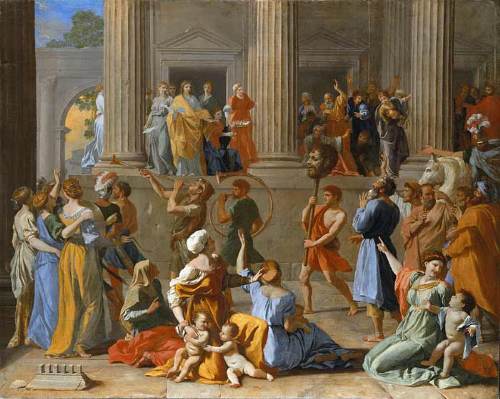
The Triumph of David. Young David holds the impaled head of the Philistine giant, Goliath,  and marches in front of King Saul, who is riding a white horse.
The Triumph of David. Young David holds the impaled head of the Philistine giant, Goliath, and marches in front of King Saul, who is riding a white horse.
During a period of illness, when the evil spirit troubled Saul, David was brought to court to soothe the king by playing on the harp. He earned the gratitude of Saul and was made an armour-bearer, but his stay at court was brief. Not long afterwards, whilst his three elder brothers were in the field, fighting under Saul against the Philistines, David was sent to the camp with some provisions and presents; there he heard the words in which the giant, Goliath of Geth, defied all Israel to single combat, and he volunteered with God’s help to slay the Philistine. His victory over Goliath brought about the rout of the enemy. Saul’s questions to Abner at this time seem to imply that he had never seen David before, though, as we have seen, David had already been at court. Various conjectures have been made to explain this difficulty. As the passage which suggests a contradiction in the Hebrew text is omitted by Septuagint codices, some authors have accepted the Greek text in preference to the Hebrew. Others suppose that the order of the narratives has become confused in our present Hebrew text. A simpler and more likely solution maintains that on the second occasion Saul asked Abner only about the family of David and about his earlier life. Previously he had given the matter no attention.
David’s victory over Goliath won for him the tender friendship of Jonathan, the son of Saul. He obtained a permanent position at court, but his great popularity and the imprudent songs of the women excited the jealousy of the king, who on two occasions attempted to kill him. As captain of a thousand men, he encountered new dangers to win the hand of Merob, Saul’s eldest daughter, but, in spite of the king’s promise, she was given to Hadriel. Michol, Saul’s other daughter, loved David, and, in the hope that the latter might be killed by the Philistines, her father promised to give her in marriage, provided David should slay one hundred Philistines. David succeeded and married Michol. This success, however, made Saul fear the more and finally induced him to order that David should be killed. Through the intervention of Jonathan he was spared for a time, but Saul’s hatred finally obliged him to flee from the court.
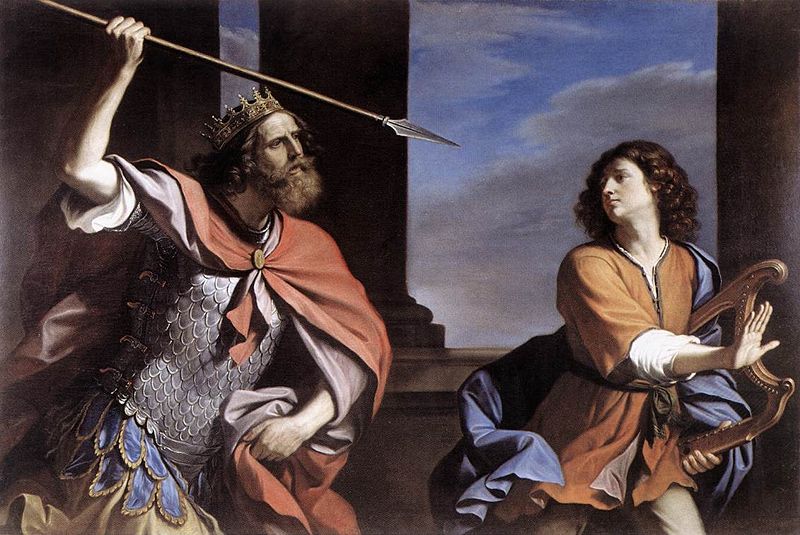
Saul Attacking David. Painting by Guercino
First he went to Ramatha and thence, with Samuel, to Naioth. Saul’s further attempts to murder him were frustrated by God’s direct interposition. An interview with Jonathan convinced him that reconciliation with Saul was impossible, and for the rest of the reign he was an exile and an outlaw. At Nobe, whither he proceeded, David and his companions were harboured by the priest Achimelech, who was afterwards accused of conspiracy and put to death with his fellow-priests. From Nobe David went to the court of Achis, king of Geth, where he escaped death by feigning madness. On his return he became the head of a band of about four hundred men, some of them his relations, others distressed debtors and malcontents, who gathered at the cave, or stronghold, of Odollam (Adullam). Not long after their number was reckoned at six hundred. David delivered the city of Ceila from the Philistines, but was again obliged to flee from Saul. His next abode was the wilderness of Ziph, made memorable by the visit of Jonathan and by the treachery of the Ziphites, who sent word to the king. David was saved from capture by the recall of Saul to repel an attack of the Philistines. In the deserts of Engaddi he was again in great danger, but when Saul was at his mercy, he generously spared his life. The adventure with Nabal, David’s marriage with Abigail, and a second refusal to slay Saul were followed by David’s decision to offer his serves to Achis of Geth and thus put an end to Saul’s persecution. As a vassal of the Philistine king, he was set over the city of Siceleg, whence he made raids on the neighbouring tribes, wasting their lands and sparing neither man nor woman. By pretending that these expeditions were against his own people of Israel, he secured the favour of Achis. When, however, the Philistines prepared at Aphec to wage war against Saul, the other princes were unwilling to trust David, and he returned to Siceleg. During his absence it had been attacked by the Amalecites. David pursued them, destroyed their forces, and recovered all their booty. Meanwhile the fatal battle on Mount Gelboe (Gilboa) had taken place, in which Saul and Jonathan were slain. The touching elegy, preserved for us in II Kings, i, is David’s outburst of grief at their death.
By God’s command, David, who was now thirty years old, went up to Hebron to claim the kingly power. The men of Juda accepted him as king, and he was again anointed, solemnly and publicly. Through the influence of Abner, the rest of Israel remained faithful to Isboseth, the son of Saul. Abner attacked the forces of David, but was defeated at Gabaon. Civil war continued for some time, but David’s power was ever on the increase. At Hebron six sons were born to him: Amnon, Cheleab, Absalom, Adonias, Saphathia, and Jethraam. As the result of a quarrel with Isboseth, Abner made overtures to bring all Israel under the rule of David; he was, however, treacherously murdered by Joab without the king’s consent. Isboseth was murdered by two Benjamites, and David was accepted by all Israel and anointed king. His reign at Hebron over Juda alone had lasted seven years and a half.
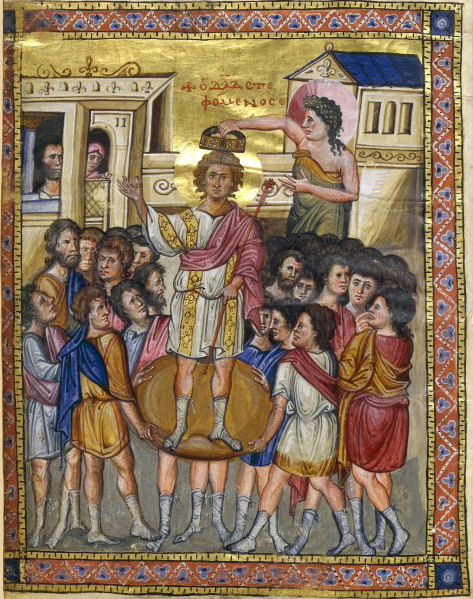
Coronation of David
Coronation of David
By his successful wars David succeeded in making Israel an independent state and causing his own name to be respected by all the surrounding nations. A notable exploit at the beginning of his reign was the conquest of the Jebusite city of Jerusalem, which he made the capital of his kingdom, “the city of David”, the political centre of the nation. He built a palace, took more wives and concubines, and begat other sons and daughters. Having cast off the yoke of the Philistines, he resolved to make Jerusalem the religious centre of his people by transporting the Ark of the Covenant (q.v.) from Cariathiarim. It was brought to Jerusalem and placed in the new tent constructed by the king. Later on, when he proposed to build a temple for it, he was told by the prophet Nathan, that God had reserved this task for his successor. In reward for his piety, the promise was made that God would build him up a house and establish his kingdom forever.
No detailed account has been preserved of the various wars undertaken by David; only some isolated facts are given. The war with the Ammonites is recorded more fully because, whilst his army was in the field during this campaign, David fell into the sins of adultery and murder, bringing thereby great calamities on himself and his people. He was then at the height of his power, a ruler respected by all the nations from the Euphrates to the Nile. After his sin with Bethsabee and the indirect assassination of Urias, her husband, David made her his wife. A year elapsed before his repentance for the sin, but his contrition was so sincere that God pardoned him, though at the same time announcing the severe penalties that were to follow. The spirit in which David accepted these penalties has made him for all time the model of penitents. The incest of Amnon and the fratricide of Absalom (q.v.) brought shame and sorrow to David. For three years Absalom remained in exile. When he was recalled, David kept him in disfavour for two years more and then restored him to his former dignity, without any sign of repentance. Vexed by his father’s treatment, Absalom devoted himself for the next four years to seducing the people and finally had himself proclaimed king at Hebron. David was taken by surprise and was forced to flee from Jerusalem. The circumstances of his flight are narrated in Scripture with great simplicity and pathos. Absalom’s disregard of the counsel of Achitophel and his consequent delay in the pursuit of the king made it possible for the latter to gather his forces and win a victory at Manahaim, where Absalom was killed. David returned in triumph to Jerusalem. A further rebellion under Seba at the Jordan was quickly suppressed.
King David, kneeling, praying to God. Jerusalem is in the background along with scenes from his life at the bottom.
At this point in the narrative of II Kings we read that “there was a famine in the days of David for three years successively”, in punishment for Saul’s sin against the Gabaonites. At their request seven of Saul’s race were delivered up to be crucified. It is not possible to fix the exact date of the famine. On other occasions David showed great compassion for the descendants of Saul, especially for Miphiboseth, the son of his friend Jonathan. After a brief mention of four expeditions against the Philistines, the sacred writer records a sin of pride on David’s part in his resolution to take a census of the people. As a penance for this sin, he was allowed to choose either a famine, an unsuccessful war, or pestilence. David chose the third and in three days 70,000 died. When the angel was about to strike Jerusalem, God was moved to pity and stayed the pestilence. David was commanded to offer sacrifice at the threshing-floor of Areuna, the site of the future temple.
The Prophet Nathan advises King David. Painting by Matthias Scheits
The last days of David were disturbed by the ambition of Adonias, whose plans for the succession were frustrated by Nathan, the prophet, and Bethsabee, the mother of Solomon. The son who was born after David’s repentance was chosen in preference to his older brothers. To make sure that Solomon would succeed to the throne, David had him publicly anointed. The last recorded words of the aged king are an exhortation to Solomon to be faithful to God, to reward loyal servants, and to punish the wicked. David died at the age of seventy, having reigned in Jerusalem thirty-three years. He was buried on Mount Sion. St. Peter spoke of his tomb as still in existence on the day of Pentecost, when the Holy Ghost descended on the Apostles (Acts, ii, 29). David is honoured by the Church as a saint. He is mentioned in the Roman Martyrology on 29 December.
The historical character of the narratives of David’s life has been attacked chiefly by writers who have disregarded the purpose of the narrator in I Par. He passes over those events that are not connected with the history of the Ark. In the Books of Kings all the chief events, good and bad, are narrated. The Bible records David’s sins and weaknesses without excuse or palliation, but it also records his repentance, his acts of virtue, his generosity towards Saul, his great faith, and his piety. Critics who have harshly criticized his character have not considered the difficult circumstances in which he lived or the manners of his age. It is uncritical and unscientific to exaggerate his faults or to imagine that the whole history is a series of myths. The life of David was an important epoch in the history of Israel. He was the real founder of the monarchy, the head of the dynasty. Chosen by God “as a man according to His own heart”, David was tried in the school of suffering during the days of exile and developed into a military leader of renown. To him was due the complete organization of the army. He gave Israel a capital, a court, a great centre of religious worship. The little band at Odollam became the nucleus of an efficient force. When he became King of all Israel there were 339,600 men under his command. At the census 1,300,000 were enumerated capable of bearing arms. A standing army, consisting of twelve corps, each 24,000 men, took turns in serving for a month at a time as the garrison of Jerusalem. The administration of his palace and his kingdom demanded a large retinue of servants and officials. Their various offices are set down in I Par., xxvii. The king himself exercised the office of judge, though Levites were later appointed for this purpose, as well as other minor officials.
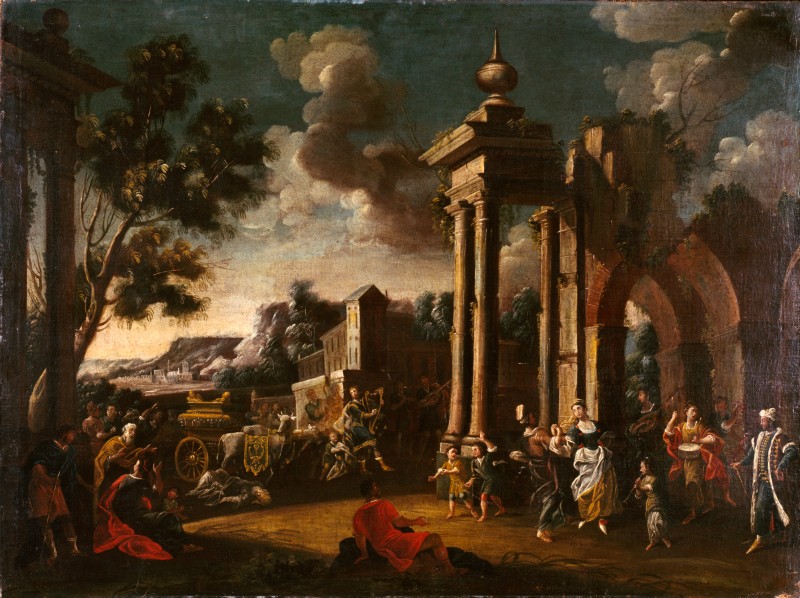
David playing the harp in from of the Arc. Painting by Viso Nicolò, part of the Artgate Cariplo Foundation.
When the Ark had been brought to Jerusalem, David undertook the organization of religious worship. The sacred functions were entrusted to 24,000 Levites; 6,000 of these were scribes and judges, 4000 were porters, and 4000 singers. He arranged the various parts of the ritual, allotting to each section its tasks. The priests were divided into twenty-four families; the musicians into twenty-four choirs. To Solomon had been reserved the privilege of building God’s house, but David made ample preparations for the work by amassing treasures and materials, as well as by transmitting to his son a plan for the building and all its details. We are told in I Par. how he exhorted his son Solomon to carry out this great work and made known to the assembled princes the extent of his preparations.
The prominent part played by song and music in the worship of the temple, as arranged by David, is readily explained by his poetic and musical abilities. His skill in music is recorded in I Kings, xvi, 18 and Amos, vi, 5. Poems of his composition are found in II Kings, i, iii, xxii, xxiii. His connection with the Book of Psalms, many of which are expressly attributed to various incidents of his career, was so taken for granted in later days that many ascribed the whole Psalter to him. The authorship of these hymns and the question how far they can be considered as supplying illustrative material for David’s life will be treated in the article PSALMS.


David was not merely king and ruler, he was also a prophet. “The spirit of the Lord hath spoken by me and his word by my tongue” (II Kings, xxiii, 2) is a direct statement of prophetic inspiration in the poem there recorded. St. Peter tells us that he was a prophet (Acts, ii, 30). His prophecies are embodied in the Psalms he composed that are literally Messianic and in “David’s last words” (II K., xxiii). The literal character of these Messianic Psalms is indicated in the New Testament. They refer to the suffering, the persecution, and the triumphant deliverance of Christ, or to the prerogatives conferred on Him by the Father. In addition to these his direct prophecies, David himself has always been regarded as a type of the Messias. In this the Church has but followed the teaching of the Old Testament Prophets. The Messias was to be the great theocratic king; David, the ancestor of the Messias, was a king according to God’s own heart. His qualities and his very name are attributed to the Messias. Incidents in the life of David are regarded by the Fathers as foreshadowing the life of Christ; Bethlehem is the birthplace of both; the shepherd life of David points out Christ, the Good Shepherd; the five stones chosen to slay Goliath are typical of the five wounds; the betrayal by his trusted counsellor, Achitophel, and the passage over the Cedron remind us of Christ’s Sacred Passion. Many of the Davidic Psalms, as we learn from the New Testament, are clearly typical of the future Messias.
JOHN CORBETT (Catholic Encyclopedia)

Monday, December 28, 2015

Feast of the Holy Innocents

When the Magi arrived in Judea seeking the newborn “king of the Jews” (Matt. 2:1-2), King Herod was worried. After ascertaining in Scriptures that Bethlehem was the likely birthplace of the Child, he met with the Wise Men. The crafty king bid them go to Bethlehem and bring him back details so he could also adore the new king.

But God Who sees into the hearts of men, warned the three Magi in a dream not to return by way of King Herod. Far from wishing to adore Christ Jesus, the tetrarch wished to destroy Him.

Realizing that he had been found out, Herod raged and ordered all little boys, two years of age and under, to be slaughtered in Bethlehem and its surroundings, hoping thus, to also destroy the Child Jesus.

But warned in time by an angel, St. Joseph had gathered the mother and child and fled to Egypt. Thus was fulfilled the prophecy of the Prophet Jeremiah: “A voice in Rama was heard, lamentation and great mourning, Rachel bewailing her children, and would not be comforted, because they are not.” (Matt.2:17-18).

The Church considers those slaughtered babes, the first martyrs, since they shed their blood because of Christ. The Church officially honors their martyrdom on December 28. Several churches in Rome and throughout Europe claim to house their relics.

Thursday, December 24, 2015

Saints of the Day

Sts. Irmina and Adela

Princesses Irmina and Adela were daughters of St. Dagobert II, King of the Francs. Their father had acceded to the throne at the age of seven but had been deposed soon after and had fled to Ireland for safety. During his exile he married the Anglo-Saxon princess, Matilda, and had five children, among them Adela and Irmina. He returned to the Frankish capital of Metz in 673 and reclaimed the throne.

Irmina was betrothed to Count Herman but he was assassinated shortly before they were to marry and she professed her desire to embrace the religious life instead. King Dagobert restored a convent at Horren in Trier where she founded a Benedictine community. When a deadly plague threatened her sisters, she sought the help of St. Willibrord. In gratitude for being preserved from this pestilence, she provided the manor where the monastery of Echternach was founded in 698. Her devotion to the poor led to her being honored as a saint after her death in the year 710.

Her sister, Adela, was married to Alberic and they had a son prior to her husband’s untimely death. Despite many marriage offers, the young widow chose to enter religion as well. She founded the convent of Palatiolum outside of Trier on lands that were then undeveloped and governed it as Abbess for many years until her death on December 24, 735. The monastic site later grew into the town of Pfalzel. Her son became the future father of St. Gregory of Utrecht.

The memory of the two royal sisters and foundresses is celebrated jointly on December 24.

Quote of the Day

The Son of God was not satisfied with promising to redeem us or with becoming Man.
But He willed to come into this world in a manner not at all consistent with His grandeur.
He came as humbly as can be imagined so that we might be more free to approach Him.

St. Louise de Marillac

Wednesday, December 23, 2015

I went shopping and was shocked with how people struggle to say “Merry Christmas”

Christmas Campaign Central

   I just went shopping and once again was shocked with how many people are struggling with saying Merry Christmas. I almost had to beg the clerk to wish me Merry Christmas.
   It is absolutely CRAZY!
   Let me ask you this. Did you read what happened in Paris last month? And all the subsequent reports?  Have you heard the reports that have come out regarding the San Bernardino killings?
   These are rhetorical questions because I know you have. So let me put this to you: fanatical Islamic people are getting more radical and bloodier by the minute and there is even a supposed fight between Al Qaeda and ISIS…  ISIS accuses Al Qaeda of being too soft.
   I guess they don’t decapitate as many people or something…
   But my point is this. While all this is going on, we here in America are becoming less Christian. We are giving up our Faith.
   I happen to have some Italian blood in me and I feel like crying out from the rooftops: WE CAN’T EVEN SAY MERRY CHRISTMAS ANYMOOOOOOOORE!
   Why do some store owners feel the need to forbid their employees of saying Merry Christmas? Because we are going to offend someone? Or because they fear losing some business?
   Are we selling Jesus for 30 pieces of silver or what?
   Anyway… I personally believe that if a store owner would put a sign outside that read, “In this store we wish our customers Merry Christmas” I believe they would get even more business.
   ....but this whole thing only makes America weaker. This is why we must fight for Christmas. Click and see what you can do:
Christmas Campaign Central
   I came across a poem which I think will help drive the point home. I know I am preaching to the choir here but wanted to share it with you. It is an inscription in an old Cathedral in Germany, city of Lubeck.
You call Me Master and obey me not,
You call Me Light and see Me not,
You call Me Way and walk Me not,
You call Me Life and desire Me not,
You call Me wise and follow Me not,
You call Me fair and love Me not,
You call Me rich and ask Me not,
You call Me eternal and seek Me not,
You call Me gracious and trust Me not,
You call Me noble and serve Me not,
You call Me mighty and honor Me not,
You call Me just and fear Me not,
If I condemn you, blame Me not.
   Evil wins when good men do nothing! We must fight the war to defend Christmas and Christianity.
   And here is why, a) because it does make a difference. Without knowing it we can have a real impact on others, b) we glorify God and show Him by our actions that we truly love Him.
   It is always important to be very calm, peaceful and respectful in the way we do things; but one good word at the right moment can make a big difference.
   I invite you to visit our Christmas Campaign Central page.  Many have found it to be a source of ideas and inspiration.
Christmas Campaign Central – Click here
   Meanwhile, a loud and clear Merry Christmas to you. May Jesus and Mary protect you and protect our country from terrorists and pagans alike! 
   I wish you a Christmas filled with blessings and lots of cheer.
   In the times we live, Christmas comes as a break from all the modern madness, a time when we remember and experience that in Christ we find the peace, the joy and the love that our souls long for and which the world knows not!

Saint of the Day

St. John of Kanti

Born on June 23, 1390, John Cantius takes his name from the town of his birth, Kanti, Poland.

Country people of some means, his parents saw early on that John was as clever as he was good. At the right time, they sent him to the University of Cracow where he received degrees, was ordained a priest and appointed to a professorship.

Leading a strict ascetic life, when warned about his health, he was wont to reply that the fathers of the desert usually lived to a ripe old age.

Such was his success as a teacher and preacher that inevitably envy reared its ugly head against him. Removed from his post, he was appointed parish priest of Olkusz. Although he gave his all to his new assignment – not without some trepidation – his parishioners did not like him at first; however, he persevered for several years and won his people’s hearts.

Recalled to the University of Cracow, St. John was appointed professor of Sacred Scriptures, a post he held until his death.  He was as welcome a guest at the houses and tables of the nobility as he was well-known to all the poor in the city. Whatever he owned was always at their disposition.

A number of miracles were attributed to him during his life. When people heard that he was dying, their sorrow was genuine and general. To those who ministered to him on his death bed he said, “Never mind about this prison that is decaying, but think of the soul that is going to leave it.”

He died on Christmas Eve of the year 1473. He was eighty-three years of age. John of Kanti or Cantius, as he is sometimes called, was canonized in 1767.

(from AmericaNeedsFatima.org)

Friday, December 18, 2015

One Christmas Eve and a Flock of Geese

One wintry evening somewhere in the Northern Hemisphere, as the sun slowly set on the horizon, its last rays tinting the snowy scene, one small cottage nestled in the rolling hills. Its chimney sent up a steady stream of smoke, mingling with the descending snow-flakes.
Inside, by the lit hearth, sat a silver-haired woman, a Bible on her knee. It was Christmas Eve, and she read a passage about the first Christmas night. Intermittently she muttered,
“I don’t understand, Lord...” I don’t understand…”
And again she bent over the weathered pages.
Presently, laying down the holy book on a side table, stoking the fire, and adding another log, she leaned back into the leather chair and closed her eyes, her mind reconstructing the scene: a lonely stable in an Oriental prairie, a clear, cold night, a dignified man, a princely maiden, an ox and a donkey, and, in their midst, laying in a troth, lovingly filled with fresh hay, a babe who was God. Wintry Cottage
“Why, o, why did You, Lord, who are the Almighty, the Creator, infinitely above your creatures, become a man like us? Wasn’t there some other way?” the good soul now asked aloud, as she looked up at the crucifix above her fire place.
Just then a noisy racket jolted her from her revelry. Looking out the window, in the waning light, she saw a flock of geese just landed in the back yard. They were obviously off-course and quacked in confusion.
“Those geese!” she thought with alarm, “they will freeze!” Of course, geese don’t freeze easily, but she didn’t know it.
Running into her old garage, she opened the door and began waving them in. But the more she beckoned the more the frightened creatures distanced themselves from her.
Finally in frustration she exclaimed,
“If only I was one of you, you foolish creatures, you would trust me, and I could save you!” 
It had stopped snowing. Just then the leaden clouds parted, revealing a patch of azure sky and a bright star twinkling down on the snowy earth. The woman smiled up into the night, 
“I get it, Lord, I get it…Thanks for becoming a man like us so you could convince us to come in from the cold …”
By A.F. PhillipsPainting by: Botaurus
(from America Needs Fatima site)

Wednesday, December 16, 2015

The Story of the World's Most Beloved Christmas Carol


Silent Night, the Christmas carol that has spread all over the world, translated into more than forty-five languages, began in a small town in Austria.
In 1816, a young Fr. Joseph Mohr, wrote the verses, some say inspired one Christmas night as he returned from visiting a family with a newborn babe high up in the Alpine hills.
When assigned as co-pastor to the charming village of Oberndorf in 1818, he looked for his friend, Franz Gruber, choir master, who set the inspired verses to a simple tune on his guitar.
At Midnight Mass that Christmas, the small church of St. Nicholas in Oberndorf resounded to the first strains of Silent Night. The two men who brought the song into being, could hardly have imagined that day, in a small snow-covered village in Austria, how their song would make the rounds of the world.


Divine Providence had a plan.
One day, an organ master from the Tyrol was called to Oberndorf to fix the church’s organ. When finished, he invited Franz Gruber to try out the keys, and the choir master played the new song. Enthralled by the attractive, simple “heavenliness” of the tune, the organ master took Silent Night back with him to his province.
There, families of young singers, similar to the Von Trapp Family, avidly picked up the new song, and carried it throughout Europe.
Noticing that the mere first strains of the melody gathered a crowd, the little song became a favorite in their repertoire, winding its way even into courts.
Its origin having been lost, it was soon known as “The Song from Heaven”.
Finally, King Frederick William IV of Prussia, whose favorite Carol it had become, wishing to obtain the song in its purest format, insisted that the history of Silent Night be traced.
After a long search, Frederick’s emissaries were finally led to St. Peter’s Abbey in Salzburg, from whence the connection was made to Oberndorf. There, they found Franz Gruber advanced in age, who gladly confirmed the song’s origins.
Thus, the little tune penned by an unknown priest, and a village musician, conquered the world by a quiet storm. Indeed, wherever and whenever Silent Night is sung or played, hearts are quieted and spirits are lifted–after all, who says it isn’t “The Song from Heaven”?


References: 
http://silentnight.web.za/history/
https://alemanhaeinfach.wordpress.com/2010/12/09/noite-feliz-origem-da-musica-de-natal-mais-famosa-do-mundo/
Wikipedia
Crusade Magazine

Saturday, December 5, 2015

Today is First Saturday

The Five First Saturdays devotion is one of the principal points of the Fatima message. It centers on the urgent need for mankind to offer reparation and expiate for the many injuries that the Immaculate Heart of Mary suffers from the hands of both impious and indifferent men.

1st Five Saturdays Devotion Card Banner

History
During the third apparition on July 13, 1917, Our Lady revealed that she would come to ask for the consecration of Russia to her Immaculate Heart and for the Communion of Reparation of the Five First Saturdays. Consequently, she asked for the devotion in 1925 and the consecration in 1929.
While staying at the House of the Dorothean Sister in Pontevedra, Portugal, Sister Lucia received a vision on December 10, 1925 where the Blessed Mother appeared alongside a Boy who stood over a luminous cloud. Our Lady rested one hand on the Boy’s shoulder while she held on the other hand a heart pierced with thorns around it.
Sister Lucia heard the Boy say, "Have pity on the Heart of your Most Holy Mother which is covered with thorns with which ingrate men pierce it at every moment with no one to make an act of reparation to pull them out."
Our Lady expressed her request in the following words,
"See, my daughter, My Heart surrounded with thorns with which ingrates pierce me at every moment with blasphemies and ingratitude. You, at least, make sure to console me and announce that all those who for five months, on the first Saturdays, go to confession, receive Communion, say five decades of the Rosary and keep me company for 15 minutes meditating on the mysteries of the Rosary, with the purpose of making reparation to Me, I promise to assist them at the hour of death with all the graces necessary for the salvation of their souls."
A few days afterward, Sister Lucia detailed this vision in a letter addressed to Monsignor Manuel Pereira Lopes, her confessor when she resided in the Asylum of Vilar in the city of Oporto, Portugal.


Why Five Saturdays?     
Sister Lucia’s confessor questioned her about the reason for the five Saturdays asking why not seven or nine. She answered him in a letter dated June 12, 1930. In it she related about a vision she had of Our Lord while staying in the convent chapel part of the night of the twenty-ninth to the thirtieth of the month of May, 1930. The reasons Our Lord gave were as follows:
The five first Saturdays correspond to the five kinds of offenses and blasphemies committed against the Immaculate Heart of Mary. They are:
  a.    Blasphemies against the Immaculate Conception
  b.    Blasphemies against her virginity
  c.    Blasphemies against her divine maternity, at the same time the refusal to accept her as the Mother of all men
  d.    Instilling , indifference, scorn and even hatred towards this Immaculate Mother in the hearts of children
  e.    Direct insults against Her sacred images
Let us keep the above reasons firmly in our minds. Devotions have intentions attached to them and knowing them adds merit and weight to the practice.

Modifications to the Five First Saturdays Devotion to facilitate its observation
The original request of Our Lady asks one to confess and receive Communion on five consecutive first Saturdays; to say five decades of the Rosary; to meditate during 15 minutes on the mysteries of the Rosary for the purpose of making reparation to the Immaculate Heart of Mary in reparation for the sins of men.
In subsequent private visions and apparitions however, Sister Lucia presented to Our Lord the difficulties that devotees encountered in fulfilling some conditions. With loving condescension and solicitude, Our Lord deigned to relax the rules to make this devotion easy to observe:
  • Confession may be done on other days other than the First Saturdays so long as one receives Our Lord worthily and has the intention of making reparation to the Immaculate Heart of Mary.
  • Even if one forgets to make the intention, it may be done on the next confession, taking advantage of the first occasion to go to confession.
  • Sister Lucia also clarified that it is not necessary to meditate on ALL mysteries of the Rosary on each First Saturdays. One or several suffice.
With much latitude granted by Our Lord Himself, there is no reason for the faithful to hesitate or delay this pious practice in the spirit of reparation which the Immaculate Heart of Mary urgently asks.

This devotion is so necessary in our days
The culture of vice and sin remains unabated even as one reads this. Abortion, blasphemy, drug abuse, pornography, divorce and bad marriages, religious indifference, the advances of the homosexual agenda and others are just some of society’s many plagues that cut deeply into the Immaculate Heart of Mary.
We must console Our Lady amidst all these insults and injuries to her and her Divine Son. She asks for reparation, she pleads for our prayers, she hopes for our amendment of life. Let us listen to her maternal pleas and atone for the ingratitude of men.
The First Five Saturdays devotion stimulates the spirit of reparation; it instills a tender love for the Holy Sacraments of Confession and the Blessed Eucharist. It nurtures a holy affection for the Immaculate Heart of Mary and the Rosary. Above all, it is an excellent means to maintain one in the state of grace while immersed in the daily spiritual battles and prosaic existence in the neo-pagan world that we live in.
Let us not delay in observing this devotion for it too gives us hope for eternal salvation.


REFERENCE:
Solimeo, Luiz Sergio, Fatima, A Message More Urgent than Ever 
(Spring Grove, PA: The American Society for the Defense of Tradition, Family, and Property-TFP, 2008.)
  
1st Five Saturdays Devotion Card Banner