Monday, September 12, 2016

Feast of the Most Holy Name of Mary

“God the Father gathered all the waters together and called them the sea – mare. He gathered all his graces together and called them Mary – Maria,” writes the great Marian apostle St. Louis Marie de Montfort in his renowned work, Treatise on True Devotion to Mary.

The feast of the Most Holy Name of Mary was first celebrated in Spain in 1513. Granted by Pope Julius II to the diocese of Cuenta in Spain, it was assigned the date of September 15, the octave day of Our Lady's Nativity, on the papal calendar. The feast was extended to all of Spain and the Kingdom of Naples In 1671.

In 1683, Vienna was besieged by Turkish invaders. Jan Sobieski, the devout King of Poland, came to the assistance of Vienna with an army that was vastly outnumbered by that of Mustapha. Early on the morning of September 12, having himself served at Holy Mass, the King entrusted himself and his army to the Virgin Mary, imploring her blessing upon himself and his troops and her assistance in the upcoming conflict. Then rising from his knees, the "Northern Lion," as he was called by the Turks, said aloud: “Let us now march to the enemy with an entire confidence in the protection of heaven, under the assured patronage of the Blessed Virgin.” And charging upon the enemy camp, they defeated and routed the Muslims completely. The Turkish forces were overwhelmed and Vienna was saved under the banner of Mary Most Holy.

In a letter to Pope Innocent XI announcing the victory of the Christian army over the Muslims at the gates of Vienna, King Jan SobieskI immediately attributed the victory to God and not to his own efforts, and paraphrased the words of Julius Caesar: “Veni, vidi, Deus vicit” – "I came, I saw, God conquered!" In commemoration of this glorious victory over the Muslims, and in thanksgiving to God and honor to Our Lady for Their aid, Pope Innocent XI extended the feast of the Holy Name of Mary to the Universal Church that same year.

Although the feast was originally celebrated on September 15, in 1911 Pope St. Pius X decreed that it be celebrated on September 12.

Sunday, September 11, 2016

How to govern the world

A man who governs his passions
is master of his world.
We must either command them or
be enslaved by them.
It is better to be a hammer than an anvil.

St. Dominic de Guzman

St. Paphnutius

After spending many years in the desert under the direction of St. Anthony, Paphnutius, the holy confessor of Egypt, was made a bishop. Paphnutius suffered persecution under the rule of Emperor Maximinus, which is said to have been the bloodiest persecution of Christians during the Roman Empire. After his right eye was gouged out, and his left knee hamstrung and mutilated, the bishop was condemned to work in the mines for refusing to comply with traditional Roman religious practices.

When the persecutions ended about the year 313, Paphnutius returned to his priestly duties, bearing forever the evidence of his sufferings. He was most ardent in defending the Catholic faith against the Arian heresy. As one who had confessed the Faith before persecutors and under torments, he was an outstanding figure of the first General Council of the Church, held at Nicaea in the year 325. He died about 350.

The Important Lessons of 9/11

On the anniversary of the 9/11 terrorist attacks, it is fitting that we reflect on what has changed in America. The Important Lessons of 9/11: http://ow.ly/lDbz303L1ai.

Saturday, September 10, 2016

The Rosary, the Devil and the Queen

In his book, The Secret of the Rosary, St. Louis de Montfort relates that Blessed Thomas of St. John was a great devotee of the Holy Rosary of the Blessed Virgin Mary. As such, he was known for his powerful, moving sermons on the Rosary, which led people to adopt this devotion to their great benefit.
Furiously jealous of the holy man’s success with souls, the devil began to so torture Thomas that he fell sick, and was so ill for so long that the doctors gave up on saving his life.
One night, when the poor man thought he was near death, the devil appeared to him in a hideous form, coward that he is, seeking to frighten Thomas into despair.
But, making an effort, the good priest turned to a beautiful picture of Our Lady near his bed crying out with all his heart and strength:
“Help me, save me, my sweet, sweet Mother!”
No sooner had he pronounced these words, the picture came alive and extending her hand, the heavenly Lady laid it reassuringly on the priest’s arm, saying:
“Do not be afraid, Thomas my son, here I am and I am going to save you. Get up now and go on preaching my Rosary as you did before. I promise to shield and protect you from your enemies.”
No sooner had Our Lady pronounced these words, than the devil fled in a hurry. Getting up, Thomas found that he was perfectly healed.
Thanking the Blessed Mother with tears of joy, Blessed Thomas again went about preaching the Holy Rosary, now with renewed favor and gumption, and his apostolate and his sermons were enormously successful.
St. Louis the Montfort concludes this story saying, “Our lady not only blesses those who say her Rosary, but also abundantly rewards those who, by their example, inspire others to say it as well.”

What is the first step downward in the average soul?

No soul ever fell away from God without giving up prayer.
Prayer is that which establishes contact with Divine Power and opens
the invisible resources of heaven.
However dark the way, when we pray, temptation can never master us.
The first step downward in the average soul is the giving up of the practice of prayer,
the breaking of the circuit with divinity,
and the proclamation of one’s owns self sufficiency.

Archbishop Fulton J. Sheen

St. Nicholas of Tolentino

In the small Italian town of Sant’ Angelo, a couple prayed for a child at the shrine of St. Nicholas of Bari. They prayed for a son and promised to dedicate him to God if their prayers were answered. In the Spring of 1245, Nicholas was born.

When he was still very young, Nicholas received the minor orders of the secular clergy in fulfillment of his parents' holy promise. However, he wished to dedicate more time and energy to God’s work, and in the year 1264 he was accepted by the Augustinian Friars. By 1270, he had been ordained a priest. He soon became renowned for his generosity and the miraculous cure of a blind woman. He performed his priestly duties in many different houses of the Order. Once, thinking to remain at a monastery near Fermo, he heard a voice calling to him whilst he was praying: “To Tolentino, to Tolentino. Persevere there.” Without hesitation, Nicholas left for Tolentino.

He spent the remaining thirty years of his life preaching on the streets of Tolentino, converting criminals, comforting the dying and caring for the sick – sometimes miraculously curing them. He died in 1305 after a year-long illness. Petitions for his canonization began immediately. Pope Eugene IV canonized him in 1446, and his relics were rediscovered in 1926 at Tolentino.

Friday, September 9, 2016

Helpful tip to reach perfection

Man’s salvation and perfection
consists of doing the will of God
which he must have in view in all things,
and at every moment of his life.

St. Peter Claver

St. Peter Claver

Peter was born in 1581 in Catalonia in Spain. He joined the Society of Jesus when he was twenty, and was sent to further his studies at the college of Montesione in Majorca. There he met St. Alphonsus Rodriguez, who predicted Peter would go to the West Indies and save souls. At his request, in 1610 he was sent to the South-American port city of Cartagena in modern-day Colombia, to complete his theological studies, and was there ordained to the priesthood in 1615.

At the time, Cartagena was the main slave market of the New World. Africans by the thousands were being shipped in from the Congo and Angola and it was estimated that one third of them died in transit due to their harsh treatment and the foul conditions of the voyage. Other Jesuits had been working among them prior to Peter’s arrival in 1610, but whereas they visited the slaves where they worked, Peter met them at the wharf. Most often he boarded the slave ships before they even docked, going down into their filthy and disease-ridden holds to treat the terror-stricken human cargo. Infants and the dying, he would baptize immediately; to the others he offered food, clothing and medical assistance; with the help of interpreters, he taught them about the sacraments and how to pray, educating them in the Catholic faith before baptizing them. In the course of forty years, Peter instructed and baptized over 300,000 slaves.

When making his solemn profession as a Jesuit religious in 1622, Peter signed the document in Latin as was the custom, and added the phrase, “aethiopum semper servus” – servant of the Ethiopians (i.e. the Africans ) – after his name, thereby making his total dedication to them official in the eyes of God as well as in fact. His missionary zeal and dedication embraced every form of misery. There were two hospitals in Cartagena at the time, one housed general patients and the other lepers and those suffering from St. Anthony’s Fire, an illness that produced infected boils, seizures and spasms, diarrhea, parenthesis, itching, mania, nausea and vomiting. He became renowned for his miracles, and converted many with his kind and caring ways.

Peter spent himself unstintingly and truly became the Apostle of Cartagena. In 1650 he fell gravely ill, and four years later on September 8, the birthday of Our Lady, he died, the last years of his life spent in his cell because his body never fully recovered from illness. He was canonized in 1888 by Pope Leo XIII and declared patron of all missionary work among the Africans by the same pope in 1896.

Thursday, September 8, 2016

Today, sorrow turns into joy

The day of the Nativity of the Mother of God
is a day of universal joy,
because through the Mother of God,
the entire human race was renewed,
and the sorrow of the first mother, Eve,
was transformed into joy.

St. John Damascene

Nativity of the Blessed Virgin Mary

Many days passed before Almighty God finally completed the masterpiece of His creation. For nine months, the soul of Mary had given form to her virginal body, and the hour, the moment, of her joyful birth approached. As the suffocating Palestinian summer neared its end, the mellowing sun poured abundant torrents of golden light on the opulent plain of Samaria, ripening the rich orchards of autumn fruit. On a magnificent September day, with nature adorned in radiant beauty, the most Holy Virgin came into the world in the white-walled city of Nazareth.

She was probably born in the same house where the great mystery of the Incarnation later took place and where Jesus spent most of His childhood and youth in work and prayer. The angels did not acclaim the coming of the glorious Queen with hymns of joy as they later did the birth of the Savior. Invisible to the eyes of mortal men, the angels considered it an honor to mount guard around the humble crib over which Saints Joachim and Anne lovingly watched. The prophecy of Isaiah had come to pass. The root of Jesse, ten centuries removed, had sprouted a new branch. On this same branch in but a few years more would blossom the eternal Flower, the Incarnate Word.

The day the Queen of Heaven was born ranks as one of the most beautiful in history since it announced to condemned mankind the long-awaited time of liberation. The birth of Mary begins the work of Redemption. In her crib, the mother of the Savior illuminates the desolate earth with the grace of her first smiles. Jesus will soon appear and, with His Precious Blood, will erase the sentence of our condemnation. The world which has suffered so much from the ravages of sin will finally delight in the joy of liberty and peace. Slavery will everywhere be abolished, and human dignity will henceforth be respected. Like a flowing stream, graces will spring forth in abundance from the sacraments. We have but to approach and draw from them — without limit — pardon, courage, and life everlasting.

The God who hid in Paradise will descend to earth and never abandon mankind. After His Ascension, Our Lord will remain among us under the Eucharistic veil until the end of time. Christ will visibly reign over the glorious souls of the resurrected elect. Such are the great joys the birth of Mary announces. “Thy nativity, O Virgin Mother of God has announced joy to the whole world.”

According to certain traditions, no one in the small town of Nazareth where Saints Joachim and Anne lived paid heed to the new arrival. Although the blood of King David flowed in her veins, her family had fallen from its ancient splendor. Who noticed these impoverished people?

Anne and Joachim had been childless for many years, but the Lord had at last answered their prayers. They saw their daughter Mary as the measure of His celestial goodness to them. Little did they suspect, however, the veritable treasures the Most High had instilled in the soul of their child. They could not have imagined the wonder of her Immaculate Conception. They did not realize that the Mother of the Redeemer now lay in their loving arms.
The Jews of the time were plunged in discouragement. The voice of the prophets had not been heard for years. Having lost their political freedom, they believed Divine Providence had abandoned them.

It was then that the hidden work of infinite Mercy began to be accomplished in their midst.

If only the obscurity of Our Lady’s birth would teach us to make little of human greatness! Let us keep a Christian perspective of indifference toward the fleeting vanities that Christ Himself shunned in His Mother’s birth. Were these important, surely He would not have refused them to His mother.

This great mystery also teaches us never to lose heart. The Immaculate Mother came into the world at a time when the Jews had lost hope. Indeed, they thought all was lost. Let us reap the benefit of this lesson. We often become discouraged when, calling on heaven to assist us, our request is not immediately granted. Sometimes God waits until we are on the brink of the abyss before extending His hand of mercy. So, let us not become discouraged and cease praying! The Almighty will intervene at the very moment when we believe ourselves completely abandoned. If we have confidence — an unlimited supply of confidence — we will be greatly rewarded!

Wednesday, September 7, 2016

Celebrate Our Lady’s birthday Sept. 8th – Learn all about her ancestry

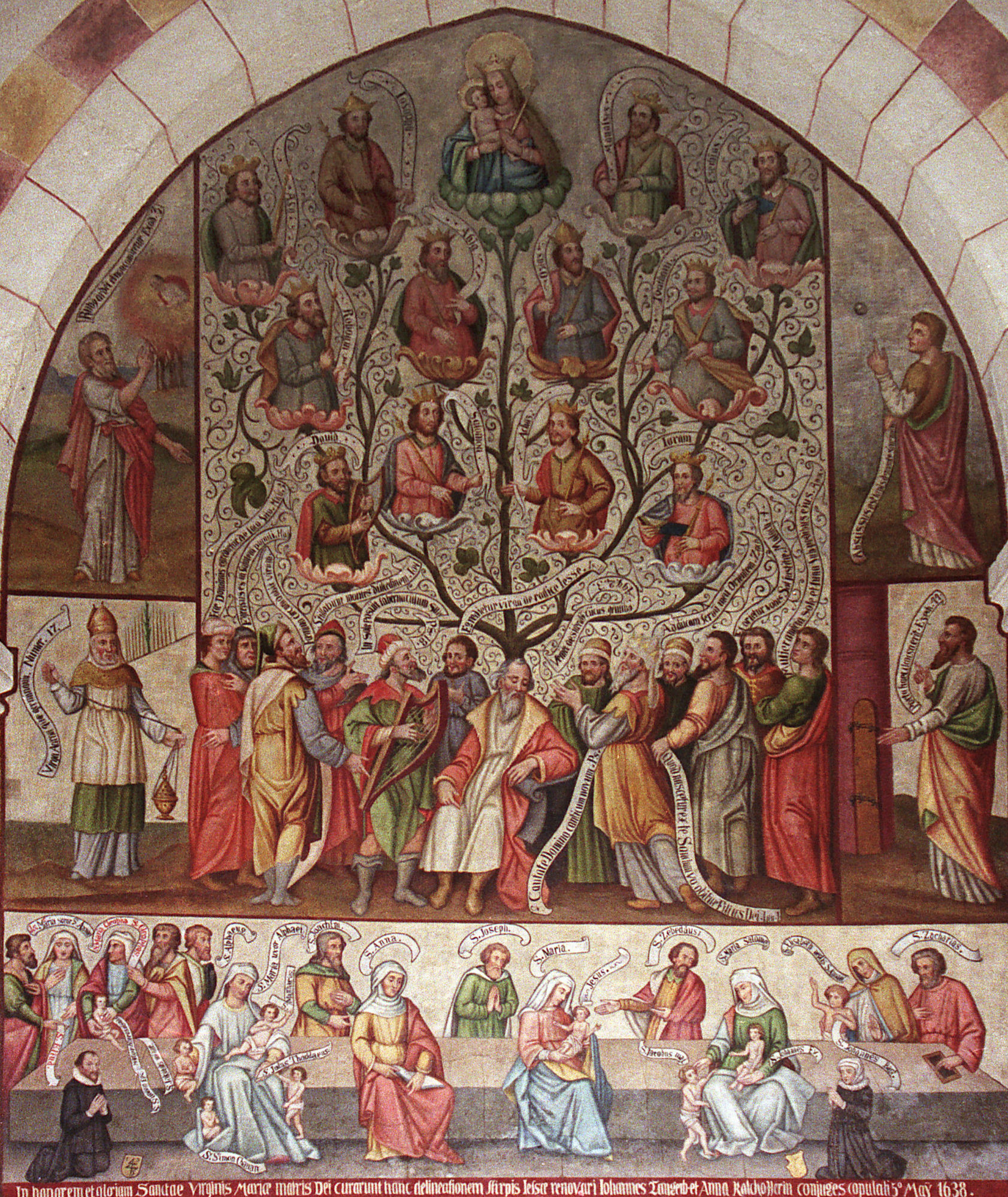
Painting from the Cathedral at Limburg showing the genealogy of Our Lady and Our Lord, also known as the Tree of Jesse.

Painting from the Cathedral at Limburg showing the genealogy of Our Lady and Our Lord, also known as the Tree of Jesse.
St. Luke (2:4) says that St. Joseph went from Nazareth to Bethlehem to be enrolled, “because he was of the house and family of David”. As if to exclude all doubt concerning the Davidic descent of Mary, the Evangelist (1:32, 69) states that the Child born of Mary without the intervention of man shall be given “the throne of David His father”, and that the Lord God has “raised up a horn of salvation to us in the house of David his servant”. [1]
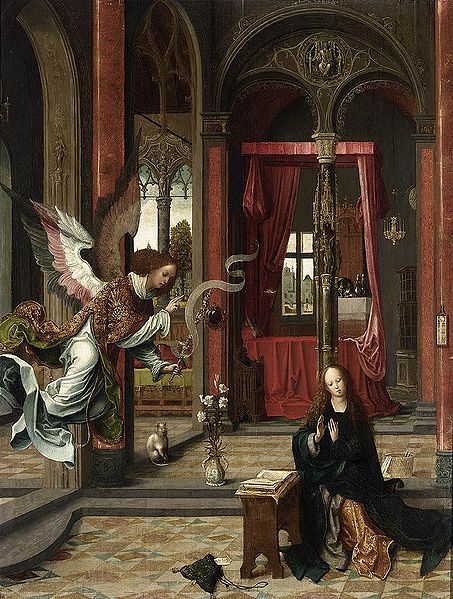
Annunciation
St. Paul too testifies that Jesus Christ “was made to him [God] of the seed of David, according to the flesh” (Romans 1:3). If Mary were not of Davidic descent, her Son conceived by the Holy Ghost could not be said to be “of the seed of David”. Hence commentators tell us that in the text “in the sixth month the angel Gabriel was sent from God…to a virgin espoused to a man whose name was Joseph, of the house of David” (Luke 1:26-27); the last clause “of the house of David” does not refer to Joseph, but to the virgin who is the principal person in the narrative; thus we have a direct inspired testimony to Mary’s Davidic descent. [2]
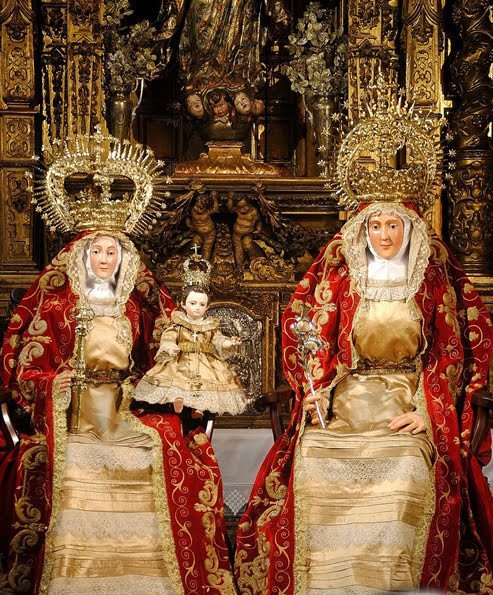
St. Anne, Our Lady and the Infant Jesus. Statue in Triana, Seville, Spain.
While commentators generally agree that the genealogy found at the beginning of the first Gospel is that of St. Joseph, Annius of Viterbo proposes the opinion, already alluded to by St. Augustine, that St. Luke’s genealogy gives the pedigree of Mary. The text of the third Gospel (3:23) may be explained so as to make Heli the father of Mary: “Jesus…being the son (as it was supposed of Joseph) of Heli”, or “Jesus…being the son of Joseph, as it was supposed, the son of Heli” (Lightfoot, Bengel, etc.), or again “Jesus…being as it was supposed the son of Joseph, who was [the son-in-law] of Heli” [3]. In these explanations the name of Mary is not mentioned explicitly, but it is implied; for Jesus is the Son of Heli through Mary.
[1] cf. Tertullian, de carne Christi, 22; P.L., II, 789; St. Aug., de cons. Evang., II, 2, 4; P.L., XXXIV, 1072.
[2] Cf. St. Ignat., ad Ephes, 187; St. Justin, c. Taryph., 100; St. Aug., c. Faust, xxiii, 5-9; Bardenhewer, Maria Verkundigung, Freiburg, 1896, 74-82; Friedrich, Die Mariologie des hl. Augustinus, Cöln, 1907, 19 sqq.
[3] Jans., Hardin., etc.

The works treating the various questions concerning the name, the birth, the life, and the death of Mary, have been cited in the corresponding parts of this article.
We add here only a few names of writers, or of collectors of works of a more general character: BOURASSE, Summa aurea de laudibus B. Mariae Virginis, omnia complectens quae de gloriosa Virgine Deipara reperiuntur (13 vols., Paris, 1866); KURZ, Mariologie oder Lehre der katholischen Kirche uber die allerseligste Jungfrau Maria (Ratisbon, 1881); MARACCI, Bibliotheca Mariana (Rome, 1648); IDEM, Polyanthea Mariana, republished in Summa Aurea, vols IX and X; LEHNER, Die Marienerehrung in den ersten Jahrhunderten (2nd ed., Stuttgart, 1886).
A.J. MAAS (Catholic Encyclopedia)
Our Lord Jesus Christ was a prince from the House of David. True, he toiled as a cabinet maker in Nazareth, but, as the Popes remind us, God willed this so that in His Person, Our Lord would unite the two extremes of the social spectrum, the most exalted and the most humble.
Our Lord is the paradigm for the harmony and cohesion that should exist between social classes. The calm and tranquility emanating from His Divine Person should permeate society as well. He is order and peace.
This social harmony could not be more contrary to the Marxist view of perpetual class warfare.

Far more dangerous than any external enemies

Our own evil inclinations

are far more dangerous

than any external enemies.

St. Ambrose of Milan

St. Clodoald of Nogent

After the death of the Frankish king in 511, his realm was divided among his four sons. Born in 524, Clodoald was the youngest son of Clodomire, second son of the king. When Clodomire died in battle, leaving his section of the kingdom to his own three sons, the princes were sent to Paris to live with their grandmother, St. Clotilda.

Until Clodoald and his brothers were of age, their portion of the kingdom was supervised by their uncle, Childbert. However, he was greedy and wanted the kingdom for himself, and he decided to have his nephews killed.

His two brothers, Theodoald and Gunther, were murdered, but Clodoald escaped to a monastery in Provence. In due course, the prince placed himself under the discipline of St. Severinus and lived as a hermit, never attempting to reclaim his kingdom. Instead, until his death in 560, Clodoald relentlessly evangelized the people of Nogent in which vicinity he had established a monastery.

Monday, September 5, 2016

What does Jesus wish?

 From the day He raised His standard of the Cross,
all must fight and win in Its shadow.
Far more by suffering and persecution
than by eloquent discourses
does Jesus wish to build His Kingdom.

St. Thérèse of Lisieux

St. Laurence Giustiniani

Laurence was born of noble parentage in Venice in 1381. His father having died when Laurence was still very young, his mother was left a widow at a very young age indeed. Rejecting any thoughts of remarrying, she resolutely turned her attention to her own sanctification and her young children’s early training in the practice of virtue. In this she was aided by Laurence’s innate attraction to all that pertained to God, an inclination of soul he demonstrated from his most tender years. Devoting herself to her children and to works of charity, fasting, assiduous prayer and her own mortification, the young widow was nevertheless perturbed by the extreme severity with which her son treated his body and the continual application of his mind to the exercises of religion.

In his nineteenth year, she endeavored to divert him from this course by arranging a marriage for him. However, having consulted a reliable spiritual director, prayed earnestly and humbly for light and guidance, and tested his own resolve in the matter, Laurence fled secretly to the monastery of St. George in Alga, on an island situated a mile from Venice. Here, even his superiors in this austere congregation judged it necessary to mitigate the rigor of his penances as Laurence at nineteen easily surpassed all his religious brethren in his fasts and prayerful vigils.

He was ordained to the priesthood in 1406, and much against his will, he was chosen general of the Order, which he governed with exemplary prudence and sanctity. The first thing in which he labored to ground his religious brothers was a profound and sincere humility by which the soul places entire confidence in God alone, the only source of the soul’s strength.

In the year 1433 Pope Eugenius IV obliged Laurence to quit his cloister by appointing him to the episcopal see of Venice. His wisdom, goodness and charity drew crowds of people to him and his humility dissolved all forms of contention and disagreement even among the most proud. The salutary affect of his discourses and example worked as effectively among his people as it had in the confines of his cloister with his brethren: he animated the tepid, filled the presumptuous with a holy fear, raised the fearful to confidence, and inflamed the fervor of all.

On one occasion, overcome by admiration for his sanctity, Pope Eugenius IV saluted Laurence as “the ornament of bishops.” His successor, Nicholas V, in consideration of his sanctity and virtue, transferred the patriarchal dignity from the see of Grado to that of Venice in 1451, making Laurence the first Patriarch of Venice. Notwithstanding the dignity this would confer upon the commonwealth of Venice, the Venetian Senate contested it, only embracing it after the bishop personally pleaded with the senators to reject the honor, attesting his willingness to put aside the weight of the office he had carried unworthily for eighteen years rather than to feel his burden increased by the additional dignity. His pure humility and charity so strongly affected the whole senate that the Doge himself was not able to refrain from tears, and he entreated Laurence to desist from raising any obstacle to the pope’s decree. The installation of the new patriarch was subsequently celebrated with great joy by the entire city.

Laurence died in 1455 at the age of seventy-four. Before his death, he personally gave blessings to all those who had come to visit him in his illness. Canonized in 1690, St. Laurence is also revered for his great works on mystical contemplation.

Sunday, September 4, 2016

How to not fear death

I die with joy,
for I desire to be united to my God.
Live so as not to fear death.
For those who live well in the world, death is not frightening,
but sweet and precious.

St. Rose of Viterbo

St. Rose of Viterbo

Born in 1235 at Viterbo in the domains of the Papal States, Rose was gifted with a profound spirituality even as a young child. Endowed by God with the gift of miracles, at the age of three she raised her maternal aunt to life. Her great love for the poor compelled her to assist them in every possible way. From her earliest years she gave herself over to prayer and penance for the conversion of sinners and at seven she retired to a little cell within her parents’ home. Rose’s health succumbed under the severe penances she imposed upon herself and the following year she fell gravely ill. During her illness Our Lady appeared to her in a dream and cured her. She was instructed by the Mother of God to be clothed in the habit of St. Francis as a tertiary, but to remain at home and be an example to her neighbors.

At this particular time, the city of Viterbo was occupied by the twice-excommunicated Emperor Frederick II. Frederick was at war with the Papacy and had sworn to conquer all of the Papal States. Inspired by Divine Providence, Rose would issue forth from her seclusion and preach in the streets and public squares of her city. With a crucifix in her hand, the young missionary would describe for the growing crowds the sufferings of Our Lord during His Passion, thereby showing them the heinousness of sin. With deep concern she exhorted them to repent of their sins and to convert. Urging them to be faithful to the authority of the Pope, Rose likewise admonished those who yielded to the Emperor. Before long, crowds began to gather in the vicinity of her home, hoping for a glimpse of her. When her father, frightened by all the attention his daughter attracted, forbade her to even leave the house to preach under pain of physical punishment, the local parish priest intervened and convinced him to withdraw his prohibition. For two years the child Franciscan preached conversion to her fellow citizens. Her ardent words were often accompanied by prodigies that stunned the crowds. The stone on which she stood to speak, for example, was seen to rise up off the ground and sustain her in midair during her preaching. While the general population was moved to conversion and penance by her words and example, the partisans of the Emperor were incensed against the young preacher and actively clamored for her death. The civil authorities, however, while they were alarmed by her public exhortations, they would not go so far as to condemn a mere child to death and instead exiled her and her parents from Viterbo. In January, 1250 they took refuge first in Soriano, where, on December 5 of the same year Rose prophesied the imminent death of the emperor. Her prediction came to pass on December 13 and soon after, Pope Innocent IV regained control of the Papal States through a stipulation in the emperor’s own will which directed that all lands he had taken from the Church be returned. Soon afterwards, Rose and her parents went to Vitorchiano. A sorceress there had greatly influenced the citizens of this hillside town and the young apostle set about her public preaching once more. Her exhortations moved the people but failed with the sorceress herself. Undaunted, Rose had an immense wooden pyre built in the public square and climbing to the top, she had it set on fire. For three hours she stood unscathed in the midst of the devouring flames singing the praises of God. Sincerely moved by the miracle, the repentant sorceress fell to her knees.

With the restoration of the papal authority in Viterbo in 1251, Rose and her parents returned to their native city. She sought admittance to the Poor Clares at the Monastery of St. Mary of the Roses but was turned away for lack of a dowry. Humbly submitting to this decision, she foretold her admission to the convent after her death. A mere fifteen years of age, her subsequent attempts to establish a religious community near the monastery with the help of her parish priest proved equally disappointing. She therefore retired once more to a cell in her family home where she died two years later on March 6, 1252. She was first buried in the Church of Santa Maria in Podio and later in the church of the Monastery where she had once requested admission.

Her last prophesy was fulfilled on September 4, 1258 but the many miracles attributed to her intercession continue to this day. Not least among the numerous favors granted to St. Rose of Viterbo by Almighty God is the ongoing incorrupt preservation of her body. As recently as 2010, scientific research on her incorrupt body revealed that she had died of a rare heart condition known as Cantrell’s Syndrome and not of tuberculosis as had been previously thought.

Saturday, September 3, 2016

Is it really love?

The proof of love is in the works.
Where love exists,
it works great things.
But when it ceases to act,
it ceases to exist.

Pope St. Gregory the Great

Pope St. Gregory the Great

Gregory was born in Rome about the year 540. His family was wealthy, distinguished and known for their piety. He was well educated and began a career in public office, becoming prefect of the city and one of the richest men in Rome by the time he was thirty.

Though he held the highest civil office, Gregory decided to give up his career, money and possessions to dedicate himself to God. He became a monk and was ordained a priest at the monastery of St. Andrew, later becoming one of the pope’s seven deacons of the Roman Church. He acted as a papal ambassador in the East for six years, and on his return to Rome, was made Abbot of St. Andrews.
In 590 Pope Pelagius died of a plague that had swept through Rome. Gregory was unanimously elected pope in the same year, but continued to live with monastic simplicity. As pope, Gregory sought peace with the invading Lombards. For nine years he strived for a settlement between the Byzantine Emperor and king of the Lombards, Agilulf, but was eventually forced to negotiate a separate treaty for the safety of Rome and the surrounding districts.

A generous and kind man, Gregory strove to ease the sufferings of the poor, feeding them on a regular basis. He converted many Jews in Rome using an uncommon method: instead of coercion, he declared that they were to be converted by meekness and charity and did not allow them to be oppressed or deprived of their synagogue. Using the same method, he converted many in England.

Gregory died in 604 at the age of 64. He humbly called himself “servus servorum Dei,” Servant of the servants of God. He is the first pope given the title of “great.”

Friday, September 2, 2016

1st Friday and 1st Saturday Devotions

 
NINE FIRST FRIDAYS DEVOTION

When Our Lord appeared to Saint Margaret Mary in 1673, He promised to grant the following favors to all those who practiced devotion to His Sacred Heart:

12 Promises of the Sacred Heart to St. Margaret Mary:
1)  I will give them all the graces necessary for their state of life.
2)  I will give peace in their families.
3)  I will console them in all their troubles.
4)  I will be their refuge in life and especially in death.
5)  I will abundantly bless all their undertakings.
6)  Sinners shall find in my Heart the source and infinite ocean of mercy.
7)  Tepid souls shall become fervent.
8)  Fervent souls shall rise speedily to great perfection.
9)  I will bless those places wherein the image of my Sacred Heart shall be exposed and venerated.
10) I will give to priests the power to touch the most hardened hearts.
11) Persons who propagate this devotion shall have their names eternally written in my Heart.
12) In the excess of the mercy of my heart, I promise you that my all powerful love will grant to all those who will receive Communion on the First Fridays, for nine consecutive months, the grace of final repentance: they will not die in my displeasure, nor without receiving the sacraments; and my Heart will be their secure refuge in that last hour.

A veritable treasure chest of spiritual gems! And what does He ask of us in return?

How to complete the Nine First Fridays Devotion:
On the first Friday of nine consecutive months:
1. Receive Holy Communion on each of the First Fridays;
2. The nine first Fridays must be consecutive;
3. They must be made in honor of and in reparation to His Sacred Heart.
 Sacred Heart Novena Banner


 FIVE FIRST SATURDAYS DEVOTION

In December of 1925, Our Lady appeared to Sister Lucia, giving her the following guaranty of salvation for those who complete the First Five Saturdays Devotion:
“I promise to assist them at the hour of death with all the graces necessary for the salvation of their souls."

Why Five Saturdays?
The five first Saturdays correspond to the five kinds of offenses and blasphemies committed against the Immaculate Heart of Mary:
1) Blasphemies against the Immaculate Conception.
2) Blasphemies against her virginity.
3) Blasphemies against her divine maternity, at the same time the refusal to accept her as the Mother of all men.
4) Instilling indifference, scorn and even hatred towards this Immaculate Mother in the hearts of children.
5) Direct insults against Her sacred images.

How to complete the Five First Saturdays Devotion:
On the first Saturday of five consecutive months:
1. Go to confession;
2. Receive Holy Communion;
3. Say five decades of the Rosary;
4. Keep Our Lady company for 15 minutes, meditating on the mysteries of the Rosary;
5. Have the intention of making reparation to Our Lady for the offenses listed above.
1st Five Saturdays Devotion Card Banner

If you seek patience

If you seek patience, you will find no better example than the cross.
Great patience occurs in two ways:
either when one patiently suffers much,
or when one suffers things which one is able to avoid and yet does not avoid.
Christ endured much on the cross, and did so patiently,
because when He suffered He did not threaten;
He was led like a sheep to the slaughter and He did not open his mouth.

St. Thomas Aquinas

St. William of Roskilde

William was an Anglo-Saxon priest, who was appointed as chaplain to Canute, the King of England and Denmark. He traveled with the king to Denmark and remained behind to evangelize the country when he saw how the people were in need. He was consecrated as the Bishop of Roskilde in 1044.
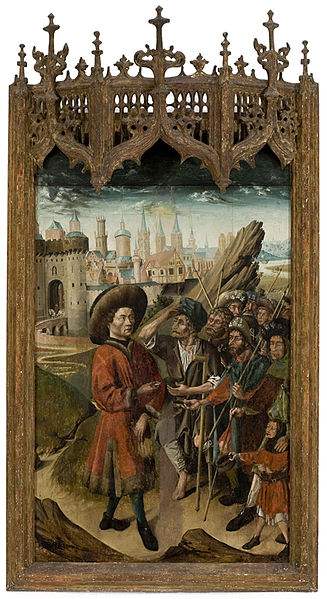
During the subsequent reign of King Sweyn Estridsson Ulfsson, or Sweyn II, the friendship that had been forged between the king and the bishop was sorely tested. One New Year's Eve it was reported to the king that several of his guests and hired men had insulted him. King Sweyn was so angry that he had them slain in church while they were hearing Matins sung. The next morning, the king, accompanied by his armed entourage, attempted to enter the church to attend Mass. At the door, they were blocked by the unarmed bishop. “Stand back, executioner!” the holy bishop exclaimed and declared the king excommunicated. The king's men drew their swords, but Bishop William stood his ground, and the king and his party withdrew. Some time later, the repentant monarch, barefooted and garbed in sackcloth returned. Expressing his heartfelt contrition, the king humbly asked for forgiveness and, in the presence of his subjects, performed public penance, whereupon the bishop gave him absolution for his crime and lifted the excommunication.

From that time onward, the two worked in perfect harmony together to counter superstition and spread the light of the Faith in Denmark. When King Sweyn died, his body was temporally held at Ringsted until the construction of the Cathedral of Roskilde was completed. It is said that when the bishop went out to meet the body, he himself died and was buried next to his friend.

Thursday, September 1, 2016

September 1 – St. Giles

(Latin Ægidius.)
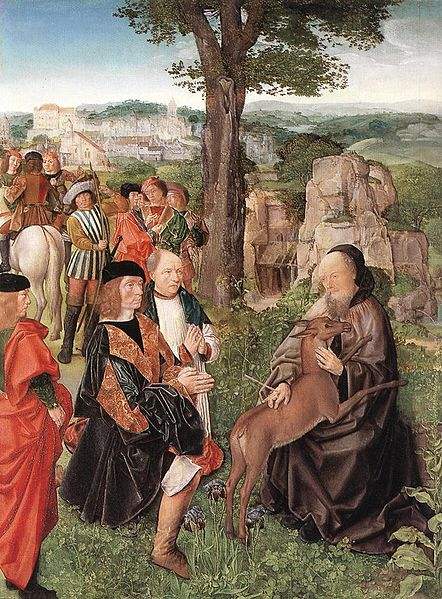
St Gilles and the Hind, painted by the Master of Saint Giles.
St Gilles and the Hind, painted by the
Master of Saint Giles.
An Abbot, said to have been born of illustrious Athenian parentage about the middle of the seventh century. Early in life he devoted himself exclusively to spiritual things, but, finding his noble birth and high repute for sanctity in his native land an obstacle to his perfection, he passed over to Gaul, where he established himself first in a wilderness near the mouth of the Rhone and later by the River Gard. But here again the fame of his sanctity drew multitudes to him, so he withdrew to a dense forest near Nimes, where in the greatest solitude he spent many years, his sole companion being a hind. This last retreat was finally discovered by the king’s hunters, who had pursued the hind to its place of refuge. The king [who according to the legend was Wamba (or Flavius?), King of the Visigoths, but who must have been a Frank, since the Franks had expelled the Visigoths from the neighbourhood of Nimes almost a century and a half earlier] conceived a high esteem for solitary, and would have heaped every honour upon him; but the humility of the saint was proof against all temptations. He consented, however, to receive thenceforth some disciples, and built a monastery in his valley, which he placed under the rule of St. Benedict. Here he died in the early part of the eighth century, with the highest repute for sanctity and miracles.
St. Giles giving to the poor.
His cult spread rapidly far and wide throughout Europe in the Middle Ages, as is witnessed by the numberless churches and monasteries dedicated to him in France, Germany, Poland, Hungary, and the British Isles; by the numerous MSS. in prose and verse commemorating his virtues and miracles; and especially by the vast concourse of pilgrims who from all Europe flocked to his shrine. In 1562 the relics of the saint were secretly transferred to Toulouse to save them from the hideous excesses of the Huguenots who were then ravaging France, and the pilgrimage in consequence declined. With the restoration of a great part of the relics to the church of St. Giles in 1862, and the discovery of his former tomb there in 1865, the pilgrimages have recommenced. Besides the city of St-Gilles, which sprang up around the abbey, nineteen other cities bear his name, St-Gilles, Toulouse, and a multitude of French cities, Antwerp, Bridges, and Tournai in Belgium, Cologne and Bamberg, in Germany, Prague and Gran in Austria-Hungary, Rome and Bologna in Italy, possess celebrated relics of St. Giles. In medieval art he is a frequent subject, being always depicted with his symbol, the hind. His feast is kept on 1 September. On this day there are also commemorated another St. Giles, an Italian hermit of the tenth century (Acta SS., XLI, 305), and a Blessed Giles, d. about 1203, a Cistercian abbot of Castaneda in the Diocese of Astorga, Spain (op. cit. XLI, 308). He is one of the Fourteen Holy Helpers.
John F. X. Murphy (Catholic Encyclopedia_

Cling to God by a wholly simple and loving movement

I think that in heaven my mission will be to draw souls,
by helping them go out of themselves
to cling to God by a wholly simple and loving movement, and
to keep them in this great silence within, that will allow
God to communicate Himself to them and transform them into Himself.

Bl. Elizabeth of the Trinity

St. Drithelm

From time to time throughout History, God reminds His creatures, in very vivid ways, of "the four last things” – Death, Judgment, Heaven or Hell. In his History of the English Church, St. Bede the Venerable records one such occasion as it was told by an Irish monk named Haemgisl.

A wealthy man and a native of Northumbria in England, Drithelm was married and the head of a devout family. No particulars of his early life, other than these few, are known of him prior to the extraordinary event which changed the course of his life forever. In the year 693, Drithelm fell suddenly and gravely ill, died, viewed the afterlife, and was then permitted to return to life in order to tell others of his vivid experience.

The morning after his death, as his grieving family was gathered around his bier, Drithelm sat up. Frightened at the sight of the dead man come back to life, everyone but his wife ran away, terrified. “Be not afraid,” he said to her, “for now I am truly risen from death and allowed again to live among men... But,” he added, “hereafter I am not to live as I have been wont, but rather in a very different manner.”

Drithelm immediately left his house and went to church, where he spent many hours in prayer. Returning home the next morning, he divided up all his possessions among his wife, his children and the poor. He then gave a detailed account of his experience to King Aldfrith of Northumbria, Aethelwood Bishop of Lindisfarne and the Irish monk. At the sovereign’s request, the Abbot of Melrose Abbey admitted Drithelm into the monastery as a monk.

Drithelm spent the rest of his life in a hermitage on the banks of the River Tweed. His remaining years were indeed lived “in a different manner” as he gave himself over to constant prayer and mortification, often combining the two by standing in the freezing waters of the river, surrounded by floating ice, while reciting the psalms. To those who would comment on his extraordinary means of penance by such remarks as, “It is wonderful, Brother Drithelm, that you can stand such cold,” the monk would reply gravely, “I have seen greater cold.” To those that heeded, he would warn them to have a wholesome and holy fear of their lot in eternity, and to those who would stop awhile and listen, he would recount his vision, thereby influencing many for the good by his words and example.

What had changed Drithelm's whole way of life was an astounding vision of eternity that he had experienced while he was "dead."

After dying, Drithelm said he had found himself in the presence of a “handsome man in a shining robe.” This guide showed him three panoramas. The first was a long valley with a road running through it. One side was being consumed by a great fire, on the other blew a blizzard of freezing snow and hail. On both sides could be seen countless souls who would cast themselves from the fiery flames to cool off in the icy blizzard, and then throw themselves out from the blizzard to warm up in the fire. Drithelm thought this must be Hell, but his guide told him it was not.

They next came to a place of intense darkness. Here the guide withdrew and left him for awhile. Soon Drithelm saw a deep pit. Out of this pit, tongues of flame would throw up souls like sparks and then swallow them up again. Among those souls he saw a clergyman, a layman, and a woman. The stench of the pit was unbearable. As he stood looking, a crowd of devils surrounded him menacingly, but when his heavenly guide returned, they all fled.

The third vision was of a pleasant meadow full of sweet-scented flowers and happy people. “This is not the Kingdom of Heaven,” his guide informed him. When they went towards the kingdom and could sense from afar its light and sweetness, the guide would not let him go any farther. He then explained to Drithelm that the first valley was filled with people who had been saved only at the moment of death. They had much purification to endure, but the prayers and Masses offered for them on earth could shorten their suffering. The pleasant meadow was for those whose need for purification was slight. Those who died without imperfection, he said, would enter Heaven at once. But those who entered the dark hole of Hell could never escape.

His heavenly guide then told Drithelm that he must return to life, but should live thereafter “in a different manner.”

Wednesday, August 31, 2016

Holy Rosary Crusade of Reparation

Holy Rosary Crusade of Reparation

After World War II, Austria was divided between four countries: America, France, the United Kingdom, and Russia. At the time, Russia was still communist. The section of Austria controlled by the communists was the richest, and included the city of Vienna. The Viennese were subject to the all the atrocities and tyrannies of communism. However, in 1946, Fr. Petrus Pavlicek, after making a pilgrimage to Mariazell, the principle Marian shrine in Austria, was told by an interior voice: “Do as I say and there will be peace.”
To obey this inspiration of Our Lady, Fr. Pevlicek founded the Holy Rosary Crusade of Reparation in 1947. This Crusade consisted of the Viennese faithful coming out of their homes in order to participate in a public Rosary procession in the streets of the city. The intentions of the Rosary were for the end of communism in their country and in the world.
At first, the processions were minuscule, but in time they grew to staggering proportions. In 1955, after eight years spreading the word about the Crusade throughout Austria, the Rosary processions would reach sizes of half a million people, about 1/10 of the Austrian population. Finally, through the help of Our Lady, the Soviet forces pulled out of Austria in October of 1955, leaving the country for good.

Whether we like it or not

Whether we like it or not, we are in combat
and it is a war of good vs. evil, right vs. wrong,
freedom vs. slavery,
civilization vs. chaos.


Brigadier General Steve Ritchie

St. Aidan of Lindisfarne

Born in Ireland, Aidan studied under St. Senan of Iniscathay on Scattery Island. He was made Bishop of Clogher, but resigned his bishopric to become a monk on Iona. This rugged and storm-swept island in the Scottish seas became renowned throughout Europe as the greatest center of Irish monasticism. The saints connected with Iona are legendary and read like a veritable litany.

King Oswald of Northumbria translates the sermon of Aidan into the Anglo-Saxon language, by A.M. von Ow, 1778.
Aidan’s virtues, however, outshone the remoteness of his seclusion and he was again selected for an episcopal see, this time for that of Lindisfarne, an island some two miles off the coast of Northumberland. The island mission was begun at the request of King Oswald, who had been educated by the Irish monk, and was then residing on the mainland at the royal fortress of Bamborough. Aidan, the monk-bishop the island of Iona, established his see on the island of Lindisfarne in 635 and it in turn became the center of great missionary activity and the religious capital of Northumbria. In fact, Lindisfarne so closely resembled the island of Iona, whence its first bishop had come, and gained for itself so sacred a reputation, that it came to be known as the Iona of England, or Holy Isle.

Having established his episcopal see, Aidan also founded a monastic community on the island. From this monastery were founded all the churches between Edinburgh and the Humber, as well as several others in the Midlands and in the country of East Anglia. In time, Aidan came to be regarded as the Apostle of Northumbria and the influence of his successors was considerable.

St. Bede is lavish in his praise of the holy bishop’s rule and of the monks who served under him, saying of St. Aidan “he was a pontiff inspired with a passionate love of virtue, but at the same time full of a surpassing mildness and gentleness.”

Aidan died a Bamborough, on the mainland, on the last day of August in the year 651. His remains were taken with great reverence to Lindisfarne to be buried among the monks of the monastery he had founded.

Tuesday, August 30, 2016

Even if you have one foot in Hell, even if you have sold your soul to the devil…

Even if you are on the brink of damnation,
even if you have one foot in Hell, even if you have sold your soul to the devil …
sooner or later you will be converted
and will amend your life and save your soul,
if and mark well what I say – if you say the Holy Rosary
devoutly every day until death for the purpose of
knowing the truth and obtaining contrition and pardon of your sins.

St. Louis de Montfort

St. Margaret Ward

Margaret Ward was born a gentleman's daughter at Congleton in Cheshire, England, and for a time lived as a lady's companion in the house of a lady of distinction named Whitall, then residing in London.

Learning that William Watson, the priest who wrote the work known as the “Quodlibets,” was imprisoned in Bridewell, she became friendly with the jailer's wife and obtained permission to visit him. After several visits she disarmed the vigilance of the jailer and furnished the priest with a rope so he could make his escape. At the appointed time the boatman whom she had engaged to convey Father Watson down the river refused to carry out his part of the plan, and in her distress she confided her difficulty to a young man, John Roche, who agreed to assist her. He provided a boat and exchanged clothes with the fugitive, who made good his escape.

But the clothes betrayed John Roche, and the rope convinced the jailer that Margaret Ward had been instrumental in the flight of the prisoner. They were both arrested and clapped in irons. Margaret was flogged and hung up by the wrists, with only the tips of her toes touching the ground. This torture was prolonged for so long that she was crippled and paralyzed, but her sufferings only served to strengthen her all the more. Still refusing to betray the priest, they were offered their freedom if they would ask the Queen’s pardon and attend a Protestant service, both of which they refused.

Margaret was tried and condemned to death at Newgate. She was hanged at Tyburn in London on August 30, 1588. On the scaffold, she was denied any last words because her persecutors were afraid of the impression her speech would have on the attending crowd.

Monday, August 29, 2016

Fashions. What do they mean?

It is often said almost with passive resignation
that fashions reflect the customs of a people.
But it would be more exact and much more useful to say
that they express the decision and moral direction that a nation intends to take:
either to be shipwrecked in licentiousness
or maintain itself at the level to which it has been raised by
religion and civilization.

Pope Pius XII

The Passion of St. John the Baptist

Shortly after he had baptized Jesus on the banks of the Jordan, John the Baptist had denounced Herod, the tetrarch of Galilee, to his face. For thirty years the dissolute ruler had indulged himself and his every whim, while holding court in his palace overlooking the Dead Sea. His latest crime: Herod had divorced his own wife and married Herodias, the wife of his elder brother Philip.

Tolerated by his Roman overlords and useful to them for their own purposes, the licentiousness and excess of the revelries he held were notorious and scandalous, and yet none dared to confront him for fear of the cruelty that lurked just below the surface of his unpredictable character. None dared to speak out. None, that is, until this John, known as the Baptist, and believed by many to be a prophet – if not indeed the Messiah. In the same direct and fearless manner in which he censured the Jewish nation for the moral decadence into which it had fallen, and called sinners to repentance, John the Baptist spelled out clearly to Herod the evil he had done: “It is not lawful for you to have her.”

For proclaiming the truth, John was imprisoned. And yet Herod dared not take any further action against him. As is common with his kind, he was superstitious, and he knew him to be a “righteous man.” Moreover, John had for him an irresistible fascination. Who was this man? Herod’s anger gave way to curiosity. During the next four months, Herod’s visits to his prisoner began to have a strange affect on this master of revels. An irresistible awe gradually took possession of him, to be replaced by fear, which in turn gave place to respect. This did not go unnoticed by his courtiers, foremost among them, Herodias, and she bided her time, watchful for any opportunity that might be used, but impatient for John’s destruction.

A favorable occasion soon presented itself in the form of Herod’s birthday for which an elaborate banquet and lavish entertainment was to be laid on. His marriage to his brother’s wife and his arrest of John the Baptist had not been well received, though none but John dared to voice any open criticism. Thus, both Herod and Herodias took care that the celebrating and feasting should be more brilliant than usual, a luxurious affair that would purchase him the favor of his flatterers once again.

Influential and powerful officials, chiefs and magnates, from near and far, gathered at the palace – their differences dissolved round Herod’s loaded table. At a certain moment, well calculated for its affect, the succession of entertainers is replaced by a single dancer: Herodias's daughter, Salome. Her performance so pleased Herod that, caught up by the adulation of the crowd, he promised her whatever she should ask for, even if it be half of his kingdom. Thus was the elaborate trap set, that having pronounced a rash oath before such an audience, his pride would not permit him to withdraw it cost him what it may. Upon asking her mother’s advice, Salome requested the head of John the Baptist on a platter.

Although inwardly regretful, in his pride Herod could not refuse the request. As St. Augustine so aptly described what followed, “an oath rashly taken was criminally kept.” A guard was sent to behead John in prison. Thus, the "voice crying in the wilderness" was silenced. The head of the Precursor was placed on a platter and presented to Salome, who gave it to her mother.

John’s holiness was so evident that the Jews thought he might be the Messiah who had been promised, but John had protested and denied it. At the Jordan, John had pointed out Christ in person exclaiming: "Behold the Lamb of God, behold him who takes away the sin of the world. This is he, of whom I said: After me there comes one, who is preferred before me: the latchet of whose sandal I am not worthy to loose.” And that there be no doubt as to Whom he meant: “And I saw, and I give testimony that this is the Son of God.”

From that moment onwards, an eclipse takes place: “He must increase, and I must decrease.” His mission was to announce the Messiah. Therefore, once the Lamb of God had arrived, the prophecy of St. John Baptist was fulfilled, and his public mission decreased as he headed toward his martyrdom. On the contrary, Our Lord would increase until the complete fulfillment of His divine mission. The humility of St. John the Baptist was rewarded. After his martyrdom, his name was covered with glory. Our Lord said that no man born of woman was greater than he. It is impossible to have a higher praise or more honorable glorification. But this glory had as its foundation his most profound humility.

Sunday, August 28, 2016

Why God allows evil

God judged it better
 
to bring good out of evil

than to suffer no evil to exist.

St. Augustine of Hippo

St. Augustine of Hippo

Augustine was born on November 13, 354 at Tagaste, on the northern coast of Africa, in what is now Algeria. He was raised as a Christian by his mother, Monica, despite his father, Patricius, being a pagan. His mother’s example of fervent faith was a strong influence on the young boy, one that would follow him throughout his life.

Although he had been enrolled amongst the catechumens in his youth and had received a Christian education in Tagaste, Augustine had nevertheless deferred the reception of Baptism, and was as yet unbaptized when the question of his advanced studies arose. Proud of his son’s academic prowess and prospects, Patricius was determined to send Augustine to Carthage, but had not the means available and thus it was that his eldest son spent his sixteenth year in an idleness that proved fatal to his virtue.

Having thrown himself wholeheartedly into the pursuit of pleasure and gradually given up the practice of prayer, by the time Augustine reached Carthage late in the year 370, he was easily won over by the seductions of the half-pagan city. When his father died in 371, soon after he arrived in Carthage, Augustine became the nominal head of the family and set up a household with a concubine, the mother of his son, Adeodatus, born about 372.

At the university Augustine studied literature and poetry, Latin, public speaking, and rhetoric. A terrible crisis of faith followed close upon his moral dissipation and Augustine fell into the snares of the Manichæans, a heretical sect that believed all flesh and matter to be evil, denied free will and attributed the commission of a crime to a foreign principle. Once he was won over by the sect, Augustine devoted himself to it with all the vehemence of his ardent nature and drew into it a number of friends by his proselytizing. Over time Augustine became disenchanted with the irresolvable contradictions he observed in the teachings of the Manichæans, but it took nine years for the illusion to die completely.

At the age of twenty-nine, Augustine set off secretly for Rome, resorting to subterfuge to avoid being followed by his mother, Monica. After a brief sojourn in Rome, he applied for a vacant professorship in Milan, where he was soon joined by his mother. His meeting with St. Ambrose so impressed him that he became a regular attendant at the bishop’s sermons. Cicero’s work Hortensius was also instrumental in Augustine’s final conversion, inspiring him with the desire to seek the truth. His passions, however, were to enslave him for another three years. Finally, through the reading of the Holy Scriptures light penetrated his mind. Grace soon followed and the thirty-three-year-old Augustine resigned his professorship, put aside a prospective marriage arranged by his mother, and retired to a country estate to devote himself entirely to the pursuit of true philosophy, now inseparable in his mind from Christianity.

With his son, and the friends who had accompanied him into retirement, he was baptized on Easter Sunday in 387 by St. Ambrose. His ordination to the priesthood in 391 was followed by his consecration as Bishop of Hippo four years later. His priestly and episcopal ministries were both admirably fruitful: he fought heresy with lionlike tenacity, challenged heretics to public debates, attended Church councils, and was a prodigious writer and zealous preacher. One of the greatest theologians of all time, among his extant works can be found more than 300 sermons, 500 letters, and numerous other writings on a wide variety of topics. Whilst refuting a Pelagian heretic, Augustine was stricken with a fatal illness. For three months he suffered with unconquerable patience amid continuous prayer, and died on August 28 in the year 430.

Saturday, August 27, 2016

Hell or paradise, even in this world

In this life there is no purgatory;
it is either hell or paradise; for
to him who serves God truly,
every trouble and infirmity turns into consolations, and
through all kinds of trouble he has a paradise within himself
even in this world: and he who does not serve God truly, and
gives himself up to sensuality,
has one hell in this world, and another in the next.

St. Philip Neri

St. Monica

Monica was born in 332 in Tagaste, North Africa. Although her parents were Christians, they gave her in marriage to a local pagan official. A violent and immoral man, Monica's married life with Patricius was far from being a happy one, especially as her husband's mother, who lived with them, seems to have been of a like disposition with himself. His wife’s almsdeeds and her habits of prayer annoyed him, but it is said that he always held her in a sort of reverence. Monica’s persistent prayers and untiring sweetness finally won out and, in 370, both her husband and mother-in-law converted to Christianity.

Patricius died a year after being baptized, leaving Monica to raise their three children alone. Augustine, the eldest of the three, had fallen prey to the Manichean heresy (which professes that all flesh and matter is evil) while yet an adolescent and was living an immoral life. She banished Augustine from her home for some time, but welcomed him back after she had a vision in which she was assured that her firstborn son would return to the faith. From that time on, she stayed close to her son, praying and fasting for him. She would beg the prayers of priests who often avoided her because of her persistence at this seemingly hopeless endeavor. When Augustine secretly set sail for Rome, she followed him. When, upon her arrival in Rome she discovered that he had left for the northern city of Milan, she set out at once in pursuit of him.

For seventeen long years, the faithful mother continued undeterred in her prayers and fasting for the conversion of her son until finally, in 387, Augustine was baptized by St. Ambrose in Milan. As if in confirmation that her earthly mission had been fulfilled, Monica died later that same year.
St. Monica with her son, St. Augustine 

Friday, August 26, 2016

In danger of losing your soul?

Fly from bad companions
as from the bite of a poisonous snake.
If you keep good companions, I can assure you that
you will one day rejoice with the blessed in Heaven;
whereas if you keep with those who are bad,
you will become bad yourself, and
you will be in danger of losing your soul.

St. John Bosco

St. Elizabeth Bichier des Ages

Born at Le Blanc in France in 1773, Elizabeth was the daughter of Antoine Bichier, the Seigneur of Ages and a public official, and Marie Augier de Moussac, whose father was a politician. She spent much of her childhood at the convent at Poitiers.

In 1792, after the death of her father, Elizabeth took her mother to live in La Guimetière. Near their new home was a parish left in chaos because of the French Revolution, and Elizabeth dedicated herself to rebuilding the community. Every night she gathered the parishioners for prayers and hymns. Elizabeth soon became aware of a nearby parish in a similar situation: a priest, André-Hubert Fournet (who later became a saint), offered the Sacrifice of the Mass in a local barn. They quickly became friends, and together they reestablished religion in the area.

With Fr. André Fournet’s spiritual guidance and assistance, Elizabeth found her true vocation. In 1806, she established a religious congregation of women to care for the sick and aged, for the education of children and to offer reparation for the blasphemies and sacrileges committed against the Most Blessed Sacrament during the French Revolution. The congregation was officially recognized by the diocese in 1816 and named “Daughters of the Cross.”

In 1836, Elizabeth fell seriously ill. After ten days of intense suffering, she died on August 26. She was canonized in 1947. Before she died, she opened over sixty convents under the rule of the Daughters of the Cross.

Thursday, August 25, 2016

A Timely Response to Our Lady’s Request

While visiting a home in Ohio, I heard an amazing story about the First Five Saturday devotion that Our Lady requested at Fatima. She asked all Catholics to make reparation to her on the first Saturday of five consecutive months by going to confession, praying at least one rosary, making a fifteen minute meditation and receiving Communion. Our Lady promised that she would “…assist them at the hour of death, with all the graces necessary for salvation.”   

The family, of good practicing Catholics, decided to take up the devotion. However, as it often happens when one sets out to do God’s will, all kinds of obstacles run into our path. On the Friday preceding the first Saturday they had a car accident. On the Saturday some were called to their jobs and some children fell ill. However, all still managed to fulfill Our Lady’s devotion requests, including the father.
Their resolution to do Our Lady’s request could not have been timelier. After completing the five month devotion, the father became extremely sick. Doctors found that he had cancer in an advanced stage and only had a few days to live.
The family asked their fellow parishioners for prayers and Masses in his intentions. Many family members began a round-the-clock vigil praying the rosary around his bed. For a whole week, those faithful prayer warriors continued to give him spiritual and psychological support with their generous vigil.
Through all the suffering, the completion of the 5 First Saturday devotion was a continuous source of consolation to the father and family. “I will see you in heaven,” he reassured his children. Shortly before his death a priest gave him last rites and he peaceably surrendered his soul to the Lord.


By Godofredo Santos

The great matter

It is easy to infuse
a most fervent devotion into others, even in a short time;
but the great matter is
– to persevere.

St. Philip Neri

St. Louis IX of France

In Louis IX of France were united the qualities of a just and upright sovereign, a fearless warrior, and a saint. This crusader king was a living embodiment of the medieval noble: he lived for the welfare of his subjects and the glory of God.

Born on April 25, 1214 at Poissy, near Paris, Louis never forgot the piety of his upbringing as it had been instilled in him by his mother, Queen Blanche of Castille. At his coronation in Rheims at the age of twelve, Louis asked of God courage, light, and strength to use his authority well, to uphold the divine honor, defend the Church, and serve the good of his people. In May, 1234 the young King married Marguerite, the eldest daughter of the Count of Provence, who bore him eleven children.

Louis did all he could to promote and inspire of a Christian culture. He gave encouragement and aid to the religious orders and often assisted in settling and housing them. Deeply religious, he loved to listen to sermons, heard two Masses daily, and often joined in singing the Divine Office. But, although he sought the company of the wise and experienced among the clergy and other ranks, he did not hesitate to oppose its members when they proved unworthy.

Ambitious to make France foremost among Christian nations, Louis was overjoyed at the opportunity to acquire the Crown of Thorns and other holy relics from the Eastern Emperor at Constantinople. He sent two Dominican friars to bring these sacred objects to France, and, attended by an impressive entourage, he met them at Sens upon their return. To house the relics, he built the shrine of Sainte-Chapelle, one of the most beautiful examples of Gothic architecture in existence.

After recovering from a violent fever in 1244, Louis announced his long-cherished intention of undertaking a crusade to the East and set out from Paris on his first crusade on June 12, 1248. However, plagued with trouble after a seemingly promising start, Louis himself, weakened by dysentery, was taken prisoner in April, 1250, and his army routed.
After six years in captivity, he was released and returned to France to resume his sovereign role. He was involved intimately in the lives of his people. He had a passion for justice, and changed the "King's court" of his ancestors into a popular court, where, seated in his palace or under a spreading oak in the forest of Vincennes, he listened to any of his subjects who came with grievances and gave to them wise and impartial judgments.

In 1267, Louis once more determined to go on another crusade. His people objected, fearing they would lose their excellent and revered ruler, who, though only fifty-two years old, was worn with toil, illness, and austerities. Louis was determined though, and set sail on July 1, 1270, heading for Tunis. The crusade was a dismal failure. Dysentery and other diseases broke out among the crusaders, and Louis soon contracted the disease to which he succumbed on August 15. His bones and heart were taken back to France and kept enshrined in the abbey-church of St. Denis, until they were scattered at the time of the French Revolution.

He was canonized by Pope Boniface VIII in 1297.

Wednesday, August 24, 2016

Advice for the Intellectual Life


by Plinio Corrêa de Oliveira


With the authorization of the recipient, we have transcribed a letter to a young man containing advice for the intellectual life. Such advice, mutatis mutandis, can be useful to all who fight in the defense of truth.

            My dear friend,

            Salve Maria!

            I read with much affinity the letter you sent me.

            Do not think badly of me if I tell you that I could not stop smiling when I saw that you wanted to be a man like myself. I guarantee you, with the greatest sincerity, that you would take no advantage from this. In fact, the effect would be negative. If I may wish that something good happened to you, it would be precisely that this would not happen. Moreover, each one of us has a unique and unmistakable personality, and is called by God to accomplish his own ideal of perfection. We are compelled to be faithful to the truth within us. This is the only way we can attain it.

            Only a passion for the truth justifies the existence of philosophers and writers

            Speaking of the truth, we have arrived at the crucial point of everything you said to me in your letter. The world is full of philosophers and writers. Nonetheless, there is only one thing that justifies the existence of one or the other: the passion for the truth. Without this passion, books and philosophies are nothing but vanities, very dangerous vanities, that put fire to the earth and enflame the ardor of hell.

            He who has a passion for the truth is disposed to dispossess himself without any restrictions. He will sacrifice the most enticing ideas, the most ingenious systems, the most profound and luminous lucubrations, the most highly prized intuitions, the loftiest pleasures of the intelligence, and finally, the most captivating notions and the most esthetically pleasing images, in order to austerely search for and manifest the truth, and only the truth. This is always difficult for us, in our human condition, to do, because of the essentially transcendental nature of the truth.

            He who has a passion for the truth brings mans’ aversion on himself

            And this is not all. The truth was never highly esteemed by man, and is absolutely despised in our days. The truth is one and immutable, but man loves the diversified spectacle of succeeding appearances; the truth is eternal, but man follows the fashions; the truth is serious but man is frivolous; the truth points to obligation, whereas man wants pleasures; at any rate, the truth is rigid and man has no fiber.

             Therefore, he who has a passion for the truth necessarily brings mans’ aversion on himself, but he will prefer the truth to temporal goods, to a career, to renown, and to his own reputation. He will be persecuted and accused by those who adulterate the truth and use it simply as an instrument of their presumption and lust.

            But this is still not everything. The passion for the truth can bring him to years of endless silence, while the others, through the production of literary and philosophical works, exalt themselves in the face of favorable and contrary opinion. He, nonetheless, will remain silent until the only motive arises that will make him manifest himself: to give testimony to the truth.

            Considering what I have just said, you could reply that, instead of showing the way of philosophy, I have shown the way of sanctity. That is true. I just want to emphasize that for he who has the vocation to study philosophy, his spiritual perfection is passion for the truth. For us, Catholics, the truth is not only epistemological or metaphysical, but is the Second Person of the Most Holy Trinity, the Word of God that became flesh in order to save us.

            And now that we have reached this height, we can put the conclusions aside so as to answer your particular questions.

            The intellectual life is intimately linked to and dependent on the spiritual life

            The first answer is that there should be no distinction between your spiritual and your intellectual life. Once you say you want to do God’s will in everything and decide that you have the vocation to pursue philosophical studies, you should not worry about your future, nor about how you are going to make a living: perform your duties conscientiously and hope in Divine Providence. Have confidence. God does not forget those who serve him.

            Nevertheless, God is wont to prove the trust of his servants. When this happens to you, do not assume you are abandoned: this is the normal route of Divine Providence. The solution will come when all appears lost or put in jeopardy. However, do not expect definite solutions. A certain margin of uncertainty and risk will always remain. This is necessary because God wants us to put our trust in Him alone and not in human solutions.
           
            On the other hand, we cannot lose sight of the fact that we are exiles in this world, and that our present life is provisory and precarious. For this reason, there are no definitive situations in this world; nor should we desire that such situations exist. We must live on faith, and because the object of faith is invisible and beyond human reason, it is necessarily obscure. St. Peter, walking on the tempestuous sea, is the image of Christian life. I am well aware that this path is difficult. It is the narrow way Our Lord showed us to salvation. There is no other.

            Avoid any separation between thought and life

            Secondly, referring specifically to your studies, it is necessary to carefully avoid any separation between your thoughts and your life. Philosophy cannot be dealt with the way one resolves a geometrical proposition. In other words, the philosopher cannot place himself comfortably “outside” of philosophy and formulate it with elegance and without attachments. To the contrary he, his life, his destiny, and the destiny of humanity are viscerally dependent on the course of philosophy. The first philosophical problem he should consider is himself, because it is through the flesh and blood of his existence that he keeps himself grounded in reality.

            This being the case, the philosopher should have not only a keen and developed intelligence, but also a rich, strong, and vigorous personality through which all of reality could amply resonate. In order to acquire this well-endowed and profound personality, I think it is useful that, besides all the studies that are particularly philosophical, which I will address shortly, you cultivate your soul by coming in contact with the great works in which certain fundamental characteristics of the human soul are expressed. Frequent exposure to these books results in an incalculable broadening of vision in relation to all problems. The works of Virgil, Dante, Shakespeare, and the French classics are in this category. Take note that they are not irreprehensible, but the magnificent breath that aggrandizes man flows in all of them.

            Also, I am not telling you to do a systematic study of these works. What I am telling you is far from this. It is not about studying as in completing a task, but to appreciate and to savor it. You choose the work that you like the most, or you could just as well vary by reading at one time a selection from one and later a passage from another. You have complete liberty. The most important thing is that you read the original works.

            It is not only appreciation of the great literary works that brings us to our desired objective but also of paintings of the great masters and music of the great composers, such as Bach and Handel. Nevertheless, each one should follow his own inclinations in these matters. I prefer rather to suggest ideas than to implement them.

            St. Thomas is clearer than his commentators

            Considering now your studies, I must say that I understand perfectly the dissatisfaction and perplexity that certain authors, who present themselves as thomists, give you. These authors are truly neither philosophers nor thomists, and the best thing you can do for the moment is to put them aside. They can only confuse you and set you on a dangerous path.

In respect to Maritain, he is but a vulgar man gifted with literary qualities, and without any scientific seriousness. His followers have superficial mentalities and allow themselves to be cajoled into and satisfied with his lyrical-metaphysical notions; notions which, when analyzed more meticulously, do not hold water because they are quickly seen to be imprecise, doubtful and full of contradictions. I must confess that, when I was your age, I allowed myself to be mislead by these notions because they aroused my sensibilities. God, however, gave me the grace to see the poison in them before it was too late.

When one becomes familiar with the knowledge of the true philosophers, he is ashamed of the hollow, stupid, and pretentious digressions of certain pseudothomist philosophists of our day. They do nothing but deform Thomism, adapting it to the most recent fads (which they do not even understand). At the same time, with naïve incompetence, they miss the most profound thoughts of St. Thomas.

Go directly to the source. Try to familiarize yourself with the works of St. Thomas. Do not worry; the angelic doctor is more intelligible than any of his commentators. It all depends on us habituating ourselves to his style, and more importantly, to his discipline. This will not be difficult as long as we apply ourselves with humility.

To begin with, I would recommend the Prima of the Summa and the De Veritate. In the Prima, leave questions 2, 23, and 24 aside. As far as the De Veritate, for the time being do not go beyond the 3rdquestion. Since you are beginning, do not devote yourself to systematic study, but do as I suggested for the classical works. Remember that you are still not attempting to acquire knowledge of the works of St. Thomas but only to familiarize yourself with them.  Therefore, when you come across a more difficult topic, do not force yourself to comprehend it. Instead, find an easier topic.

And now I am going to make a more relevant observation: meditation and reflection are more valuable than reading. For this reason try as much as possible to resolve problems on your own. This is better than searching for ready-made solutions.  Above all, stick to the text of St. Thomas. Do not read the explanations at the foot of the page. We can think of other things for you to do once you are accustomed to the style and reasoning of St. Thomas.

         The authentic spiritual life: the only nourishment for the intelligence

We have finally arrived at the final and most important conclusion. The true philosopher can nourish his mind and his personality only through an authentic spiritual life. It seems to me that the best basis for an authentic spiritual life is still the Spiritual Exercises of St. Ignatius, naturally complemented with the Imitation of Christ. Keeping in mind the orientation I have been giving you through my suggestions, always attempt to use the original texts without commentaries. And since Catholic piety is based on Marian inspiration, always have on hand the excellent works of St. Louis Maria Grignion de Montfort; all of them, if that is possible.

The devil makes his catches in the murky waters of agitation

        With this, after having asked God to enlighten me for the responsibility of this task, I think I have answered the questions you presented in your letter in the best way possible. You will certainly encounter many shortcomings in my response: It’s my human side. If, however, you have recourse to God with confidence, He will supplement the faults.

         Before all else, be calm and tranquil. I seemed to discern a certain agitation in your letter. Try not to be worried. The devil makes his catches in the murky waters of agitation. He is masterful at irritating nerves and tormenting consciences through the imagination, suggestions, instigations, and even working directly on the body, where he causes physical sensations of discomfort, anguish, disgust, palpitations of the heart, and whatever else there is. Do not allow any of these things to bother you. Look straight to the hearts of Jesus and Mary and walk with confidence on the white-capped waves.

And here we are, my friends and I, at your disposition for whatever you need. No formalities. And do not forget me in your prayers.

Yours in Jesus and Mary,
Plinio

____________________________