

By Tonia Long
No sooner have the Christmas decorations been taken down than we are surrounded by pink hearts and red roses – St. Valentine’s Day is upon us. Labeled a “Hallmark holiday,” the feast named after a martyr of the Church has lost much of its true meaning.
Holy Mother Church has instituted these special days for our edification and sanctification. They are part of our Catholic heritage and are being stripped of their meaning – especially for our younger generation.
And what I propose is this: Let’s take back our Catholic holidays!
It can be as simple as what my mother used to do. You can do it too, for your family and friends.
Take St. Valentine’s Day, for example.

What I looked forward to the most was the candy – what child wouldn’t?!? My mom would hide chocolate hearts all around our living room. Each heart had a Scripture quote taped to it. We would have sooo much fun searching for our candy! Then, using much restraint, we would read out our Scripture quote (which always had something to do with God’s love for us) before eating the chocolate.
Lessons learned:
**Good things come to those who search for them.
**If you are looking for love, you will find it in the Holy Scriptures.
After the excitement, Mom would settle us down for story time (no
small task!). It was the same story every time, but it never got old. By
the end of it, we knew just whose feast day it was and why! He was our
Super Hero!**If you are looking for love, you will find it in the Holy Scriptures.
And last, but not least, came the Valentine cards. Grandparents, aunts, uncles, cousins and neighbors looked forward to these homemade gems every year. By the time we finished making them, there was paper, glue, glitter and holy cards everywhere!
So, how do YOU take back St. Valentine’s Day?
It’s as simple as 1, 2, 3:
1.Share the Holy Scriptures: There’s a lot of love in there!
2.Tell a short story about St. Valentine. (see below)
3.Click on the link or any of the cards you see below and spread TRUE LOVE – No true love is sustained without the help of grace.
This is your Catholic Faith – your children’s heritage! Don’t let it become just another “Hallmark holiday.”2.Tell a short story about St. Valentine. (see below)
3.Click on the link or any of the cards you see below and spread TRUE LOVE – No true love is sustained without the help of grace.
Click here to print these cards(Instructions are included)


(click on each card below to print)


(click any card below to print all three)


SAINT VALENTINE
Saint Valentine, priest and martyr, lived nearly 1,700 years ago in pagan Rome.
Father Valentine answered God’s call to the priesthood at a time when it wasn’t easy to be a Catholic, and it was downright dangerous to be a priest or bishop.
 The
infant Catholic Church was being brutally persecuted by Emperor
Claudius II. But that didn’t scare young Valentine! He knew that the
Christian Faith was the only remedy for the sick and permissive society
in which he lived. Especially when it came to Her teachings about the
relationship that should exist between a man and a woman as husband and
wife.
The
infant Catholic Church was being brutally persecuted by Emperor
Claudius II. But that didn’t scare young Valentine! He knew that the
Christian Faith was the only remedy for the sick and permissive society
in which he lived. Especially when it came to Her teachings about the
relationship that should exist between a man and a woman as husband and
wife.Polygamy was the norm in pagan Rome. And to make matters worse, the Emperor issued an edict that prohibited the marriage of young people. This was based on the hypothesis that unmarried soldiers fought better than married soldiers because married soldiers might be afraid of what might happen to their wives or families if they died in battle.
Saint Valentine took that edict as a challenge. He made it his own personal mission to share the Catholic vision of marriage and the graces of the Sacrament with all those who would listen. And he would go one step further; he would secretly marry as many couples as he could.
Father Valentine was eventually caught, imprisoned and tortured for performing marriage ceremonies against the edict of Emperor Claudius II. But even while in prison, Father Valentine found ways to carry on his mission.
One of the men who was to judge him was a man called Asterius, whose daughter was blind. Saint Valentine prayed with her and healed the young girl with such charity and compassion that Asterius himself became a Christian as a result.
In the year 269 AD, Valentine was sentenced to execution all because of his stand for Christian marriage. The last words he wrote were in a note to Asterius' daughter. He inspired today's romantic missives by signing it, "from your Valentine."
So what does it REALLY mean to be a “Valentine”? Simply this: that there comes a time when you have to lay your life on the line for what you believe. And with the power of the Holy Spirit we can do that – just like Saint Valentine.


 Catherine’s
father, Pier Francesco dei Ricci, was of an old and respected family of
Florence. Her mother died when she was a small child, and Catherine was
brought up by a devoted stepmother, Fiammetta da Diacceto. Her
stepmother soon observed the child's unusual tendency to holiness, and
did her utmost to foster and develop it.
Catherine’s
father, Pier Francesco dei Ricci, was of an old and respected family of
Florence. Her mother died when she was a small child, and Catherine was
brought up by a devoted stepmother, Fiammetta da Diacceto. Her
stepmother soon observed the child's unusual tendency to holiness, and
did her utmost to foster and develop it. Meletius
was born a Melitene, and belonged to one of the most distinguished
families of Lesser Armenia. He was a kind and gentle man, and a great
lover of peace. His virtue gained him the confidence and esteem of both
the Catholics and Arians, and he was made Bishop of Antioch. However,
the patriarchal Church of Antioch had been oppressed by the Arians, who
denied the divinity of Christ, since 331, and some among the Catholics
refused to acknowledge the new bishop, distrusting him because he had
the support of the Arians.
Meletius
was born a Melitene, and belonged to one of the most distinguished
families of Lesser Armenia. He was a kind and gentle man, and a great
lover of peace. His virtue gained him the confidence and esteem of both
the Catholics and Arians, and he was made Bishop of Antioch. However,
the patriarchal Church of Antioch had been oppressed by the Arians, who
denied the divinity of Christ, since 331, and some among the Catholics
refused to acknowledge the new bishop, distrusting him because he had
the support of the Arians.
 Born
into a humble family which little by little fell into extreme poverty,
Bernadette had always been a frail child. Quite young, she had already
suffered from digestive trouble, then after having just escaped being a
victim of the cholera epidemic of 1855, she experienced painful attacks
of asthma, and her ill health almost caused her to be cut off forever
from the religious life. When asked by Monsignor Forcade to take
Bernadette, the Mother Superior of the Sisters of Nevers replied:
"Monsignor, she will be a pillar of the infirmary."
Born
into a humble family which little by little fell into extreme poverty,
Bernadette had always been a frail child. Quite young, she had already
suffered from digestive trouble, then after having just escaped being a
victim of the cholera epidemic of 1855, she experienced painful attacks
of asthma, and her ill health almost caused her to be cut off forever
from the religious life. When asked by Monsignor Forcade to take
Bernadette, the Mother Superior of the Sisters of Nevers replied:
"Monsignor, she will be a pillar of the infirmary." At
the first exhumation, it was quickly evident that a miracle had taken
place; Saint Bernadette’s skin tone was perfectly natural. The mouth was
open slightly and it could be seen that the teeth were still in place.
Although the rosary in her hands had decayed, showing rust and corrosion
in some spots, the virginal hands that still grasped it were perfect!
The sisters present thoroughly washed the body and clothed it in a new
habit before placing it in an officially-sealed double casket.
At
the first exhumation, it was quickly evident that a miracle had taken
place; Saint Bernadette’s skin tone was perfectly natural. The mouth was
open slightly and it could be seen that the teeth were still in place.
Although the rosary in her hands had decayed, showing rust and corrosion
in some spots, the virginal hands that still grasped it were perfect!
The sisters present thoroughly washed the body and clothed it in a new
habit before placing it in an officially-sealed double casket. coffin.
… the body does not seem to have putrefied, nor has any decomposition
of the cadaver set in, although this would be expected and normal after
such a long period in a vault hollowed out of the earth."
coffin.
… the body does not seem to have putrefied, nor has any decomposition
of the cadaver set in, although this would be expected and normal after
such a long period in a vault hollowed out of the earth." This
is the face which was lifted eighteen times to the Lady of Lourdes, the
very same hands which fingered her rosary during the apparitions, and
the fingers which scratched the earth in obedience to Our Lady’s request
and made the miraculous spring appear.
This
is the face which was lifted eighteen times to the Lady of Lourdes, the
very same hands which fingered her rosary during the apparitions, and
the fingers which scratched the earth in obedience to Our Lady’s request
and made the miraculous spring appear.
 She
turned her head towards the grotto and saw in the opening of the rock a
young and beautiful lady. "The Lady" was dressed in white with a yellow
rose at each foot and a rosary draped over her arm. Removing her own
rosary from her pocket, Bernadette knelt down before "the Lady" and
began to pray.
She
turned her head towards the grotto and saw in the opening of the rock a
young and beautiful lady. "The Lady" was dressed in white with a yellow
rose at each foot and a rosary draped over her arm. Removing her own
rosary from her pocket, Bernadette knelt down before "the Lady" and
began to pray. Complying
with Our Lady’s request, there is now a church at the grotto. Our Lady
asked that people come in procession, and persevere with prayer and
personal conversion.
Complying
with Our Lady’s request, there is now a church at the grotto. Our Lady
asked that people come in procession, and persevere with prayer and
personal conversion.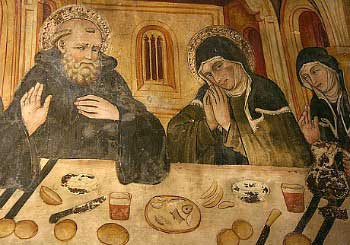 She
visited her brother once a year, and as she was not allowed to enter
his monastery, he went with a few of his brothers to meet her at a house
some distance away to pray together and speak of spiritual matters. On
one such occasion in 543, they had passed the time as usual in prayer
and holy conversation and in the evening sat down to eat supper.
Scholastica begged her brother to remain until the next day, deviating
from their usual custom, so that they might continue their conversation.
Benedict refused to spend the night outside his monastery as it was
contrary to his order’s rule.
She
visited her brother once a year, and as she was not allowed to enter
his monastery, he went with a few of his brothers to meet her at a house
some distance away to pray together and speak of spiritual matters. On
one such occasion in 543, they had passed the time as usual in prayer
and holy conversation and in the evening sat down to eat supper.
Scholastica begged her brother to remain until the next day, deviating
from their usual custom, so that they might continue their conversation.
Benedict refused to spend the night outside his monastery as it was
contrary to his order’s rule. Michael
was born in Cuenca, Ecuador in 1854 to a wealthy family. From birth he
had a deformity that disabled him and prevented him from walking. One
day, as he sat in his wheelchair, he saw a rose in the garden. Above the
flowers, he saw a beautiful lady wearing a white and blue dress,
calling his name. His family, who could see nothing other than the rose,
was astonished when he proceeded to get up and walk. From then on,
Michel spoke with Our Lady and Jesus on a regular basis.
Michael
was born in Cuenca, Ecuador in 1854 to a wealthy family. From birth he
had a deformity that disabled him and prevented him from walking. One
day, as he sat in his wheelchair, he saw a rose in the garden. Above the
flowers, he saw a beautiful lady wearing a white and blue dress,
calling his name. His family, who could see nothing other than the rose,
was astonished when he proceeded to get up and walk. From then on,
Michel spoke with Our Lady and Jesus on a regular basis. Jerome
was born in Venice in 1481. As a military commander who prided himself
on the strength of his army, he was not a man of God. Yet when he was
taken prisoner and thrown in a dungeon, the proud leader turned to God
and miraculously escaped his captors. After his conversion, Jerome
dedicated himself to Our Lady and the work of God, and was eventually
ordained to the priesthood in 1518.
Jerome
was born in Venice in 1481. As a military commander who prided himself
on the strength of his army, he was not a man of God. Yet when he was
taken prisoner and thrown in a dungeon, the proud leader turned to God
and miraculously escaped his captors. After his conversion, Jerome
dedicated himself to Our Lady and the work of God, and was eventually
ordained to the priesthood in 1518. At
that time, famine and plague were rampant in Northern Italy, and Jerome
devoted himself to caring for sick orphans, housing and teaching them
Catholicism. After contracting the plague and recovering, Jerome decided
to wholly devote himself to caring for others. In 1531, he established
multiple orphanages and a shelter for penitent prostitutes, and just a
year later, along with two other priests, a congregation for men. The
congregation, named The Clerks Regular of Somascha, mainly saw to the
care of orphans and the instruction of youths and young clerics.
At
that time, famine and plague were rampant in Northern Italy, and Jerome
devoted himself to caring for sick orphans, housing and teaching them
Catholicism. After contracting the plague and recovering, Jerome decided
to wholly devote himself to caring for others. In 1531, he established
multiple orphanages and a shelter for penitent prostitutes, and just a
year later, along with two other priests, a congregation for men. The
congregation, named The Clerks Regular of Somascha, mainly saw to the
care of orphans and the instruction of youths and young clerics.

 Born
on the Greek island of Aegina, Luke belonged to a family of farmers.
Saracen raiders forced his family to leave their homeland for Thessaly,
where Luke worked in the fields and tended sheep. He was a dutiful
child, but his charity towards the poor often frustrated his parents:
Luke would often give his own food and clothing to those less fortunate.
He was so charitable that God blessed him, and his family’s crops
flourished, but his parents still did not approve.
Born
on the Greek island of Aegina, Luke belonged to a family of farmers.
Saracen raiders forced his family to leave their homeland for Thessaly,
where Luke worked in the fields and tended sheep. He was a dutiful
child, but his charity towards the poor often frustrated his parents:
Luke would often give his own food and clothing to those less fortunate.
He was so charitable that God blessed him, and his family’s crops
flourished, but his parents still did not approve. In
1597, Hideyoshi, a powerful Japanese official, listened to the gossip
and lies of a Spanish merchant. The merchant said that Paul and the
missionaries were traitors of Japan, and were spies for Spain and
Portugal. Hideyoshi cut off the left ears of twenty-six Catholics,
including Paul Miki, smeared their cheeks with blood as a warning to
others and paraded them through towns before executing them. Priests,
brothers, laymen, catechists, doctors, servants, old men and innocent
children were bound to crosses and raised into the air, a lance trust
into their sides, killing them. Hideyoshi crucified the martyrs on a
hill, now known as the Holy Mountain, above Nagasaki. They were
canonized in 1862.
In
1597, Hideyoshi, a powerful Japanese official, listened to the gossip
and lies of a Spanish merchant. The merchant said that Paul and the
missionaries were traitors of Japan, and were spies for Spain and
Portugal. Hideyoshi cut off the left ears of twenty-six Catholics,
including Paul Miki, smeared their cheeks with blood as a warning to
others and paraded them through towns before executing them. Priests,
brothers, laymen, catechists, doctors, servants, old men and innocent
children were bound to crosses and raised into the air, a lance trust
into their sides, killing them. Hideyoshi crucified the martyrs on a
hill, now known as the Holy Mountain, above Nagasaki. They were
canonized in 1862.
 Alphonsus,
King of Leon and Galicia, very much wanted all his servants to honor
the Blessed Virgin by saying the Rosary. So he would hang a large rosary
on his belt and always wear it, but unfortunately never said it
himself. Nevertheless, his wearing it encouraged everyone to say the
Rosary very devoutly.
Alphonsus,
King of Leon and Galicia, very much wanted all his servants to honor
the Blessed Virgin by saying the Rosary. So he would hang a large rosary
on his belt and always wear it, but unfortunately never said it
himself. Nevertheless, his wearing it encouraged everyone to say the
Rosary very devoutly. Very
little is known about St. Agatha, other than that she was martyred in
Sicily during the persecution of Emperor Decius in 251. According to
legend, Agatha dedicated her life to Our Lord at a young age and refused
any man who wanted to marry her. Agatha was arrested after refusing the
advances of Quintian, a powerful man of high rank, and was imprisoned
in a brothel. Throughout the month she spent being tortured in the
brothel, Agatha would pray, “Jesus Christ, Lord of all, you see my
heart, you know my desires. Possess all that I am. I am your sheep: make
me worthy to overcome the devil," and was preserved from being
violated.
Very
little is known about St. Agatha, other than that she was martyred in
Sicily during the persecution of Emperor Decius in 251. According to
legend, Agatha dedicated her life to Our Lord at a young age and refused
any man who wanted to marry her. Agatha was arrested after refusing the
advances of Quintian, a powerful man of high rank, and was imprisoned
in a brothel. Throughout the month she spent being tortured in the
brothel, Agatha would pray, “Jesus Christ, Lord of all, you see my
heart, you know my desires. Possess all that I am. I am your sheep: make
me worthy to overcome the devil," and was preserved from being
violated. Agatha
was removed from the brothel and again advanced upon by her captor.
Again, she refused him, saying she was dedicated to God alone. Her
captor then sent her to prison, and had her tortured repeatedly. He
refused her any medical care, but God comforted her in the form of a
vision of St. Peter. Agatha was tortured yet again, and this time her
body was grossly mutilated. She died with this prayer on her lips:
"Lord, my Creator
Agatha
was removed from the brothel and again advanced upon by her captor.
Again, she refused him, saying she was dedicated to God alone. Her
captor then sent her to prison, and had her tortured repeatedly. He
refused her any medical care, but God comforted her in the form of a
vision of St. Peter. Agatha was tortured yet again, and this time her
body was grossly mutilated. She died with this prayer on her lips:
"Lord, my Creator , you have always protected me from the cradle; you have taken me from the love of the world and given me patience to suffer.”
 John
de Britto, was born in Lisbon on March 1, 1647 to a noble Portuguese
family. His father died while serving as Viceroy of Brazil. Growing up,
John was a playmate to the future King of Portugal, Pedro II. At
fifteen, the young nobleman applied to join the Society of Jesus into
which he was duly accepted. His talent for academic excellence was soon
noted by his superiors; however, John’s great admiration and devotion to
St. Francis Xavier urged him to apply to serve in the Indian missions.
Amid strong opposition from his family, in 1673 John traveled to Madura
in southern India.
John
de Britto, was born in Lisbon on March 1, 1647 to a noble Portuguese
family. His father died while serving as Viceroy of Brazil. Growing up,
John was a playmate to the future King of Portugal, Pedro II. At
fifteen, the young nobleman applied to join the Society of Jesus into
which he was duly accepted. His talent for academic excellence was soon
noted by his superiors; however, John’s great admiration and devotion to
St. Francis Xavier urged him to apply to serve in the Indian missions.
Amid strong opposition from his family, in 1673 John traveled to Madura
in southern India. Very
few facts are known about St. Blaise. It is believed that he lived in
the early fourth century, and was of a noble and wealthy Christian
Armenian family. While he was still very young, Blaise was made a
bishop. Although the Edict of Toleration (311), granting freedom of
worship in the Roman Empire was already five years old, there was still
much persecution of Christians in Armenia. God instructed Blaise to
escape his enemies by fleeing to the mountains, where he lived as a
hermit.
Very
few facts are known about St. Blaise. It is believed that he lived in
the early fourth century, and was of a noble and wealthy Christian
Armenian family. While he was still very young, Blaise was made a
bishop. Although the Edict of Toleration (311), granting freedom of
worship in the Roman Empire was already five years old, there was still
much persecution of Christians in Armenia. God instructed Blaise to
escape his enemies by fleeing to the mountains, where he lived as a
hermit. Forty
days after the birth of Jesus, St. Joseph again helped his virgin wife
onto the donkey only now she carried the creator of the universe in her
arms. Slowly they made their way to Jerusalem to comply with the Mosaic
Law. In their case, there was really no need for “ransom” or
“cleansing”, Jesus being God, and Mary being a virgin before, during and
after the birth of her divine Son (CCC 496-507, 510). Yet, before the
eyes of men, unaware of these circumstances, the holy family wished to
give an example of humility and obedience by submitting to the age-old
mandate. The fact that St. Joseph offered two doves is evidence of their
poverty.
Forty
days after the birth of Jesus, St. Joseph again helped his virgin wife
onto the donkey only now she carried the creator of the universe in her
arms. Slowly they made their way to Jerusalem to comply with the Mosaic
Law. In their case, there was really no need for “ransom” or
“cleansing”, Jesus being God, and Mary being a virgin before, during and
after the birth of her divine Son (CCC 496-507, 510). Yet, before the
eyes of men, unaware of these circumstances, the holy family wished to
give an example of humility and obedience by submitting to the age-old
mandate. The fact that St. Joseph offered two doves is evidence of their
poverty.


 Henry
Morse was born to protestant parents in Suffolk, England, in 1595, and
left his home to study law in London where he learned of the Catholic
Faith and converted at the age of 23. Henry traveled to Rome where he
was ordained a priest.
Henry
Morse was born to protestant parents in Suffolk, England, in 1595, and
left his home to study law in London where he learned of the Catholic
Faith and converted at the age of 23. Henry traveled to Rome where he
was ordained a priest. The
youngest of a poor farming family of Piedmont in northern Italy, John
Melchior Bosco was born on August 16, 1815. He lost his father at the
age of two, and his saintly “Mamma” Margarita brought up three sons in
extreme poverty and want.
The
youngest of a poor farming family of Piedmont in northern Italy, John
Melchior Bosco was born on August 16, 1815. He lost his father at the
age of two, and his saintly “Mamma” Margarita brought up three sons in
extreme poverty and want. Intelligent
and talented, John Bosco received his first instruction from a priest
who, perceiving his gifts, took him under his wing. Supported by his
mother and facing many difficulties, he pursued the priesthood, and at
twenty-two was ordained in the diocese of Turin.
Intelligent
and talented, John Bosco received his first instruction from a priest
who, perceiving his gifts, took him under his wing. Supported by his
mother and facing many difficulties, he pursued the priesthood, and at
twenty-two was ordained in the diocese of Turin.