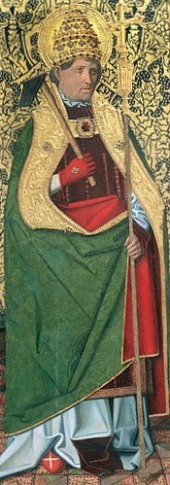
Very few facts are known about St. Blaise. It is believed that he
lived in the early fourth century, and was of a noble and wealthy
Christian Armenian family.
While
he was still very young, Blaise was made a bishop. Although the Edict
of Toleration (311), granting freedom of worship in the Roman Empire was
already five years old, there was still much persecution of Christians
in Armenia.
God instructed Blaise to escape his enemies by fleeing to the mountains, where he lived as a hermit.
Then, one day in 316, a hunting party stumbled upon the solitary
hermit and took him back to Cappadocia. Agricolaus, governor of
Cappadocia, tried to persuade Blaise to worship pagan idols.
The first time Blaise refused, and he was beaten.
The second time, he was hung from a tree and his flesh torn with iron hooks.
The third time he refused, he was beheaded.
As legend has it, a mother brought her young son, who was slowly
dying of suffocation due to a bone lodged in his throat, to be blessed
by Blaise. But at Blaise’s command the child was able to cough up the
bone and lived.
On his feast day, February 3rd, the blessing of St. Blaise is given: two
candles are consecrated and then held by a priest in a crossed position
either over the heads or at the throats of the faithful.
“I promise you, in the excessive mercy of my Heart that my
all powerful love will grant to all those who receive Holy Communion on
the first Friday for nine consecutive months, the grace of final
repentance; they shall not die in my disgrace nor without receiving the
sacraments; my divine Heart shall be their safe refuge in that last
moment.” — Our Lord to St. Margaret Mary
How to complete the First Friday’s Devotion:
Receive Holy Communion on each First Friday;
The nine Fridays must be consecutive;
They must be made in honor and in reparation to His Sacred Heart.
ACT OF REPARATION TO THE SACRED HEART OF JESUS
Sacred Heart of Jesus, animated with a desire to repair the outrages
unceasingly offered to Thee, we prostrate before Thy throne of mercy,
and in the name of all mankind, pledge our love and fidelity to Thee!
The more Thy mysteries are blasphemed, the more firmly we shall believe them, O Sacred Heart of Jesus!
The more impiety endeavors to extinguish our hopes of immortality, the more we shall trust in Thy Heart, sole hope of mankind!
The more hearts resist Thy Divine attractions, the more we shall love Thee, O infinitely amiable Heart of Jesus!
The more unbelief attacks Thy Divinity, the more humbly and profoundly we shall adore It, O Divine Heart of Jesus!
The more Thy holy laws are transgressed and ignored, the more we shall delight to observe them, O most holy Heart of Jesus!
The more Thy Sacraments are despised and abandoned, the more
frequently we shall receive them with love and reverence, O most liberal
Heart of Jesus!
The more the imitation of Thy virtues is neglected and forgotten, the
more we shall endeavor to practice them, O Heart of Jesus, model of
every virtue!
The more the devil labors to destroy souls, the more we shall be
inflamed with desire to save them, O Heart of Jesus, zealous Lover of
souls!
The more sin and impurity destroy the image of God in man, the more
we shall try by purity of life to be a living temple of the Holy Spirit,
O Heart of Jesus!
The more Thy Holy Church is despised, the more we shall endeavor to be her faithful children, O Sweet Heart of Jesus!
The more Thy Vicar on earth is persecuted, the more we will honor him
as the infallible head of Thy Holy Church, show our fidelity and pray
for him, O kingly Heart of Jesus!
O Sacred Heart, through Thy powerful grace, may we become Thy
apostles in the midst of a corrupted world, and be Thy crown in the
kingdom of heaven. Amen.
12 Promises of the Sacred Heart to St. Margaret Mary
1. I will give them all the graces necessary for their state of life.
2. I will give peace in their families.
3. I will console them in all their troubles.
4. I will be their refuge in life and especially in death.
5. I will abundantly bless all their undertakings.
6. Sinners shall find in my Heart the source and infinite ocean of mercy.
7. Tepid souls shall become fervent.
8. Fervent souls shall rise speedily to great perfection.
9. I will bless those places wherein the image of my Sacred Heart shall be exposed and venerated.
10. I will give to priests the power to touch the most hardened hearts.
11. Persons who propagate this devotion shall have their names eternally written in my Heart.
12. In the excess of the
mercy of my heart, I promise you that my all powerful love will grant
to all those who will receive Communion on the First Fridays, for nine
consecutive months, the grace of final repentance: they will not die in
my displeasure, nor without receiving the sacraments; and my Heart will
be their secure refuge in that last hour.
Be blessed, O most pure Virgin, for having vouchsafed to manifest
your shining with life, sweetness and beauty, in the Grotto of Lourdes,
saying to the child, St. Bernadette: "I am the Immaculate Conception." A
thousand times we congratulate you upon your Immaculate Conception. And
now, O ever Immaculate Virgin, Mother of mercy, Health of the sick,
Refuge of sinners, Comforter of the afflicted, you know our wants, our
troubles, our sufferings; deign to cast upon us a look of mercy. By
appearing in the Grotto of Lourdes, you were pleased to make it a
privileged sanctuary, whence you dispense your favors, and already many
have obtained the cure of their infirmities, both spiritual and
physical. We come, therefore, with the most unbounded confidence to
implore your maternal intercession. Obtain for us, O loving Mother, the
granting of our request.
(mention your request)
Through gratitude for your favors, we will endeavor to imitate your virtues, that we may one day share your glory.
Our Lady of Lourdes, Mother of Christ, you had influence with your
Divine Son while upon earth. You have the same influence now in Heaven.
Pray for us; obtain for us from your Divine Son our special requests if
it be the Divine Will. Amen
O Mary Immaculate, Our Lady of Lourdes, Virgin and Mother, Queen of
Heaven, chosen from all eternity to be the Mother of the Eternal Word
and in virtue of this title preserved from original sin, we kneel before
you as did little Bernadette at Lourdes and pray with childlike trust
in you that as we contemplate your glorious appearance at Lourdes, you
will look with mercy on our present petition and secure for us a
favorable answer to the request for which we are making this novena.
(mention your request)
O brilliant star of purity, Mary Immaculate, Our Lady of Lourdes,
glorious in your assumption, triumphant in your coronation, show unto us
the mercy of the Mother of God. Virgin Mary, Queen and Mother, be our
comfort, hope, strength, and consolation. Amen
Our Lady of Lourdes, pray for us.
Saint Bernadette, pray for us.
DAY TWO
Be blessed, O most pure Virgin, for having vouchsafed to manifest
yourself shining with light, sweetness and beauty, in the Grotto of
Lourdes, saying to the child Saint Bernadette: "I am the Immaculate
Conception!" O Mary Immaculate, inflame our hearts with one ray of the
burning love of your pure heart. Let them be consumed with love for
Jesus and for you, in order that we may merit one day to enjoy your
glorious eternity. O dispenser of His graces here below, take into your
keeping and present to your Divine Son the petition for which we are
making this novena.
(mention your request)
O brilliant star of purity, Mary Immaculate, Our Lady of Lourdes,
glorious in your assumption, triumphant in your coronation, show unto us
the mercy of the Mother of God. Virgin Mary, Queen and Mother, be our
comfort, hope, strength, and consolation. Amen
Our Lady of Lourdes, pray for us.
Saint Bernadette, pray for us.
DAY THREE
"You are all fair, O Mary, and there is in you no stain of original
sin." "O Mary, conceived without sin, pray for us who have recourse to
thee." O brilliant star of sanctity, as on that lovely day, upon a rough
rock in Lourdes you spoke to the child Bernadette and a fountain broke
from the plain earth and miracles happened and the great shrine of
Lourdes began, so now hear our fervent prayer and grant us, we beseech
you, the petition we so earnestly seek.
(mention your request)
O brilliant star of purity, Mary Immaculate, Our Lady of Lourdes,
glorious in your assumption, triumphant in your coronation, show unto us
the mercy of the Mother of God. Virgin Mary, Queen and Mother, be our
comfort, hope, strength, and consolation. Amen
Our Lady of Lourdes, pray for us.
Saint Bernadette, pray for us.
DAY FOUR
O Immaculate Queen of Heaven, we your wayward, erring children, join
our unworthy prayers of praise and thanksgiving to those of the angels
and saints and to your own, that the One, Holy, and Undivided Trinity
may be glorified in heaven and on earth. Our Lady of Lourdes, as you
looked down with love and mercy upon Bernadette as she prayed her rosary
in the Grotto, look down now, we beseech you, with love and mercy upon
us. From the abundance of graces granted you by your Divine Son, sweet
Mother of God, give to each of us all that your motherly heart sees we
need and at this moment look with special favor on the grace we seek in
this novena.
(mention your request)
O brilliant star of purity, Mary Immaculate, Our Lady of Lourdes,
glorious in your assumption, triumphant in your coronation, show unto us
the mercy of the Mother of God. Virgin Mary, Queen and Mother, be our
comfort, hope, strength, and consolation. Amen
Our Lady of Lourdes, pray for us.
Saint Bernadette, pray for us.
DAY FIVE
O Mary Immaculate, Mother of God and our mother, from the heights of
your dignity look down mercifully upon us while we, full of confidence
in your unbounded goodness and confident that your Divine Son will look
favorably upon any request you make of Him in our behalf, we beseech you
to come to our aid and secure for us the favor we seek in this novena.
(mention your request)
O brilliant star of purity, Mary Immaculate, Our Lady of Lourdes,
glorious in your assumption, triumphant in your coronation, show unto us
the mercy of the Mother of God. Virgin Mary, Queen and Mother, be our
comfort, hope, strength, and consolation. Amen
Our Lady of Lourdes, pray for us.
Saint Bernadette, pray for us.
DAY SIX
O glorious Mother of God, so powerful under your special title of
Our Lady of Lourdes, to you we raise our hearts and hands to implore
your powerful intercession in obtaining from the benign Heart of Jesus
all the helps and graces necessary for our spiritual and temporal
welfare and for the special favor we so earnestly seek in this novena.
(mention your request)
O Lady of Bernadette, with the stars of heaven in your hair and the
roses of earth at your feet, look with compassion upon us today as you
did so long ago on Bernadette in the Grotto of Lourdes.
O brilliant star of purity, Mary Immaculate, Our Lady of Lourdes,
glorious in your assumption, triumphant in your coronation, show unto us
the mercy of the Mother of God. Virgin Mary, Queen and Mother, be our
comfort, hope, strength, and consolation. Amen
Our Lady of Lourdes, pray for us.
Saint Bernadette, pray for us.
DAY SEVEN
O Almighty God, Who by the Immaculate Conception of the Blessed
Virgin Mary did prepare a worthy dwelling place for Your Son, we humbly
beseech You that as we contemplate the apparition of Our Lady in the
Grotto of Lourdes, we may be blessed with health of mind and body. O
most gracious Mother Mary, beloved Mother of Our Lord and Redeemer, look
with favor upon us as you did that day on Bernadette and intercede with
Him for us that the favor we now so earnestly seek may be granted to
us.
(mention your request)
O brilliant star of purity, Mary Immaculate, Our Lady of Lourdes,
glorious in your assumption, triumphant in your coronation, show unto us
the mercy of the Mother of God. Virgin Mary, Queen and Mother, be our
comfort, hope, strength, and consolation. Amen
Our Lady of Lourdes, pray for us.
Saint Bernadette, pray for us.
DAY EIGHT
O Immaculate Mother of God, from heaven itself you came to appear to
the little Bernadette in the rough Grotto of Lourdes. As Bernadette
knelt at your feet and the miraculous spring burst forth from the earth,
as multitudes have knelt ever since before your shrine, O Mother of
God, we kneel before you today to ask that in your mercy you plead with
your Divine Son to grant the special favor we seek in this novena.
(mention your request)
O brilliant star of purity, Mary Immaculate, Our Lady of Lourdes,
glorious in your assumption, triumphant in your coronation, show unto us
the mercy of the Mother of God. Virgin Mary, Queen and Mother, be our
comfort, hope, strength, and consolation. Amen
Our Lady of Lourdes, pray for us.
Saint Bernadette, pray for us.
DAY NINE
O glorious Mother of God, to you we raise our hearts and hands to
implore your powerful intercession in obtaining from the benign Heart of
Jesus all the graces necessary for our spiritual and temporal welfare,
particularly for the grace of a happy death. O Mother of our Divine
Lord, as we conclude this novena for the special favor we seek at this
time, we feel animated with confidence that your prayers in our behalf
will be graciously heard. O Mother of My Lord, through the love you bear
to Jesus Christ and for the glory of His Name, hear our prayers and
obtain our petitions.
(mention your request)
O brilliant star of purity, Mary Immaculate, Our Lady of Lourdes,
glorious in your assumption, triumphant in your coronation, show unto us
the mercy of the Mother of God. Virgin Mary, Queen and Mother, be our
comfort, hope, strength, and consolation. Amen
Think of what the Saints have done for their neighbor because they loved God. But what Saint’s love for God can match Mary’s? She loved Him more in the first moment of her existence than all the Saints and angels ever loved Him or will love Him. Just as there is not one among all the Blessed who loves God as Mary does, so there is no one, after God, who loves us as much as this most loving Mother does.
In Israel the Law of Moses considered the first-born male
child to belong to God. The same law considered the mother “unclean”
after giving birth. For forty days she could not go out or touch
anything sacred.
In order to “ransom” the child and “cleanse” the mother, a visit to
temple was required, which involved a sacrificial offering of a lamb and
a dove. If the family had limited means, the lamb could be exchanged
for a dove. Thus, two doves were sufficient to fulfill the precept.
Forty days after the birth of Jesus, St. Joseph again helped his
virgin wife onto the donkey only now she carried the creator of the
universe in her arms. Slowly they made their way to Jerusalem to comply
with the Mosaic Law. In their case, there was really no need for
“ransom” or “cleansing”, Jesus being God, and Mary being a virgin
before, during and after the birth of her divine Son (CCC 496-507, 510).
Yet, before the eyes of men, unaware of these circumstances, the holy
family wished to give an example of humility and obedience by
submitting to the age-old mandate. The fact that St. Joseph offered two
doves is evidence of their poverty.
At that time there was a priest, a venerable old man named Simeon to
whom the Holy Ghost had revealed that he would not die before seeing
Christ the Redeemer (Luke 2:26).
As the holy family entered the temple, Simeon was inspired to meet them, and taking the Child in his arms exclaimed: “Now thou dost dismiss thy servant, O Lord, according to thy word in peace; because my eyes have seen thy salvation…” (Luke 2:29-30)
And turning to Mary Most Holy, he prophesized, “Behold this child
is set for the fall and resurrection of many in Israel, and for a sign
which shall be contradicted…and thy own soul a sword shall pierce…” (Luke 2:34-35)
An eighty-four year old woman, the holy prophetess Anna, who lived in
the temple, also gave thanks to God and spoke of Him to all present.
(Luke 2:36-38)
The feast of the Presentation of the Lord was celebrated in the
Church of Jerusalem as early as the mid-fourth century and probably
earlier.
Throughout the history of the Church this feast has been called The Presentation, The Purification of Mary and also Candlemas, as, traditionally, candles were blessed on February 2nd.
Saint Joan was born on December 27, 1556, in Bordeaux in 1556, the
daughter of Richard de Lestonnac, a member of the Parliament of
Bordeaux, and Jeanne Eyquem, the sister of the noted philosopher, Michel
Eyquem de Montaigne.
She grew up at a time when the conflict between the Protestant
revolutionaries and the defenders of the Catholic faith was at its
height. This was painfully evident in her own family: while her mother
became an enthusiastic Calvinist and tried to persuade her to convert,
her father and her uncle Montaigne adhered to the Catholic faith and
were her support in remaining a Catholic.
Pont de Pierre in Bordeaux, France
At 17 years old, she was married to Gaston de Montferrant, with whom
she had seven children, only four of which survived infancy. Despite the
heartbreak of losing three infant children, Joan and Gaston enjoyed a
happy marriage which lasted for 24 years until Gaston died suddenly in
1597. This marked the beginning of a very painful period in Joan’s life,
with the further death of three important men in her life: her father,
her uncle and her eldest son.
Religious life
At the age of 46, and with her children now grown, Saint Joan turned
to a contemplative life and entered the Cistercian Monastery in Toulouse
where she was given the religious name of Jeanne of Saint Bernard.
After just six months of relative peace and spiritual comfort, she
became very ill and had to leave the monastery. She then went to live on
her estate to recover her health. Eventually she was able to perform
many acts of charity, including distributing food and alms to the poor.
Soon Saint Joan began to meet regularly with young women of her
social class to pray and discuss religious questions. She developed a
strong devotion to Saints Scholastica, Clare of Assisi, Catherine of
Siena and Teresa of Avila.
Practicing
the corporal works of mercy is a key component of growing in sanctity,
as Saint Joan and her companions in the faith demonstrated.
The Holy Ghost inspired her with the idea of forming a new
congregation, and several young girls joined her as novices. They
ministered to victims of a plague that struck Bordeaux in 1605, risking
their lives to minister to the poor in the slums. Saint Joan and her
young followers were also determined to counteract the evils of heresy
promulgated by Calvinism, a certain “plague” of the soul.
The Compagnie de Notre-Dame
Saint Joan of Lestonnac's brother, a Jesuit attached to the college
in Bordeaux, arranged a meeting between her and two Jesuit fathers: Jean
de Bordes and François de Raymond.
Jeanne
de Lestonnac (1556-1660), Catholic saint and founder of Sisters of the
Company of Mary, Our Lady, holds the constitutions of the order.
The Jesuits asked Saint Joan to serve as foundress of a new teaching
order for young women, a sort of “Jesuit” formation for young ladies.
The three decided upon a cloistered community to follow the Benedictine
rule, modified to allow sisters to teach.
The new institute, approved by Pope Paul V in 1607, was the first
religious order of women teachers approved by the Church, taking the
name of the Compagnie de Notre-Dame.
In 1608, Joan and her companions received the religious habit from the Archbishop of Bordeaux.
Joan was elected superior in 1610, and the group moved in September
to a large, old monastery on rue du Hâ. They were well received and
financially supported by the city's elite. The community established its
first school for girls in Bordeaux.
Foundations proceeded in
Beziers, Périgueux, and Toulouse through Lestonnac's personal
connections, as well as her connections with the Jesuits and Bordelaise
political elites.
At her death on February 2, 1640, at the age of 84, thirty houses existed in France. Many miracles occurred at her tomb.
Saint Joan De Lestonnac was beatified in 1900 by Pope Leo XIII and canonized on May 15, 1949, by Pope Pius XII.
As of 2016, her religious order has over 1,450 sisters that can be
found in 27 countries throughout Europe, Africa, as well as North and
South America.
Henry Morse was born to protestant parents in Suffolk, England, in
1595, and left his home to study law in London where he learned of the
Catholic Faith and converted at the age of 23. Henry traveled to Rome
where he was ordained a priest.
He made his way back home to England, where he was immediately arrested and imprisoned at York with a fellow priest, a Jesuit.
The
three years of his imprisonment became for the young ordained priest an
intense novitiate, and by the time he was released, he had made his
final vows as a Jesuit.
Upon his release from prison, Henry was banished from England, but
returned in 1633 under a false name. During the plague of 1636, Henry
would travel to the homes of Catholics and Protestants alike, caring for
the sick. He caught the plague from his patients three times, but
miraculously recovered each time.
The people of England were so touched by Henry’s zeal and goodness,
over 100 people converted to Catholicism in less than a year.
He was then betrayed by a friend, arrested by the authorities and
again banished from England. Instead, he traveled to Southern England
and ministered to the people there. Then, in 1645, Henry was arrested
for the last time and sent to London for execution.
After celebrating a final Mass, Fr. Henry Morse proclaimed his faith
to the crowd, prayed aloud for himself and for his executioners and was
executed. “I am come hither to die for my religion.” He said to the
crowd: “…I pray that my death may be some kind of atonement for the sins
of this kingdom.”
Then, striking his breast three times, he gave a signal to a priest hidden in the crowd to give him absolution and said: “Into your hands, O Lord, I commend my spirit.”
Do you want Our Lord to give you many graces? Visit Him often. Do you want Him to give you few graces? Visit him seldom. Visits to the Blessed Sacrament are powerful and an indispensable means of overcoming the attacks of the devil. Make frequent visits to Jesus in the Blessed Sacrament and the devil will be powerless against you.
The youngest of a poor farming family of Piedmont in northern Italy, John Melchior Bosco was born on August 16, 1815.
He lost his father at the age of two, and his saintly “Mamma” Margarita brought up three sons in extreme poverty and want.
When he was nine, John had the first of a series of vivid dreams that
left a profound impression upon him for the rest of his life. Standing
in a field filled with fighting, cursing and blaspheming lads, he tried
in vain to pacify them with arguments and fists. Then he saw a beautiful
lady who said, “Softly, softly does it…if you wish to win them! Take your shepherd’s staff and lead them to pasture.” At this the boys were transformed into wild beasts and then into lambs.
Intelligent and talented, John Bosco received his first instruction
from a priest who, perceiving his gifts, took him under his wing.
Supported by his mother and facing many difficulties, he pursued the
priesthood, and at twenty-two was ordained in the diocese of Turin.
Turin, a vast industrialized city of 117,000 inhabitants, had seen an
influx of migrants from the country in search of work. Many young men,
some as young as 11 and 12, lived in the streets, under bridges or in
bleak public dormitories.
Visiting prisons in the city, Don Bosco was heartsick at the condition of many of these youth who ended up behind bars.
In 1842 he began to gather these social outcasts, befriend them and
instruct them in the Catholic faith. By 1846 the numbers of this young
flock had risen to 400.
Despite the anti-clerical government’s opposition to new religious
orders, Don Bosco went on to found the Oratory of Saint Francis de
Sales, known as the Salesians, where boys learned the faith, Christian
morality, academics and a trade.
A teacher, spiritual director, mystic and miracle worker, Don Bosco
knew how to mingle the spiritual with the human so as to win these young
souls. He was beloved of his students, guiding them out of darkness and
hopelessness into light and hope.
At the time of Don Bosco’s death on January 31, 1888 the Salesians
had 250 houses dispersed throughout the world. His Feast day is also
celebrated on January 31.
Pray with great confidence, with confidence based upon the goodness and infinite generosity of God and upon the promises of Jesus Christ. God is a spring of living water which flows unceasingly into the hearts of those who pray.
Angela de Merici was born in Desenzano, on the southwestern shore of beautiful Lake Garda, in northern Italy.
Left an orphan at the age of ten with an older sister and a brother,
they were taken in by an uncle living in the neighboring town of Salò.
Photo by: Benoit Lhoest
Angela
was much distressed when her sister suddenly died without the
assistance of the last sacraments. At this time she had a vision, the
first of many in her life, which set her mind at rest as to her sister’s
salvation. In gratitude, she made a special consecration of herself to
God, joined the Third Order of St. Francis and began to lead a life of
great austerity.
After her uncle died when she was twenty, Angela moved back to
Desenzano. Convinced of the need to instruct young girls in the Faith,
she converted her home into a school.
In a vision, she was shown that she would found a congregation for
the instruction of young girls. Angela talked with fellow Franciscan
tertiaries and friends who began to help her.
Though petite in
stature, Angela had looks, charm and leadership. Her school thrived and
she was approached about starting a similar school in the larger city of
Brescia where she came in contact with leading families whom she
influenced with her great ideals.
In 1525 on a pilgrimage to Rome, Pope Clement VII, who had heard of
her holiness, suggested she found a congregation of nursing sisters in
Rome. But Angela who felt called elsewhere and shunned publicity,
declined and returned to Brescia.
On November 25, 1535, with twelve other virgins, Angela Merici laid
the foundations for her order for the teaching of young women, the first
congregation of its kind in the Church. She placed her order under the
protection of St. Ursula the patroness of medieval universities and
popularly venerated as a leader of women.
To this day her followers are known as the Ursulines.
Angela died only five years after establishing the Ursulines, and was canonized in 1807 by Pope Pius VII.
Timothy and Titus were two of St. Paul’s favorite and most trusted disciples.
Saint Timothy
Timothy had a Greek father and a Jewish mother
named Eunice. His grandmother, Lois, was the first to become Christian
in the family.
Timothy
was a convert of St. Paul around the year 47 and later joined his
apostolic work. He is the recipient of St. Paul’s Epistles to Timothy in
the Gospel. He was with the great Apostle when the church of Corinth
was founded and worked with him for fifteen years.
St. Paul sent Timothy on difficult missions, often to face
disturbances at churches he had just established, and was installed by
Paul as his representative to the church of Ephesus.
Timothy was relatively young for the work he was doing as we read in
Tim. 4:12, “Let no one have contempt for your youth,” and that he
suffered with his health when we read in Tim. 5:23 “Stop drinking only
water, but have a little wine for the sake of your stomach and your
frequent illnesses.”
Timothy was with St. Paul in Rome during his house arrest, and at
some point was in prison himself. Around the age of eighty he tried to
halt a pagan procession and was beaten and stoned to death.
Saint Titus
Titus was Greek and a convert from paganism; he is mentioned in several of the Pauline epistles.
He is seen as a peacemaker, administrator and great friend of the Apostle Paul.
When
St. Paul was having trouble with the community at Corinth, Titus was
the bearer of his severe letter and with tact, firmness and charity
succeeded in smoothing things out, which gave St. Paul great joy.
St. Paul charged Titus with the administration of the Christian
community in the Isle of Crete and instructed him to organize the
faithful, correct abuses and appoint presbyter-bishops. There is no
record of his death.
Saul, later Paul, was a Jew of the tribe of Benjamin. Being born at
Tarsus in Cilicia, he was by privilege a Roman Citizen. As a young man
he studied the Law of Moses in Jerusalem under Gamaliel, a learned and
noble Pharisee, and became a scrupulous observer of the law.
Later, sincerely persuaded that the followers of Jesus opposed God’s
true law, he became a zealous persecutor of the first Christians. He
took part in the murder of St. Stephen, deacon and first martyr of the
Catholic Church.
In the fury of his zeal, he next applied to the high priest for a
commission to travel to Damascus, then a Christian center, to arrest all
followers of Jesus.
He was nearing the end of his trip on the road to Damascus with a
contingent of armed men, when, about noon, they were surrounded by a
brilliant light. Saul was struck to the ground, and though all saw the
light he alone heard a clear voice:
“Saul, Saul, why do you persecute Me?” Saul answered,
“Who are You, Lord?” and the voice rejoined, “Jesus of Nazareth Whom
you persecute. It is hard for you to kick against the goad.” (Acts
9:4-5)
Then Christ Our Lord instructed him to arise and proceed to Damascus
where he would learn what was expected of him. On arising Saul found
that he was blind, and was led into the town to the house of a man
called Judas.
In Damascus, Christ appeared to Ananias, a virtuous man, and bid him
go to Saul. Ananias trembled at the name of the well-known persecutor
but obeyed.
Finding
Saul, the holy man laid his hands upon him and said, “Brother Saul, the
Lord Jesus, who appeared to you on your journey, sent me that you may
receive your sight, and be filled with the Holy Ghost.” Immediately
something like scales fell from Saul’s eyes and he could see.
Saul arose, was baptized, and ate. He stayed for a while with the
disciples of Damascus and began to preach in the synagogues that Christ
Jesus was the Son of God to the astonishment of all who knew his
previous persuasion.
Saul, who became Paul, was the great apostle of the Gentiles, preaching far and wide to the pagan world.
Do not lose your inner peace for anything whatsoever, not even if your whole world seems upset. If you find that you have wandered away from the shelter of God, lead your heart back to Him quietly and simply.
Francis de Sales was born in the Duchy of Savoy, in present-day
France, in the Château de Sales. His father was Francis, Lord of Boisy,
Sales and Novel and his mother Frances de Sionnz, the daughter of a
prominent magistrate. Born prematurely, Francis was delicate but slowly
strengthened, though his health was never robust.
Being the oldest son of six, his father destined him for a secular
career, despite Francis’ early leanings to the religious life. He
attended the Jesuit college of Clermont in Paris where he excelled in
rhetoric, philosophy and theology. During this period, Francis suffered a
terrible temptation to despair of being saved. He was miraculously
delivered before an image of Our Lady and there and then made a vow of
chastity.
At twenty-four he received his law degree in Padua. With a brilliant
career ahead of him, and a noble prospect of marriage, Francis declared
his intention of following an ecclesiastical career. A sharp struggle
ensued between him and his father who only relented in his opposition
when Bishop Granier of Geneva offered Francis the post of Provost of the
Chapter of Geneva in the patronage of the Pope.
Francis was ordained in 1593. The next year he volunteered to
evangelize the region of Le Chablais, recently returned to the Duchy of
Savoy from Calvinist Geneva and on which the Genevans had imposed their
creed. With enormous tact, charity and zeal the young provost confuted
the preachers sent to debate him, converted several prominent Calvinists
and at great personal risk and traveling extensively brought back to
the Church tens of thousands of the people of Chablais.
He was consecrated Bishop of Geneva in 1602, ruling his diocese from
Annecy in France where he immediately established regular catechetical
lessons for young and old. He himself taught the children of whom he was
beloved.
He visited the parishes throughout his rugged diocese, made
provisions for the clergy, reformed religious orders, and preached
incessantly, everywhere known for his kindness and patient zeal.
Those who flocked to hear the holy bishop said, “Never have such holy, apostolic sermons been preached.”
With St. Jeanne Frances de Chantal he founded the Order of the
Visitation for girls and widows who had not the health or inclination
for the austerities of the great orders.
In the midst of all his activities he found time to write numerous
letters and works, among the most famous being his Introduction to the
Devout Life.
Francis de Sales died in 1622 at age fifty-six and crowds thronged to venerate him.
He was canonized in 1665 and proclaimed a Doctor of the Church by Blessed Pope Pius IX in 1877.
God does not wish to see us in affliction, but it is we who draw down sufferings upon ourselves, and by our sins enkindle the flames in which we are to burn. God punishes us, because we oblige Him to do so.
St. Vincent was a native of Huesca, Spain, but lived in Zaragoza.
He was ordained a deacon by his friend, Saint Valerius of Zaragoza.
In 303 the Roman emperor published edicts against the clergy and in
304 against the laity. Vincent and his bishop were imprisoned in
Valencia, and though they were subjected to hunger and torture, they
thrived.
Speaking for Valerius who had a speech impediment, Vincent angered
Dacian, the governor, by his outspoken and fearless manner. Dacian
exiled Valerius but subjected Vincent to the gridiron. Seeing the deacon
unmoved, the governor had the torturers beaten.
Finally Dacian suggested a compromise. He suggested that Vincent at
least give up the Sacred Scriptures to be burned according to the
emperor’s edict. On the saint’s refusal, Dacian lost control and had him
thrown in jail where the holy deacon converted the jailer.
In despair, the governor wept but, strangely enough, ordered the
martyr to be given some rest. But Vincent had earned his eternal rest.
As soon as he was laid on a bed, he gave up his faithful soul to God.
The doctor should not meddle. The right of the child is equal to the right of the mother’s life. The doctor can’t decide; it is a sin to kill in the womb.
Vincent
Pallotti was born in Rome in 1795, the son of a well-to-do grocer. In
school he was known as a “little saint” and, although bright, he was
also considered “a bit slow” – an illusion amply disproved by the
apostolic endeavors of his life.
He was ordained a priest when
only twenty-three, and taking his doctorate in theology soon after,
became an assistant professor at the Sapienza University of Rome.
As
a close friend of St. Gaspar del Bufalo, a missionary in Italy, he
decided to give up his teaching post for a more apostolic life. Inflamed
by the missionary spirit, he longed to send missionaries throughout the
world and to work for the conversion of the Mohammedans.
Don
Pallotti, as he was known, was a great confessor and fulfilled that
office at several colleges. He had an intense devotion to the Mystery of
the Most Holy Trinity and a tender love for the Blessed Virgin Mary.
In
1835 he began the Society of Catholic Apostolate. He organized schools
for shoemakers, tailors, coachmen, joiners and market-gardeners to
improve their education and general pride in their trade. He started
evening classes for young workers and an institute to teach better
methods of agriculture.
Widely regarded as another St. Philip
Neri, he was indefatigable in his work with those in need. Burning with
zeal to save sinners, he once dressed as an old woman to reach a dying
person whose relative had sworn to shoot the first priest to approach.
He was also a great exorcist, and healed the sick with a word of
encouragement or a blessing. He foresaw the future, and once predicted
the movement of Catholic Action, even its name.
Vincent
Pallotti died on January 22, 1850 at the age of fifty-five. When his
body was exhumed in 1906 and again in 1950, it was found to be
completely incorrupt. It is enshrined in the Church of St. Salvatore in
Onda in Rome.
Agnes
was born around 291 in a Christian, patrician family of Rome, and
suffered martyrdom in the terrible persecution of Diocletian.
As a young maiden, she pledged herself to Christ and defended her virginity to the death.
Exceptionally
beautiful, she turned down numerous suitors, but when she refused
Procop, the Prefect’s own son, things became very complicated. Procop
tried to win Agnes with gifts and promises but she answered: “I’m
already promised to the Lord of the Universe. He is more splendid than
the sun and the stars, and He has said He will never leave me!”
Angered,
Procop took the maiden before his father, and accused her of being a
Christian. The Prefect tried to turn her from her Faith first by
cajolements, and then by placing her in chains, but she only rejoiced.
The
pagan official, set on overcoming Agnes by any means, next had her
taken to a house of prostitution but she was visibly protected by an
angel.
Finally, Agnes was condemned to death, but she was happy
as a bride about to meet her bridegroom. Even pagan bystanders were
moved to tears at the sight of the radiant maiden going to her death,
and begged her to relent, to which she retorted: “If I were to try to
please you, I would offend my Spouse. He chose me first and He shall
have me!” Then praying, she offered her neck for the death stroke.
St.
Agnes is one of seven women besides the Blessed Virgin to be mentioned
in the Canon of the Mass. She is the patron of chastity, young girls,
engaged couples, rape victims and virgins. She is depicted holding a
lamb as her name in Latin means “lamb”, “agnus”. But the name “Agnes” is
actually taken from the Greek “hagne” meaning chaste, pure, sacred.
Agnes’
relics repose beneath the high altar of the Church of Sant’Agnese Fuori
le mura, built upon the place she was originally buried. This church
was built in her honor by the daughter of the Emperor Constantine, and
is one of the oldest in Rome. St. Agnes’ skull is in the Church of
Sant’Agnese in Agone at Piazza Navona.
God's purpose in creating us is to draw forth from us a response of love and service here on earth, so that we may attain our goal of everlasting happiness with Him in heaven.
Although St. Fabian and St.
Sebastian’s feasts are liturgically separate, they are celebrated on the
same day; and the relics of the two saints are both kept and venerated
together in the Basilica of St. Sebastian in Rome.
Saint Fabian
Pope St. Fabian was the first layman ever to be elected to the
papacy. Before entering into his pontificate in 236, Fabian was a humble
and well respected farmer.
Upon the death of his predecessor, Pope Anterus, Fabian traveled with
some companions to Rome to mourn his passing with the faithful and to
be present when the new pope was elected.
While attending the council to determine who Anterus’ successor would
be, a dove suddenly appeared and descended upon the head of Fabian as a
clear sign of his divine election. By unanimous vote, Fabian was
instantly chosen as the next pope.
During his fourteen-year pontificate, the Church enjoyed relative
peace under Emperor Philip, and Fabian was able to do much to
consolidate and develop the Church.
He died a martyr’s death in 250 and was one of the first victims of
the persecution under Emperor Decius, who considered him a rival and
personal enemy. He was buried in the Catacomb of Calixtus.
Saint Sebastian
Celebrated alongside St. Fabian is the Roman martyr, Sebastian.
Though
the narrative of his story is largely unhistorical, legend tells us
that he was a young officer in the imperial army, who secretly dedicated
himself to the spiritual and temporal assistance of the Christians and
martyrs.
It was he who exhorted Sts. Marcus and Marcellianus to constancy in
the Faith and inspired them with the courage to face their deaths when
they began to waver under the pleas of their friends.
Being thus discovered, Sebastian was condemned by Emperor Diocletian
and delivered over to Mauritanian archers to be shot to death.
Miraculously, he survived though and was nourished back to health by
St. Zoe, a convert of his and mother of Sts. Marcus and Marcellianus.
Refusing to flee, Sebastian confronted the Emperor again and harshly reproached him for his cruelty to the Christians.
He died in 288 after being clubbed to death and his body thrown into
the common sewer. It was privately removed, and he also was buried in
the cemetery of Calixtus.
Wulfstan (Wulstan) was a native of Warwickshire, England.
Photo by: Christopher Guy
After his priestly ordination, he became a novice at the monastery of
Worcester where he edified all by the innocence and sanctity of his
life. He was assiduous at prayer, often watching all night in church.
The first task assigned to him at the monastery was the instruction
of children, then treasurer and eventually - though against his fierce
resistance - he was made prior. In 1062, he was elected Bishop of
Worcester.
Wulfstan was a powerful preacher, often moving his audience to tears.
To his vigorous action is particularly attributed the suppression of
the heinous practice among the citizens of Bristol of kidnapping men
into slavery and shipping them over to Ireland. St. Patrick who became
the great apostle and patron of the Irish was such a slave in his youth.
After the Norman conquest of England, William the Conqueror was
initially uncertain about Wulfstan. But acknowledging his capacity and
uprightness, Wulfstan was the only bishop William retained at his post
under the new rule.
For the next thirty years Wulfstan rebuilt his cathedral, cared for
the poor and put forth great effort in alleviating the harsh decrees of
the Normans upon the vanquished Saxons.
Whenever the English complained of the oppression of the Normans, Wulfstan told them: “This is a scourge of God for our sins, which we must bear with patience.”
The saintly bishop died on January 19 at eighty-seven years of age
after washing the feet of a dozen poor men, a humble ritual he performed
daily. He was canonized in 1203.
At the name of Mary, the angels rejoice and the demons scramble.
Thomas a Kempis, author of the famous Imitation of Christ, affirms that:
“The devils fear the queen of heaven
so much that by just hearing her name pronounced they fly from the
person who utters it like from a burning fire”.
St. Ambrose compares her name to a sweet ointment, because whenever pronounced, it is a healing balm to our sinful souls.
“The name of Mary heals sinners, rejoices hearts and inflames them with God’s love”, says St. Alphonsus Liguori in his Glories of Mary.
Our Blessed Lady revealed to St. Bridget that there is not on earth a
sinner, no matter how far he may be from God’s love who, on invoking
her name with the resolution to repent, does not cause the devil to flee
from him or her. No matter how imprisoned a sinner may be in the
devil’s grip, as soon as the latter hears this sinner pronounce the
sweet name of Mary, he is obliged to release him or her.
Our Lady also revealed to St. Bridget that in the same way as the
devils fly from a person invoking her name, so do the angels approach
pious souls that pronounce her name with devotion.
So, fellow sinners, let us invoke this “air-clearing” sweet and
powerful name of Mary often! We and our loved ones will be the better,
the freer and the happier for it!
Taken from The Glories of Mary by Saint Alphonsus Liguori
Margaret
of Hungary was the daughter of King Bela IV, a champion of Christendom,
and Maria Laskarina, a pious Byzantine princess. Bella IV being the
brother of St. Elizabeth of Hungary, Margaret was the saintly Queen of
Hungary’s blood niece.
King Bela and his queen, worried about an
impeding Tartar invasion, vowed to dedicate to God the child they were
expecting. Bela was victorious over the Tartars, and little Margaret was
taken to the Dominican monastery at Vezprem at the age of three.
The
child thrived in her new surroundings. By age four she had memorized
the Little Office of the Blessed Virgin Mary. At age ten she was moved
to a convent built for her by her father on an island – today named
Margaret Island – on the Danube near Buda and there she professed her
vows at age twelve.
King Ottokar II of Bohemia having seen
Margaret at eighteen years of age, ignoring her religious habit, sought
her in marriage. A dispensation would have been possible in this case,
and King Bela seemed to favor the prospect for political reasons. Yet,
Margaret adamantly refused declaring she would have no other bridegroom
than Jesus Christ, and would rather cut off her nose and lips.
Margaret’s
was a life of astounding penance, prayer and charity toward the poor.
To avoid preferential treatment in the convent because of her royal
rank, she sought the most menial tasks to the point that a maid once
said that she was humbler than a servant. Her
body worn out by the fatigue of long hours of labor, fasting and
prayer, Margaret died at the age of twenty-eight on January 18, 1270.
The virtuous princess was universally venerated as a saint from the time
of her death.
People hate the truth for the sake of whatever it is they love more than the truth. They love truth when it shines warmly upon them and hate it when it rebukes them.
Anthony was born in 251 in the village of Koman, south of Memphis in
Egypt. Anthony’s well-to-do parents died before he was twenty leaving
him in charge of a younger sister, and the owner of a considerable
estate.
In 272, wishing to leave all to follow Christ, after securing his
sister’s support and upbringing, he distributed his holdings among the
poor, and retired to a life of solitude. He lived a life of penance,
sleeping on a rush mat on the bare floor, eating and drinking bread and
water. The devil was allowed to attack him grievously, on one occasion
subjecting him to a beating that left him for dead, only to be saved by
friends. Anthony emerged victorious from all these trials.
At the age of thirty-five, the holy hermit moved from his solitude in
the vicinity of his native village, to a location across the eastern
branch of the river Nile where he made his abode in some ruins on the
summit of a mountain. There he lived for twenty years, rarely seeing any
man except one who brought him bread every so often.
St. Athanasius, his friend and first biographer, speaks of Anthony as
not only spending his time in prayer and meditation but also in making
mats. He also gardened.
At fifty-four, being sought out by men who wanted to follow his way
of life, Anthony founded his first monastery in Fayum in a series of
scattered caves, which he visited occasionally.
In 311 as religious persecution again broke out under Emperor
Maximinus, Anthony left his solitude to give courage to the martyrs in
Alexandria. When the persecution abated, he returned to his previous
solitude. He later founded another community of monks near the Nile
called Pispir, though he continued to live on his mountain.
Years later, at the request of the bishops, Anthony again journeyed
to Alexandria to confute the Arians, who denied the divinity of Christ.
All ran to hear the holy hermit, and even pagans, struck by the dignity
of his character, flocked around him. Heathen teachers and philosophers
often sought him out, and were astounded at his meekness and wisdom.
Anthony died at age 101 surrounded by his spiritual sons in his hermitage on Mount Kolsim.
His last words were, “Farewell, my children, Anthony is departing and will no longer be with you.” Thus saying, he stretched out his feet and calmly ceased to breathe.
*Header image: Saint Anthony of Egypt driving away devils. Drawing by Grégoire Huret (1606–1670).
Honoratus was born into a patrician Roman family that had settled in
Gaul, present-day France. As a young man, he renounced paganism and won
his elder brother Venantius over to Christ.
Although their father objected and placed obstacles before them, the
two brothers decided to leave the world. Under the tutelage of the
hermit St. Caprasius they sailed from Marseilles with the intention of
leading a secluded life in a Grecian desert.
In Greece, illness struck and Venantius died in peace. Also ill,
Honoratus was obliged to return to Gaul with his instructor. At first,
he lived as a hermit in the mountains near Fréjus. Later, he settled on
the island of Lérins off the southern coast of France. Followed by
others, he founded a monastery on the island about the year 400. The
monastic community is active to this day. St. Patrick, the great apostle
of Ireland is said to have studied at Lérins.
In 426 Honoratus was pressed upon to accept the bishopric of Arles,
where he reestablished Catholic orthodoxy, challenged by the Arian
heresy. He died three years later exhausted from his apostolic labors.
The island of Lérins, today the island of Saint Honorat just south of
Cannes, is home to Cistercian monks who live in a majestic monastery
and produce fine wines and liqueurs which are well-known throughout the
world.
Sava, born in 1174, was the youngest of the three sons of Stephen I,
founder of the Nemanyde dynasty, of the independent Serbian State.
At the age of seventeen he became a monk on Mount Athos, on the Greek
peninsula. Abdicating the throne in 1196, his father joined him and
together they established the thriving monastery of Khilandari.
Sava returned to Serbia in the year 1207 to help settle an inheritance dispute between his two brothers.
As his brother Stephen took the throne, Sava set to work to revamp
the Faith in his country, which had become lax and mixed up with
paganism.
With the help of missionary monks from Khilandari, he established
several important monasteries in Serbia. He also convinced the Eastern
Emperor Theodore II, a relative, to establish Serbia’s own bishopric in
order that its clergy might be better managed. The emperor established
the prince-monk Sava as Serbia’s first Metropolitan of the new
hierarchy.
Under Sava, his brother Stephen II was duly recognized by the Holy
See and although he had already been crowned by a papal legate in 1217,
he was again crowned by his brother the Archbishop in 1222 with a crown
sent by Pope Honorius III.
Thus, the retiring young prince, who left home to become a monk,
succeeded before the age of fifty in consolidating, both civilly and
religiously, the country founded by his father.
St. Sava died with a smile on his face on January 14, 1237 and is the patron saint of Serbia.
Hilary was born into an illustrious family in Poitiers, Gaul, in
present-day France. Although he was brought up in idolatry, its tenets
and beliefs did not satisfy his spiritual thirst.
Chancing upon a copy of the Sacred Scriptures one day, after years of
searching and studying, Hilary opened the Book of Exodus to God's words
to Moses, "I AM WHO I AM.""I was frankly amazed
at such a clear definition of God, which expressed the incomprehensible
knowledge of the divine nature in words most suited to human
intelligence," he wrote later.
Photo by: Wolfgang Sauber
The
pursuit of meaning for his own existence, which had consumed all his
thoughts up until then, had found its answer and he converted to
Christianity. By this time he was married and had a daughter named Apra.
His eminent qualities attracted not only the attention of Gaul but of
the Church, and in 350, against his humble protests, he was chosen, by
clergy and laity alike, and consecrated Bishop of Poitiers.
He went on to wisely and valiantly combat the Arian heresy. The
Arians did not believe in the divinity of Christ and they exerted much
power and enjoyed the support of the emperor. This led to many
persecutions. When Hilary refused to support the Arians in their
condemnation of St. Athanasius in 356, he was himself exiled by Emperor
Constantius. However, he continued his courageous fight from exile. "Although in exile we shall speak through these books, and the word of God, which cannot be bound, shall move about in freedom," he challenged them.
Doctrinal works flowed from his pen during this period, the most
renowned and esteemed of these being On the Holy Trinity. The earliest
writing of Latin hymns is also attributed to him.
Returning to Gaul from exile, Hilary strengthened the weak in the
Faith and convoked a synod to condemn that of Rimini in 359. He fought
Arianism to his very death in 368.
St. Hilary was proclaimed Doctor of the Church by Blessed Pius IX in 1851.
Though in desolation we must never change our former resolutions, it will be very advantageous to intensify our activity against the desolation. We can insist more upon prayer, upon meditation, and on much examination of ourselves. We can make an effort in a suitable way to do some penance.
Marguerite Bourgeoys was born the sixth child of twelve children in Troyes, France in 1620.
At the age of twenty, touched by a special grace from Our Lady, and
feeling called to the religious life, she applied to the Carmelites and
the Poor Clares but was unsuccessful in both ventures. A priest friend
suggested that perhaps God had other plans for her.
When Marguerite was thirty-four, she was invited by the visiting
governor of the French settlement in Canada to start a school at
Ville-Marie, today Montreal. She generously accepted and traveled to the
French colony then numbering two hundred people. Ville-Marie also had a
hospital and a Jesuit mission chapel.
Marguerite started a school, but soon realized her need for help.
Returning to Troyes, she recruited a friend, Catherine Crolo, and two
other young women.
In 1667 they added classes in their school for Indian children. Six
years later, on a second trip to France, Marguerite was joined by six
other young women, and had her school approved by King Louis XIV.
The congregation of Notre Dame de Montreal was established in 1676
but their rule and constitutions were only approved in 1698, as orders
of non-cloistered religious sisters were then a novelty.
Marguerite and her sisters worked untiringly for the establishment
and growth of the French settlement, and when she died in 1700 she was
known as “Mother of the Colony”.
Theodosius was born in Garissus, Cappadocia in 423. He took to the
road as a pilgrim, and, in his travels visited the famous St. Simeon the
Stylite on his pillar.
Eventually, he retired as a hermit to a cave on a mountain near
Bethlehem, but his sanctity and miracles attracted many who wished to
serve God under his direction.
A spacious monastery was built on a place called Cathismus, which became a haven of saints in the desert.
Persecuted by Emperor Anastasius who favored the Eutychian heresy,
Theodosius traveled extensively through Palestine exhorting the faithful
to remain strong in the faith of the four general councils.
The Emperor ordered the saint’s banishment, which was executed, but
Theodosius died soon after in 529 at the advanced age of one hundred and
five.
His funeral was honored by miracles, and he was buried in his first
cell, called the Cave of the Magi, because the wise men who visited the
Infant Christ were said to have lodged in it.
He was born in 928 of a prominent Venetian family. At twenty he was
appointed to the command of the city’s fleet and defeated the Dalmatian
pirates who infested the Adriatic Sea.
In 976 there was a revolution in Venice that ended with the violent
death of Doge Peter Candiani IV and the partial burning of the city.
Although there are allegations that Orseolo was involved in the popular
outbreak, the testimonies are inconclusive.
Peter Orseolo was elected doge in place of Candiani and, reputedly,
ruled with energy and tact. Still, one night in 978, he secretly left
Venice and sought admittance to the Benedictine Abbey of Cuxa, in
Rousillon, on the border of France and Spain.
Though married for thirty-two years and having an only son who was
destined to become one of the greatest Venetian doges, there is early
evidence that Peter and his wife had lived as brother and sister since
their son’s birth. As early as 968 there is also evidence that he wished
to become a monk.
At Cuxa, Peter Orseolo led a life of the strictest asceticism, and
then wishing for an even greater solitude, built a hermitage for
himself.
He died in 987 and many miracles were said to have taken place at his tomb.
St. Adrian was North African Berber by birth. Known for his virtue
and learning, while Abbot of Nerida, near Naples, he was twice invited
by Pope St. Vitalian to travel to England as the new Archbishop of
Canterbury.
In his humility, he first proposed a fellow monk for the position.
When it was again offered to him, he recommended Theodore of Tarsus in
his stead, finally accepting the Pope's condition that he accompany
Theodore as his assistant and adviser.
St. Theodore made St. Adrian Abbot of the Monastery of Sts. Peter and
Paul, later known as the Abbey of St. Augustine at Canterbury.
Under his influence, the monastic school became a center of learning
and virtue with far-reaching influence. Greek, Latin, Roman law and the
ecclesiastical sciences were taught there.
After being a true beacon of sanctity and knowledge to England for thirty-nine years, St. Adrian died on January 9, 710.
Our Lord was baptized not that He might be cleansed by the waters, but to cleanse them: that, being purified by the flesh of Christ, Who knew no sin, they might possess the power of Baptism.
Some saints only come to light after their death. St. Thorfinn is one of these.
A Norwegian bishop, he lived the last years of his life at the Cistercian Monastery of Ter Doerst in Flanders, Belgium.
In this Flemish monastery the foreign bishop remained hidden and unknown until some fifty years after his death.
It was in the course of some building operations within the monastery
that his tomb was opened and his remains were found to exude a strong
and sweet perfume.
On inquiry, a monk by the name of Walter, remembered the exiled
bishop as a person who had a quiet, kind, yet strong presence. He was
then asked to write his recollections of him.
Still, little is known of St. Thorfinn except that he was Bishop of
Hamar in Norway and had been outlawed, along with two other bishops, by
King Eric of Norway over a dispute regarding rights granted to the
clergy by the previous king.
After numerous hardships, including shipwreck, the holy bishop had made his way to the Abbey of Ter Doerst in Belgium.
If the Magi had come in search of an earthly King, they would have been disconcerted at finding that they had taken the trouble to come such a long way for nothing. Consequently they would have neither adored nor offered gifts. But since they sought a heavenly King, though they found in Him so signs of royal pre-eminence, yet, content with the testimony of the star alone, they adored: for they saw a man, and they acknowledged a God.
Raymond of Peñafort was born in 1175 in Spain and was a relative of the king of Aragon.
By the age of twenty he was already a teacher of philosophy, and in
his early thirties earned a doctorate in both Canon and Civil Law.
At forty-one he joined the Dominican Order and was later called to Rome to be confessor to Pope Gregory IX.
At the Pontiff’s instance Raymond compiled all the laws and decrees
of the popes and the Church Councils. For this work he is known as the
patron of canon lawyers.
At the age of sixty, he was appointed Archbishop of Tarragona, but resigned within two years after becoming ill.
He was thunderstruck when he was elected the third Superior General
of the Dominicans. As such, he visited all the Dominicans on foot and
reorganized their constitutions.
With King James of Aragon and St. Peter Nolasco he founded the Order
of Our Lady of Ransom dedicated to rescuing Christian prisoners from
their Muslim captors.
St. Raymond is often pictured sailing over water using his cloak as a sail.
When accompanying King James to the island of Majorca, the latter,
despite his qualities, was giving scandal. At the saint’s rebuke, the
king promised to send the woman away but did not follow through on his
word. On hearing of the saint’s threat to leave the island, the king
forbade every captain in Majorca to grant him passage.
Laying his cloak upon the waves and holding one end of it over a
staff, the saint prayed, made the sign of the cross, stepped onto his
cloak and sailed for six hours back to the Spanish mainland – which fact
converted the king.
St. Raymond was known as a great devotee of Our Lady, an ascetic,
contemplative, lawyer, preacher, opposer of heresies and apostle to
Muslims.


 Vincent
Pallotti was born in Rome in 1795, the son of a well-to-do grocer. In
school he was known as a “little saint” and, although bright, he was
also considered “a bit slow” – an illusion amply disproved by the
apostolic endeavors of his life.
Vincent
Pallotti was born in Rome in 1795, the son of a well-to-do grocer. In
school he was known as a “little saint” and, although bright, he was
also considered “a bit slow” – an illusion amply disproved by the
apostolic endeavors of his life. Agnes
was born around 291 in a Christian, patrician family of Rome, and
suffered martyrdom in the terrible persecution of Diocletian.
Agnes
was born around 291 in a Christian, patrician family of Rome, and
suffered martyrdom in the terrible persecution of Diocletian.


 St. Ambrose compares her name to a sweet ointment, because whenever pronounced, it is a healing balm to our sinful souls.
 Margaret
of Hungary was the daughter of King Bela IV, a champion of Christendom,
and Maria Laskarina, a pious Byzantine princess. Bella IV being the
brother of St. Elizabeth of Hungary, Margaret was the saintly Queen of
Hungary’s blood niece.
Margaret
of Hungary was the daughter of King Bela IV, a champion of Christendom,
and Maria Laskarina, a pious Byzantine princess. Bella IV being the
brother of St. Elizabeth of Hungary, Margaret was the saintly Queen of
Hungary’s blood niece. Her
body worn out by the fatigue of long hours of labor, fasting and
prayer, Margaret died at the age of twenty-eight on January 18, 1270.
The virtuous princess was universally venerated as a saint from the time
of her death.
Her
body worn out by the fatigue of long hours of labor, fasting and
prayer, Margaret died at the age of twenty-eight on January 18, 1270.
The virtuous princess was universally venerated as a saint from the time
of her death.


